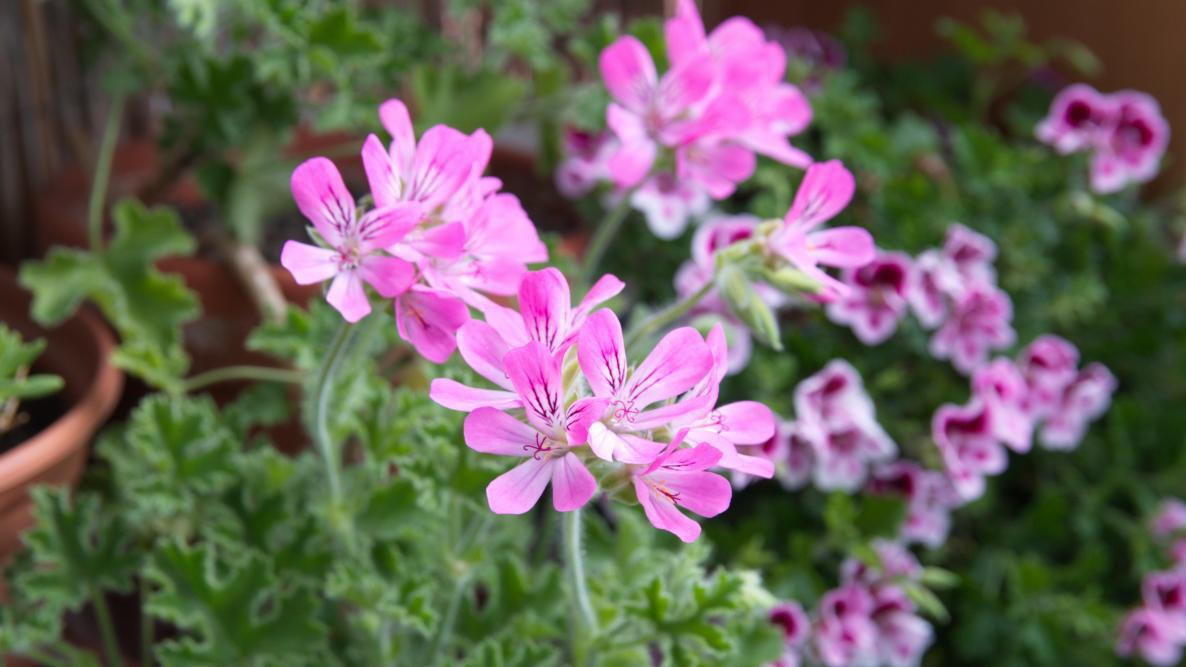
Growing
How to Care for Geraniums
- If planting in the ground, add a light mulch to cover the soil to cool the root zone.
- Allow soil to dry to some extent between waterings, then water thoroughly. Over-moist soil does more damage than under-watering. Do the finger poke; if it’s dry at 1-inch depth, then water. Do not water from overhead nor splash the foliage when watering, or you’ll invite disease.
- Deadheading is important for continuous bloom throughout the summer. Deadhead all spent blooms. Also, deadhead after a heavy bloom or a strong rain. One reader shared a tip, “For continued reblooming, finger pinch just below the spent flower as much as possible. I did, and each of my pelargoniums bloomed from spring into fall year after year.
- To promote bushiness and curtail legginess, pinch back the stems.
- During active growing months, fertilize every 2 weeks or so. Use a water-soluble fertilizer at half-strength. Don’t fertilize in winter, when the plant should be dormant.
- If you’re bringing in the plant for winter, water much less, but do not let the roots dry out entirely. Geraniums do best when given a period of dormancy through the winter months, during which they use less water and do not grow much. See below for more overwintering instructions.
- Geraniums can be repotted in spring to encourage new growth—or, if they need to be refreshed.

Overwintering Geraniums
- Geraniums that have spent the summer outdoors can be kept as houseplants, provided they get lots of sun. In northern climes, the sun may not be strong enough in late winter to stimulate buds on some varieties.
- Before the first fall frost, lift the plants and, using a sharp, clean knife, cut the stems back in a shapely fashion to about 6 to 8 inches. They should not have to support great masses of leaves in the low-sunlight environment they are about to enter. Save a few stems as cuttings to root—an easy way to multiply your plants.
- Transplant the “mother plant” to the smallest pot possible—enough to just fit the roots—using regular potting soil to fill.
- Keep the plants in the shade for a week, then place them in a sunny spot (they need all the sun they can get) and keep them cool.
- During winter, geraniums grow best with night temperatures of 50° to 60°F (10° to 16°C) but will survive if they drop to 32°F (0°C) and/or rise above 80°F (27°C), as long as they are kept relatively dry.
- When new growth appears in the spring, cut off all the old leaves.
The only thing more difficult than achieving new growth is keeping it. And here’s some help with that:
- Water is only available when the leaves show signs of drooping, and only small amounts are provided. Do not fertilize or feed the plants. It is critical that these plants get rest.
- If you want your overwintered geraniums to bloom for Memorial Day, pinch them back in February. Once warm weather returns and all danger of frost has passed, take the plants outdoors and transplant them to beds or pots, as you wish.
Types
- Interspecific: zonal and ivy hybrids; nonstop flower producers
- Ivy (Pelargonium peltatum): named for a trailing habit and ivy-like foliage; single, semidouble, or double flowers; colors include bicolor, burgundy, pink, purple, red, salmon, and white. Very popular for hanging baskets, window boxes, and containers.
- Regal, aka ‘Martha Washington’ (P. x domesticum): bicolor burgundy, lavender, pink, and white blooms; fussy—prefers cool, wet, climate conditions to hot, humid, and/or sunny; inappropriate conditions will reduce flower production; often a houseplant
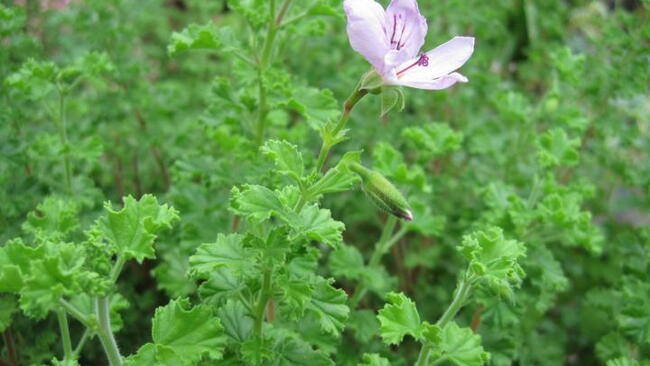
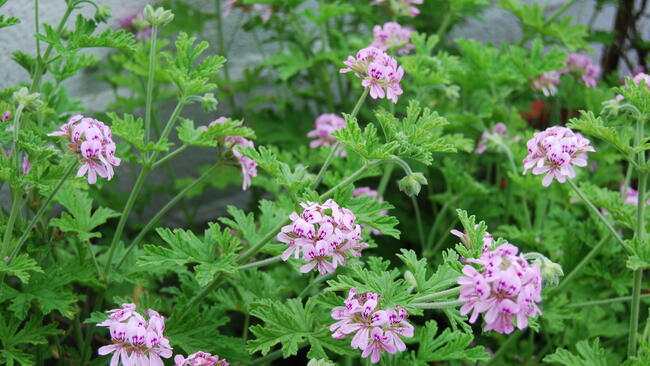
- Scented: foliage yields scent (cedar, lemon, lime, mint, orange, and rose) when brushed or rubbed; note that ‘Citronella’ does not repel mosquitoes; pink or white flowers are smaller than those of zonals. It can be addictive to collect them all. Learn more about scented geraniums.
- Seed: similar to zonals; propagated by seeds; slower-growing, shorter, more compact than zonals; smaller but more numerous flowers than zonals; flowers “shatter” (are shed naturally)
- Variegated: a form of zonal; bi- or tricolor foliage; tends to have fewer flowers than other zonal types
- Zonal (P. x hortorum): the most common form; “zonal” refers to patterns on the leaves that darken with maturity; propagated by cuttings; single or double flowers; colors include bicolor, orange, purple, red, salmon, and white. These thrive in containers (as well as outdoors).

More Like This




Because geraniums do not have "resting structures" like bulbs or tubers, they should be brought in for the winter. Three frosts is enough to kill them. Leaving the stalks on, dig them, pot them or clump them together and wrap them in a tarp, and put them in a cool (not freezing), dry area. Come spring, cut them back, move them back into the garden, and begin watering. Note: If they freeze during the winter, they will not come back.
Interesting problem to have, Ethan. The heavy light may be contributing to the growth; so, too, water. It's actually normal for geraniums to get bushy. Try this: Prune out all old or unhealthy stems (if you have any!). Pinch back (pinch out) new growth, once it reaches a few inches. Pinch it to 1/2 to 1 inch from the tip. You can also prune about a third of the plant and not suffer loss. And check the pot size; sometimes rootbound plants "force" their growth to the top. BTW, you can do this and still trans-fer/-plant the geranium outdoors for the summer. Lucky you!
You can use a water-soluble 20-20-20 fertilizer. Mix 1 teaspoon into 1 gallon of water. It's also important to pinch off the faded flowers and longer stems to keep the plant bushy and healthy. You can easily propagate your plants buy putting the stem cuttings into moist vermiculite or any well-drained sterile soil mix. Put a plastic bag over the top and in a week or so the cutting will have roots and you can plant it in a bigger pot.
They are pretty rugged plants. I just make sure to get them in before the first frost. When night temps. dip into the low 40s you could bring them in just to be on the safe side.
- « Previous
- 1
- 2
- …
- 10
- Next »

Comments