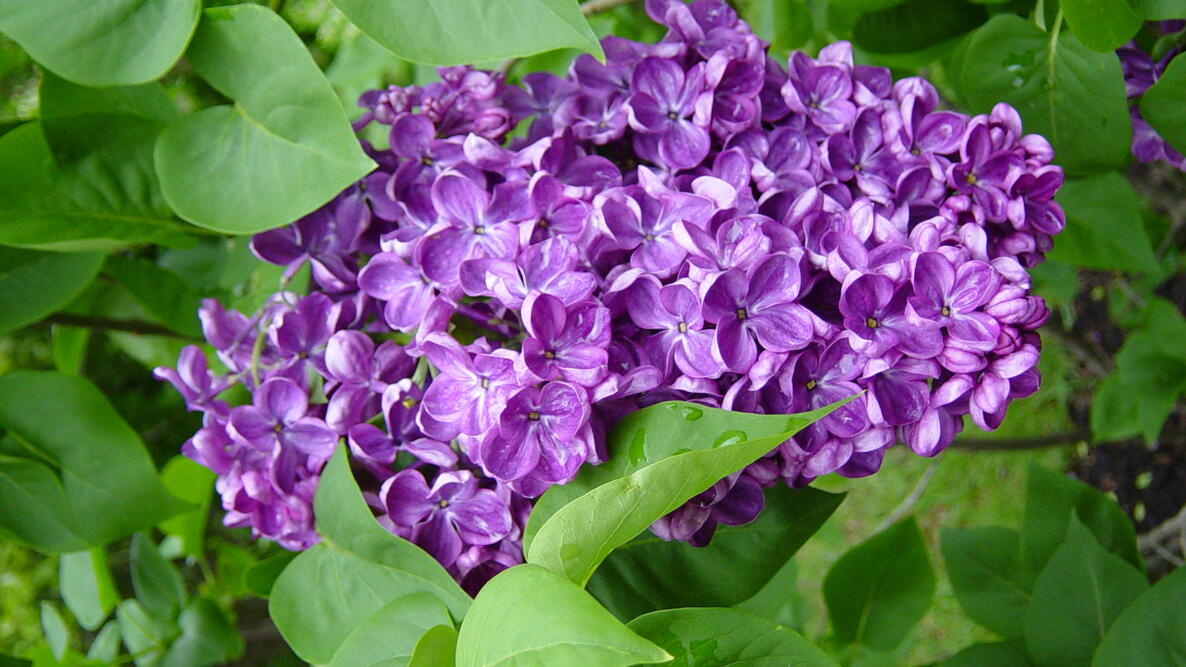
Caption
Huge blooms, wonderful scent.
Types
For early flowers, try Syringa x hyacinthiflora hybrids; they bloom 7 to 10 days before S. vulgaris. Its fragrant blooms attract butterflies and hummingbirds.
The most common and fragrant lilacs are of the S. vulgaris variety:
- Try ‘Charles Joly’, a double magenta flower, an early bloomer.
- Mid-season lilacs include ‘Monge’, a dark reddish purple, and ‘Firmament’, a fine blue.
- Late-season beauties include ‘Miss Canada’, a reddish-pink, and ‘Donald Wyman’, a pink-purple flower.
Uncommon types/varieties include …
- S. x ‘Penda’ Bloomerang Purple: flowers in spring, pauses, then flowers again from midsummer through fall.
- Although common lilacs love cold weather, a few thrive as far south as Zone 8, including cutleaf hybrid S. x laciniata, with fragrant, pale lavender flowers, and S. pubescens ssp. patula ‘Miss Kim,’ with pale, lilac-blue blooms that fade to white.
Small Lilacs
For gardeners, especially those in urban spaces, who just don’t have the room for the traditional larger lilac, there are compact varieties! They’ll even grow in a container on your patio or balcony.
- ‘Baby Kim’ grows only 2 to 3 feet high (and 3 feet wide) in a nicely rounded shape with purple flowers that attract butterflies. Extended hardiness from Zones 3 to 8.
- ‘Little Lady’ (S. x) is a compact lilac that matures to 4 to 5 feet tall and wide with dark pink buds that open to lilac-pink flowers. Hardy in Zones 2 to 7.
- ‘New Age Lavender’ and ‘New Age White’ (S. vulgaris) are super-compact, growing from 4 to 5 feet tall and wide, and bred for mildew resistance. Their fragrant flowers attract butterflies and hummingbirds. Hardy to Zone 4.





Hi, Megan,
After hard pruning, where everything is cut down to about 6 to 8 inches (on grafted plants, be sure to make the cut above the graft union), it will take a few years for the bush to re-establish and fill out, but you should see some nice growth coming up over the years. We're guessing the 4-foot-growth appeared this year after the hard pruning last winter? For the next few years, perhaps refrain from pruning drastically any further, to allow the plant to re-establish itself. Do, however, continue to remove any dead, diseased, or crossing branches.
In general, if a lilac bush needs just a tiny bit of pruning to keep it in shape, and to encourage bushy growth, you can cut the tips of branches that are too tall back to a side shoot or bud. This will encourage that side shoot to grow outward instead of the tip continuing to grow upward. Deadheading spent flowers can also help the plant focus its energy on growing shoots and new flowers. Remove any suckers that pop up near the base of the plant.
Make sure that the plant has good growing conditions; full sun, as you have, is great for it. Also check if it has well-draining soil. Clay soil can slow its growth. Lilacs do best in neutral soil pH.
Hope this helps!
Hi, Kami, You're dealing with runners or suckers. Most lilac plants spread this way (one variety, Miss Canada lilac (Syringa x prestoniae, does not send out as many as most others; other "safe," suckerless options include Meyer lilac, Peking, and Manchurian lilac).
What to do? There are not a lot of options. As you've learned, covering the runners will not stop them. One solution may be to install barriers, or edging, that you bury about 6 inches or more below ground level. Use a steel or metal edged type. First cut (at ground level or as low/deep as you can) and pull the existing runners, then put in the barrier. It should reduce or stop the runners for a few seasons.
- « Previous
- 1
- 2
- …
- 10
- Next »

Comments