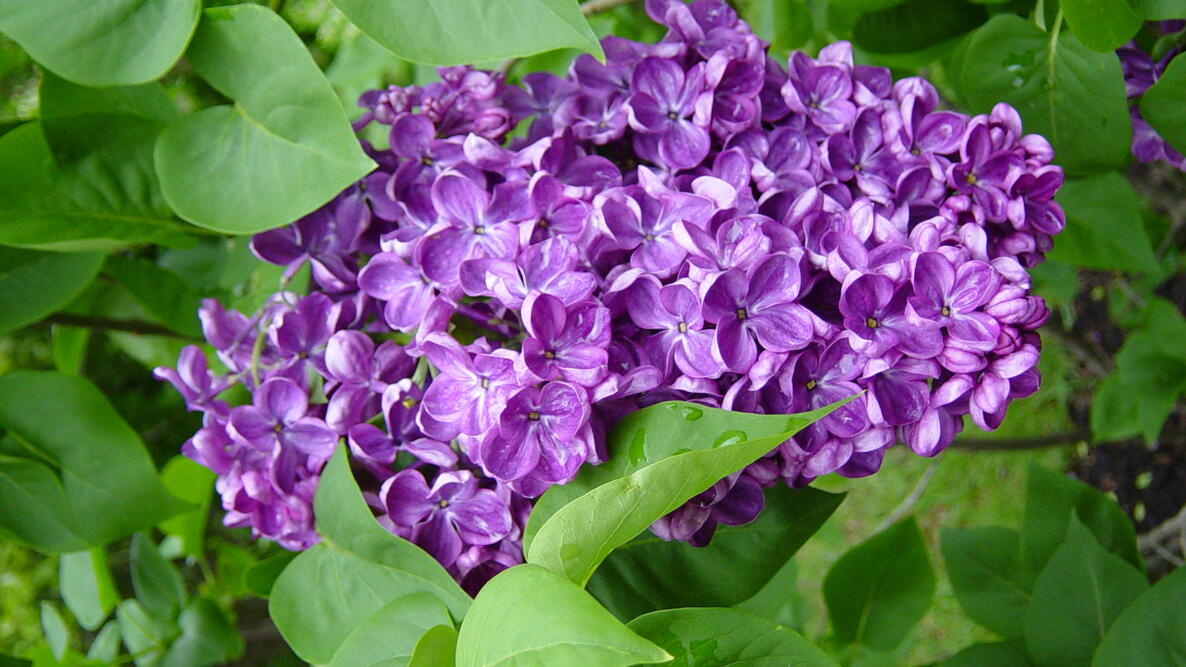
Caption
Huge blooms, wonderful scent.
Types
For early flowers, try Syringa x hyacinthiflora hybrids; they bloom 7 to 10 days before S. vulgaris. Its fragrant blooms attract butterflies and hummingbirds.
The most common and fragrant lilacs are of the S. vulgaris variety:
- Try ‘Charles Joly’, a double magenta flower, an early bloomer.
- Mid-season lilacs include ‘Monge’, a dark reddish purple, and ‘Firmament’, a fine blue.
- Late-season beauties include ‘Miss Canada’, a reddish-pink, and ‘Donald Wyman’, a pink-purple flower.
Uncommon types/varieties include …
- S. x ‘Penda’ Bloomerang Purple: flowers in spring, pauses, then flowers again from midsummer through fall.
- Although common lilacs love cold weather, a few thrive as far south as Zone 8, including cutleaf hybrid S. x laciniata, with fragrant, pale lavender flowers, and S. pubescens ssp. patula ‘Miss Kim,’ with pale, lilac-blue blooms that fade to white.
Small Lilacs
For gardeners, especially those in urban spaces, who just don’t have the room for the traditional larger lilac, there are compact varieties! They’ll even grow in a container on your patio or balcony.
- ‘Baby Kim’ grows only 2 to 3 feet high (and 3 feet wide) in a nicely rounded shape with purple flowers that attract butterflies. Extended hardiness from Zones 3 to 8.
- ‘Little Lady’ (S. x) is a compact lilac that matures to 4 to 5 feet tall and wide with dark pink buds that open to lilac-pink flowers. Hardy in Zones 2 to 7.
- ‘New Age Lavender’ and ‘New Age White’ (S. vulgaris) are super-compact, growing from 4 to 5 feet tall and wide, and bred for mildew resistance. Their fragrant flowers attract butterflies and hummingbirds. Hardy to Zone 4.


That is a very good question—and a difficult one to answer, too! We've never tried that ourselves, but our guess is that the process would be far too time-consuming and difficult to make it worth the effort. If you intended on digging up the lilac each year and "hibernating" it each winter, the plant would be unlikely to thrive. There are a few varieties of lilacs that may survive into Zone 7 (mid-North Carolina). Here's a list from NC State University Extension. Check out Syringa oblata and Syringa patula specifically, and try contacting NC State University, as they may be able to give you some more specific, local advice. Good luck!
Lilacs bloom on old wood. They grow flower buds each summer for the next spring's bloom.
Apparently poplars are popular in Manitoba. This article explains a lot about them, including their lifespan, which seems to time out pretty close to your trees: http://www.winnipegfreepress.com/historic/31341249.html The article (dating from 2003!) also explains why these trees tend to die after a few decades. The question that comes to our mind is, if your trees have a disease, would that disease continue into the lilacs? And if there is disease, it would seem wise to remove the entire thing, stumps and all.
Here's more; specifically, about poplar rust: https://www.gov.mb.ca/agriculture/crops/plant-diseases/poplar-rust.html Could that be afflicting your trees?
Honestly, it seems like you need to know what the problem is and if it resides in the ground before going forward with planting. An arborist in your area should be able to tell you. The University of Manitoba has a program; perhaps they'll take your call. We hope this helps.
- « Previous
- 1
- 2
- …
- 10
- Next »

Comments