
Caption
Huge blooms, wonderful scent.
Types
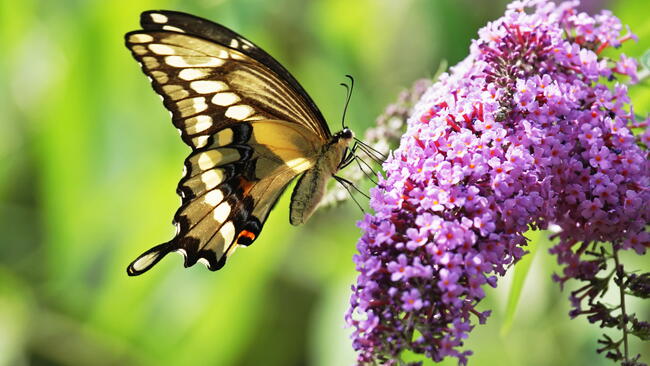
For early flowers, try Syringa x hyacinthiflora hybrids; they bloom 7 to 10 days before S. vulgaris. Its fragrant blooms attract butterflies and hummingbirds.
The most common and fragrant lilacs are of the S. vulgaris variety:
- Try ‘Charles Joly’, a double magenta flower, an early bloomer.
- Mid-season lilacs include ‘Monge’, a dark reddish purple, and ‘Firmament’, a fine blue.
- Late-season beauties include ‘Miss Canada’, a reddish-pink, and ‘Donald Wyman’, a pink-purple flower.
Uncommon types/varieties include …
- S. x ‘Penda’ Bloomerang Purple: flowers in spring, pauses, then flowers again from midsummer through fall.
- Although common lilacs love cold weather, a few thrive as far south as Zone 8, including cutleaf hybrid S. x laciniata, with fragrant, pale lavender flowers, and S. pubescens ssp. patula ‘Miss Kim,’ with pale, lilac-blue blooms that fade to white.
Small Lilacs
For gardeners, especially those in urban spaces, who just don’t have the room for the traditional larger lilac, there are compact varieties! They’ll even grow in a container on your patio or balcony.
- ‘Baby Kim’ grows only 2 to 3 feet high (and 3 feet wide) in a nicely rounded shape with purple flowers that attract butterflies. Extended hardiness from Zones 3 to 8.
- ‘Little Lady’ (S. x) is a compact lilac that matures to 4 to 5 feet tall and wide with dark pink buds that open to lilac-pink flowers. Hardy in Zones 2 to 7.
- ‘New Age Lavender’ and ‘New Age White’ (S. vulgaris) are super-compact, growing from 4 to 5 feet tall and wide, and bred for mildew resistance. Their fragrant flowers attract butterflies and hummingbirds. Hardy to Zone 4.





Lilac roots are shallow and spread about one and half times the width of the bush. If you plant the lilac about 8 feet from your septic system you should be OK.
Our guess is that the heavy rain and wet soil killed your lilac. Please see our planting and care sections at the top of this page. You may need to amend the soil with organic matter (compost or aged manure) to make it drain better. Lilacs can be planted in the spring or fall. See link below for some lilac varieties to grow in your region.
www.chicagobotanic.org/plantinfo/lilacs
There's no point in bringing flowers that thrive in Michigan to Florida. They probably will not survive the heat and they need a winter.
Florida is not really lilac country, from what we have come to understand. However, there are some cultivars that tolerate condition in Alabama . . . and maybe they would grow for you. Look for S. x hyacinthiflora 'Betsy Ross' and 'Old Glory.'
Other alternatives —remember these may not be exactly like what grows in Michigan—could be cutleaf lilac and Syringa patula, aka Miss Kim and Manchurian lilac.
Google to find sources and other advice on them.
We have no experience in growing lilacs in buried pots but suspect that they will do fine. Just make sure that there are holes in the pot for drainage.
Ways to "bring back" your lilacs are not unlike getting them going. This is from the Planting tips, above, edited to suit your needs:
- Grow lilacs in fertile, humus-rich, well-drained, neutral to alkaline soil (at a pH near 7.0). If your soil is in poor condition, add compost to enrich. DITTO for poor plants: Improve the soil, sprinkle with some lime to raise pH, if needed (check to see).
- Select a site where your lilac will get full sun—at least 6 hours. If lilacs don’t get enough sun, they will not bloom well. DITTO for poor plants: have trees or buildings begun shading your lilac?
- Make sure the site drains well. Lilacs don’t like wet feet and will not bloom with too much water. DITTO for poor plants. If you improve the soil (see first bullet here), also "wake it up" but raking/scratching it to loosen it and allow new additives to reach the roots.
This is from the Care tips above, edited:
- Each spring, apply a layer of compost under the plant, followed by mulch to retain moisture and control weeds. HERE WE GO AGAIN! see above
- Water during the summer if rainfall is less than 1 inch per week. ARE YOU DOING THIS?
- Lilacs won’t bloom if they’re overfertilized. They can handle a handful of 10-10-10 in late winter, but no more. TOO LATE NOW FOR THAT BUT MAKE A NOTE.
- After your lilac bush has finished blooming, spread some lime and well-rotted manure around the base. Trim the bush to shape it, and remove suckers at the same time. NOTE THIS ON YOUR CALENDAR, TOO. Per the advice above, a little lime—note, a "sprinkle" now—will not harm the plants.
As for pruning, it's still early, still spring. See the advice above. (Yes, prune now.)
- « Previous
- 1
- 2
- …
- 10
- Next »

Comments