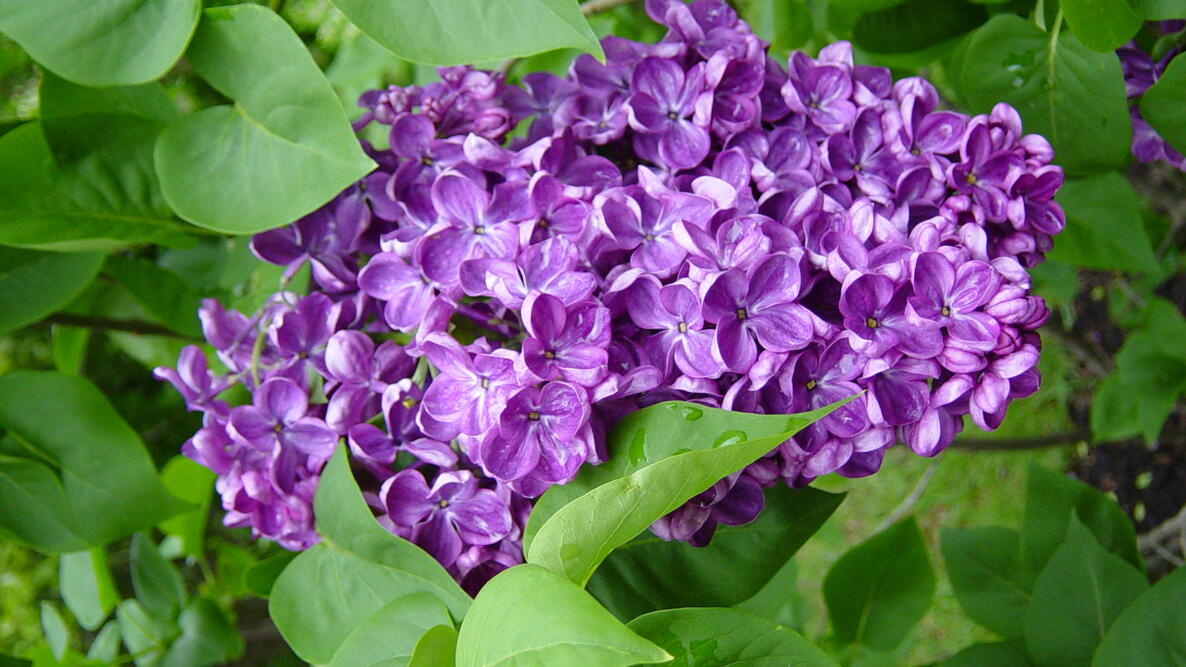
Caption
Huge blooms, wonderful scent.
Types
For early flowers, try Syringa x hyacinthiflora hybrids; they bloom 7 to 10 days before S. vulgaris. Its fragrant blooms attract butterflies and hummingbirds.
The most common and fragrant lilacs are of the S. vulgaris variety:
- Try ‘Charles Joly’, a double magenta flower, an early bloomer.
- Mid-season lilacs include ‘Monge’, a dark reddish purple, and ‘Firmament’, a fine blue.
- Late-season beauties include ‘Miss Canada’, a reddish-pink, and ‘Donald Wyman’, a pink-purple flower.
Uncommon types/varieties include …
- S. x ‘Penda’ Bloomerang Purple: flowers in spring, pauses, then flowers again from midsummer through fall.
- Although common lilacs love cold weather, a few thrive as far south as Zone 8, including cutleaf hybrid S. x laciniata, with fragrant, pale lavender flowers, and S. pubescens ssp. patula ‘Miss Kim,’ with pale, lilac-blue blooms that fade to white.
Small Lilacs
For gardeners, especially those in urban spaces, who just don’t have the room for the traditional larger lilac, there are compact varieties! They’ll even grow in a container on your patio or balcony.
- ‘Baby Kim’ grows only 2 to 3 feet high (and 3 feet wide) in a nicely rounded shape with purple flowers that attract butterflies. Extended hardiness from Zones 3 to 8.
- ‘Little Lady’ (S. x) is a compact lilac that matures to 4 to 5 feet tall and wide with dark pink buds that open to lilac-pink flowers. Hardy in Zones 2 to 7.
- ‘New Age Lavender’ and ‘New Age White’ (S. vulgaris) are super-compact, growing from 4 to 5 feet tall and wide, and bred for mildew resistance. Their fragrant flowers attract butterflies and hummingbirds. Hardy to Zone 4.


Comments

Hi Don,
Most lilacs in the Syringa vulgaris family require a considerable chill period during the winter and don't do well south of USDA Zone 7. You are on the 7b and 8a line. We would say give it a try and maybe also plant a miss Kim or a Bomerang.
Hi Brenda,
Lilacs set next year's buds on old wood, so the buds that you see are going to be fine during the winter. The only threat to the buds is if you get a late freeze in the spring after the buds have started to open.
Hi, I live in Houston, zone 9a. I really like lilacs and planning to buy but I am not sure if it will grow well due to Houston weather :( It's really hot, especially in summer. What do you think?
You can try Bloomerang, Blue Skies, Superba or Miss Kim lilacs. Zone 9 is too hot for most of the traditional lilacs.
Good luck!
Hi Sherry,
Fall is a good time to transplant the lilac. Make sure to get as much as you can of the root system and water well after its been moved to the new location.
- « Previous
- 1
- 2
- …
- 10
- Next »

You won't necessarily lose the lilac. A Montreal (yes, Canada) web site for that city''s botanical gardens (among other sites) advises as follows for TREES: If the central leader is broken, damaged or very weak, or has a dead terminal bud, choose a vigorous lateral branch to replace it. If the best-located lateral branch is growing at an oblique angle, cut back the damaged leader as close to this branch as possible. Place a stake in the ground to support the lateral branch. You will be able to remove the stake after two or three years. If the tree has an almost vertical lateral branch, cut back the damaged leader just above that branch, which will straighten up and eventually take over from the original leader. You can read more here: http://espacepourlavie.ca/en/pruning-deciduous-trees
We hope this helps—