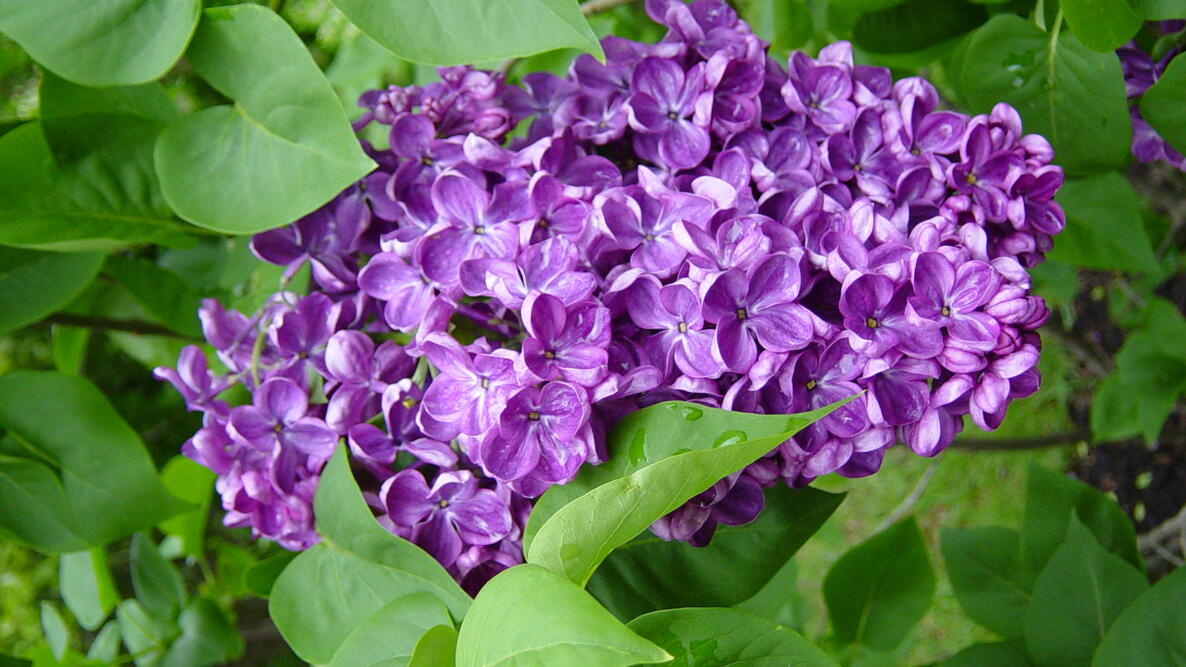
Caption
Huge blooms, wonderful scent.
Types
For early flowers, try Syringa x hyacinthiflora hybrids; they bloom 7 to 10 days before S. vulgaris. Its fragrant blooms attract butterflies and hummingbirds.
The most common and fragrant lilacs are of the S. vulgaris variety:
- Try ‘Charles Joly’, a double magenta flower, an early bloomer.
- Mid-season lilacs include ‘Monge’, a dark reddish purple, and ‘Firmament’, a fine blue.
- Late-season beauties include ‘Miss Canada’, a reddish-pink, and ‘Donald Wyman’, a pink-purple flower.
Uncommon types/varieties include …
- S. x ‘Penda’ Bloomerang Purple: flowers in spring, pauses, then flowers again from midsummer through fall.
- Although common lilacs love cold weather, a few thrive as far south as Zone 8, including cutleaf hybrid S. x laciniata, with fragrant, pale lavender flowers, and S. pubescens ssp. patula ‘Miss Kim,’ with pale, lilac-blue blooms that fade to white.
Small Lilacs
For gardeners, especially those in urban spaces, who just don’t have the room for the traditional larger lilac, there are compact varieties! They’ll even grow in a container on your patio or balcony.
- ‘Baby Kim’ grows only 2 to 3 feet high (and 3 feet wide) in a nicely rounded shape with purple flowers that attract butterflies. Extended hardiness from Zones 3 to 8.
- ‘Little Lady’ (S. x) is a compact lilac that matures to 4 to 5 feet tall and wide with dark pink buds that open to lilac-pink flowers. Hardy in Zones 2 to 7.
- ‘New Age Lavender’ and ‘New Age White’ (S. vulgaris) are super-compact, growing from 4 to 5 feet tall and wide, and bred for mildew resistance. Their fragrant flowers attract butterflies and hummingbirds. Hardy to Zone 4.


Comments

It's always wise to remove any dead or broken branches when pruning an older bush. Look around the bottom of the bush to see if you have any new growth or suckers. Add some lime and compost to the soil and wait until next spring to see if the bush will survive.
Hi, Abby, Lots to deal with here. First, are you sure that you have morning glories, the self-seeding annual, or is it more likely that you have binderweed, the invasive weed? We think it's bindweed, or field bindweed, aka false morning glory. It has plagued fields, farms, and yards for years. Here are some suggestions from a coop extension in your state—more than we could tell you here. Go to this link and click on the pdf below the "Description" information: http://learningstore.uwex.edu/Assets/pdfs/A3924-19.pdf
As for the lilac, don't be too hard on your dad; you might really appreciate his help elminating the bindweed. There is probably more going on with the lilac than the effects of a pruning sometime in the past. For example, you may have a variety that is not hardy in your part of Wisconsin. Or it may be getting too much nitrogen. Or not enough sun. Click on this link; it's a pdf with details about lilac varieties and care from the same Wisconsin source: http://learningstore.uwex.edu/assets/pdfs/A3825.pdf
We hope this helps.
Cut out all the thin suckers coming up around the plant at the base. Then check the lilac when it is dormant to select the shrub's strongest two or three branches and remove all others.
Not knowing what type of vine you have it's hard to give advice. You can try to cut the vines back to soil level as soon as you see them. You can dig down a bit to see if the vine has spreading roots or if you can dig up the roots. Take a piece of the vine to your local nursery and see if they can identify it. Some people use Roundup on just the plants they want to get rid of. There are not many organic alternatives to Roundup.
- « Previous
- 1
- 2
- …
- 10
- Next »

We trim our lilac bush every few years when it gets really tall. This year, we trimmed it after it bloomed like always. We had big dead branches down in the middle and one was old and rotten so I broke it off. The bush seem to look dead and still does. What did I do to it?