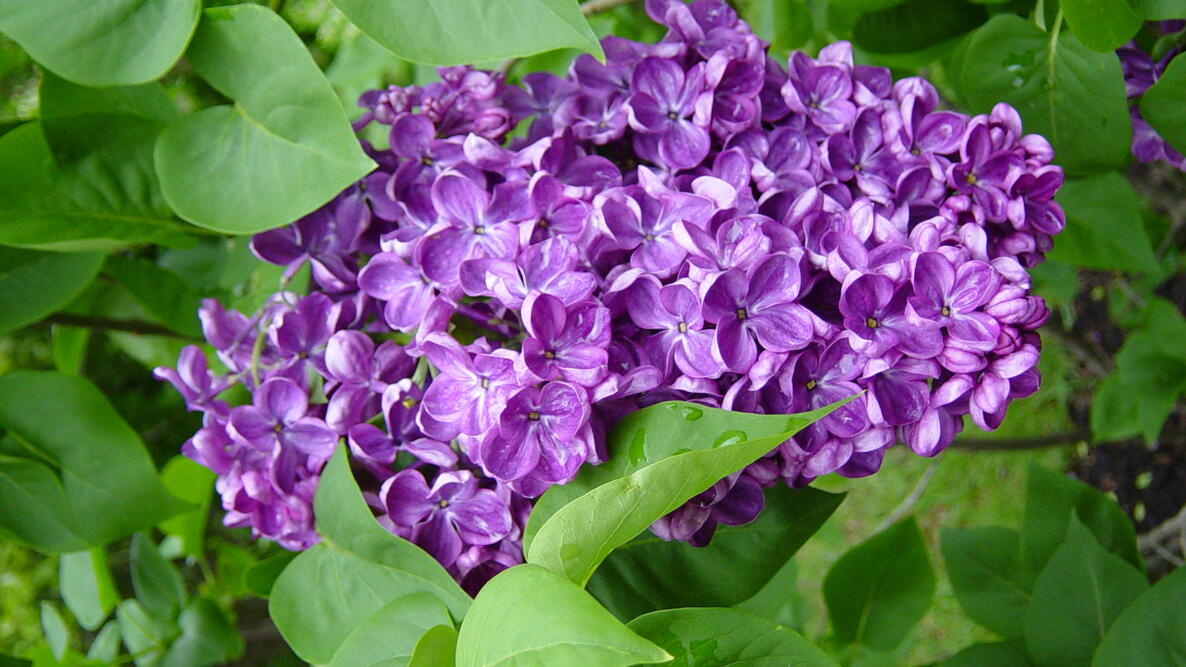
Caption
Huge blooms, wonderful scent.
Image Credit:
Wally Patrick
Botanical Name
Syringa spp.
Grown as
Toxicity
Sun Exposure
Water Needs
Height
Spread
Soil pH
Resilience
Plant Type
Types
For early flowers, try Syringa x hyacinthiflora hybrids; they bloom 7 to 10 days before S. vulgaris. Its fragrant blooms attract butterflies and hummingbirds.
The most common and fragrant lilacs are of the S. vulgaris variety:
- Try ‘Charles Joly’, a double magenta flower, an early bloomer.
- Mid-season lilacs include ‘Monge’, a dark reddish purple, and ‘Firmament’, a fine blue.
- Late-season beauties include ‘Miss Canada’, a reddish-pink, and ‘Donald Wyman’, a pink-purple flower.
Uncommon types/varieties include …
- S. x ‘Penda’ Bloomerang Purple: flowers in spring, pauses, then flowers again from midsummer through fall.
- Although common lilacs love cold weather, a few thrive as far south as Zone 8, including cutleaf hybrid S. x laciniata, with fragrant, pale lavender flowers, and S. pubescens ssp. patula ‘Miss Kim,’ with pale, lilac-blue blooms that fade to white.
Small Lilacs
For gardeners, especially those in urban spaces, who just don’t have the room for the traditional larger lilac, there are compact varieties! They’ll even grow in a container on your patio or balcony.
- ‘Baby Kim’ grows only 2 to 3 feet high (and 3 feet wide) in a nicely rounded shape with purple flowers that attract butterflies. Extended hardiness from Zones 3 to 8.
- ‘Little Lady’ (S. x) is a compact lilac that matures to 4 to 5 feet tall and wide with dark pink buds that open to lilac-pink flowers. Hardy in Zones 2 to 7.
- ‘New Age Lavender’ and ‘New Age White’ (S. vulgaris) are super-compact, growing from 4 to 5 feet tall and wide, and bred for mildew resistance. Their fragrant flowers attract butterflies and hummingbirds. Hardy to Zone 4.

I don't know my zone........South Florida????
You might want to learn how to use a computer before you go spewing uselessness. The dark letters with dark numbers are your zone. Click on that and you may just learn something....
Zone maps are the same for all plants. Just search online for a zone map and it will tell you what zone you live in.
Can Lilac bushes be planted in rock?
I have a lilac bush that I planted 3 to 4 years ago, it is planted on the east side of my house in east TN. I realize that I have not gotten the suckers off and not put lime out in the fall, but it has never bloomed. What else am I doing wrong?
Hi, I bought a dwarf korean lilac tree exactly a year ago. When I bought it it was in full bloom but after the spring it didn't bloom again in the summer. The leafs looked a bit weak and there were little white dots on the branches. For the winter I wrapped it with burlap and when the first signes of spring showed I took the burlap out. A couple of weeks ago I could see some blooms and I can see some leafs starting to grow now but the blooms seem dry. The white dots on the branches are still there and there is something like cobwebs (a few). Any suggestions?
All lilac species are once a year bloomers, with the exception of the newly released 'Bloomerang' and 'Bloomerang Purple' from Proven Winners. The white dots on the trunk and branches are called lenticels. They are part of the tree and aid the tree in "breathing". They are completely normal and actually beneficial. The cobwebs on the tree might be a type of web worm. Remove the webs with a stick and crush any caterpillars you might find. If that is too gruesome, you can place the caterpillars into a bucket of soapy water overnight then dump them out. You may have a few blooms this year because it was newly planted last year. Be patient, it will come back beautifully by next year.
I brought home a Bloomerang purple syringa lilac bush from N.J. to Georgia. Is it going to be too hot for it here? Where would be the best place to plant it?

That particular lilac is hardy from zones 3-7. It should be planted in an area with full sun in soil with good drainage.
I live on Long Island, ny. I have 2 30+year old lilacs. For many years they were not tended to. 3 years ago I pruned them and followed your advice above. One of them has grown to 8+ feet and only had about 12 blooms. This one dies feet more Sun than the other. the second one still has not bloomed and is only about 4 ft tall. Both do have suckers that I remove. What an I doing wrong? Is it possible that the smaller one will never bloom again?
- « Previous
- 1
- 2
- …
- 10
- Next »
📣The Gardening Club Just Got Better! 3 Deliveries, 10% Store Discount, and more!

Comments