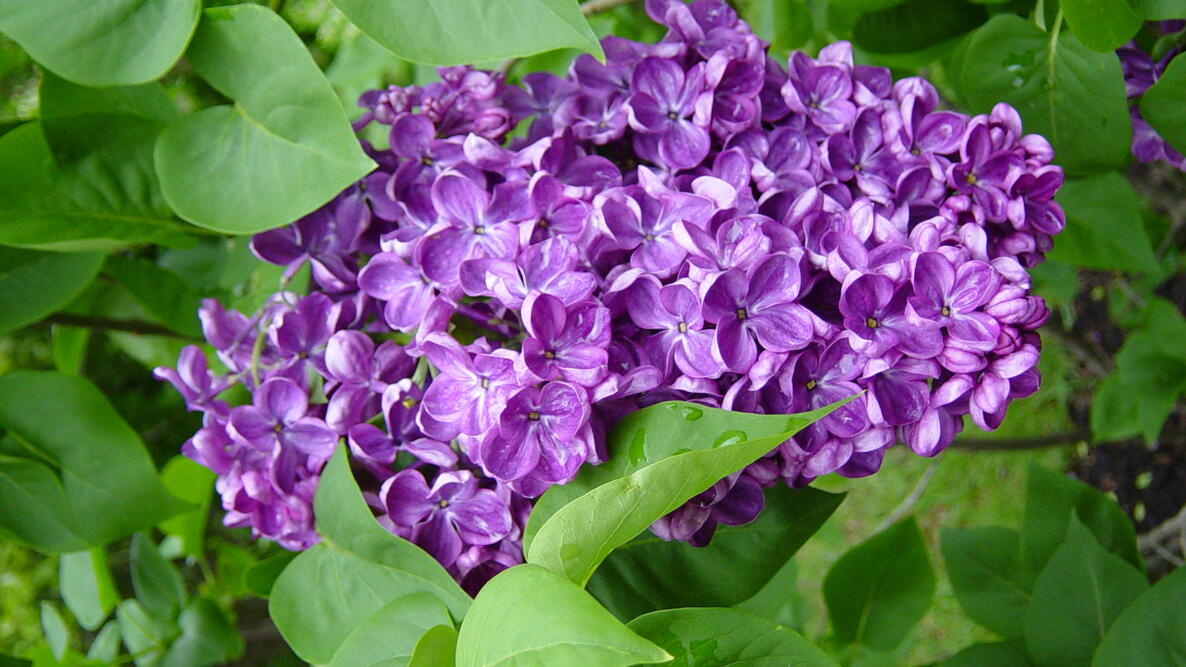
Caption
Huge blooms, wonderful scent.
Types
For early flowers, try Syringa x hyacinthiflora hybrids; they bloom 7 to 10 days before S. vulgaris. Its fragrant blooms attract butterflies and hummingbirds.
The most common and fragrant lilacs are of the S. vulgaris variety:
- Try ‘Charles Joly’, a double magenta flower, an early bloomer.
- Mid-season lilacs include ‘Monge’, a dark reddish purple, and ‘Firmament’, a fine blue.
- Late-season beauties include ‘Miss Canada’, a reddish-pink, and ‘Donald Wyman’, a pink-purple flower.
Uncommon types/varieties include …
- S. x ‘Penda’ Bloomerang Purple: flowers in spring, pauses, then flowers again from midsummer through fall.
- Although common lilacs love cold weather, a few thrive as far south as Zone 8, including cutleaf hybrid S. x laciniata, with fragrant, pale lavender flowers, and S. pubescens ssp. patula ‘Miss Kim,’ with pale, lilac-blue blooms that fade to white.
Small Lilacs
For gardeners, especially those in urban spaces, who just don’t have the room for the traditional larger lilac, there are compact varieties! They’ll even grow in a container on your patio or balcony.
- ‘Baby Kim’ grows only 2 to 3 feet high (and 3 feet wide) in a nicely rounded shape with purple flowers that attract butterflies. Extended hardiness from Zones 3 to 8.
- ‘Little Lady’ (S. x) is a compact lilac that matures to 4 to 5 feet tall and wide with dark pink buds that open to lilac-pink flowers. Hardy in Zones 2 to 7.
- ‘New Age Lavender’ and ‘New Age White’ (S. vulgaris) are super-compact, growing from 4 to 5 feet tall and wide, and bred for mildew resistance. Their fragrant flowers attract butterflies and hummingbirds. Hardy to Zone 4.



Comments

The severe winter can have caused some of the leaf problems. We recommend that you add bonemeal and compost to the soil around the lilacs and also add some mulch on top to keep the soil nice and moist. After the blooms have faded prune out any dead branches and cut some of the longer branches.
Lilacs need time to mature before they begin flowering. Your plants are still young. The blooms for the first few years will be sparse but should increase with time. Most varieties start blooming after three or four years.
Lilacs do not like to be planted too deep but 7 inches is a bit shallow; recommended depth is about 12 inches. If the tire is only a ring around the tree and and not a true container, the plant's roots should grow into the ground. Your bigger question is will it survive a hungry moose. See http://www.alaskamastergardeners.org/Lilacs.html for Alaska Master Gardeners' thoughts on this.
I have a lilac tree on the corner of my house. I can't tell you how old it is because it was here when we moved in. It is taller then the house and does have some flowers on it. The problem is the roots are so huge its pushing the foundation. So, how do I like get rid of those with out killing the tree?
Hi, Gretchen,
It would be difficult to impossible to save the tree if you remove the roots. You could move the tree, and from sound of the size of it, that would be a major undertaking. But it would eliminate the roots. We suggest that you contact a professional arborman or woman for an opinion.
- « Previous
- 1
- 2
- …
- 10
- Next »

Miss Angie, We would never argue with directions on a plant tag. Soak the roots in a bucket or under a running hose or the like until saturated. This will help them adjust to being underground, however, you still meed to water the plant in its new spot.
See "Planting" above for more advice on planting. (Note that we say above that lilacs do not like "wet feet," but yours says right on it to soak it. If you have further questions about that, you might consult the source from which you got the plant.)
Enjoy it!