
Caption
Huge blooms, wonderful scent.
Types
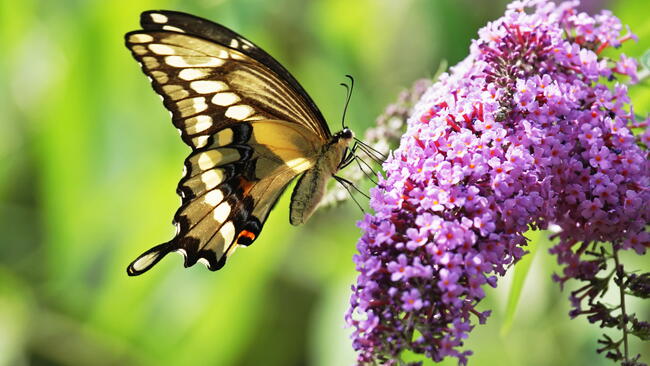
For early flowers, try Syringa x hyacinthiflora hybrids; they bloom 7 to 10 days before S. vulgaris. Its fragrant blooms attract butterflies and hummingbirds.
The most common and fragrant lilacs are of the S. vulgaris variety:
- Try ‘Charles Joly’, a double magenta flower, an early bloomer.
- Mid-season lilacs include ‘Monge’, a dark reddish purple, and ‘Firmament’, a fine blue.
- Late-season beauties include ‘Miss Canada’, a reddish-pink, and ‘Donald Wyman’, a pink-purple flower.
Uncommon types/varieties include …
- S. x ‘Penda’ Bloomerang Purple: flowers in spring, pauses, then flowers again from midsummer through fall.
- Although common lilacs love cold weather, a few thrive as far south as Zone 8, including cutleaf hybrid S. x laciniata, with fragrant, pale lavender flowers, and S. pubescens ssp. patula ‘Miss Kim,’ with pale, lilac-blue blooms that fade to white.
Small Lilacs
For gardeners, especially those in urban spaces, who just don’t have the room for the traditional larger lilac, there are compact varieties! They’ll even grow in a container on your patio or balcony.
- ‘Baby Kim’ grows only 2 to 3 feet high (and 3 feet wide) in a nicely rounded shape with purple flowers that attract butterflies. Extended hardiness from Zones 3 to 8.
- ‘Little Lady’ (S. x) is a compact lilac that matures to 4 to 5 feet tall and wide with dark pink buds that open to lilac-pink flowers. Hardy in Zones 2 to 7.
- ‘New Age Lavender’ and ‘New Age White’ (S. vulgaris) are super-compact, growing from 4 to 5 feet tall and wide, and bred for mildew resistance. Their fragrant flowers attract butterflies and hummingbirds. Hardy to Zone 4.




Yes, lilacs can make a nice border or screen—and be planted along a fence. We don't know where you live but "Beauty of Moscow" and "Pocahontas" are reader favorites as they bloom regularly and are simply pretty and fragrant. If you want a denser border, you might want to consider mixing it up with evergreens. Also, the cotoneaster is a popular plant with dark green leaves and fall color.
In terms of pruning: this is done right after flowering. Otherwise, you are removing this year's blooms.
If your lilac looks more like a tree than a bush and is overgrown, you could do a severe pruning. Each year for 3 years, remove a third of the volume by cutting the large branches to the base of the plant.
In terms of transplanting, lilacs are quite hearty and if they are not too old, they will transplant well as long as they are not coming into leaf. It's ideal to transplant lilacs (and divide them if you wish) in early spring while it's still dormant. For many areas, that might be April 1 but it depends on your location.
Yes, you can grow a lilac from a cutting. The timing is important. Take cuttings of 8 inches in mid-June. Dip in a sand/peat or vermiculite medium and mist.
You need to wait until early next spring when the lilac is dormant. Lilacs transplant well as long as they are not coming into leaf.
- « Previous
- 1
- 2
- …
- 10
- Next »

Comments