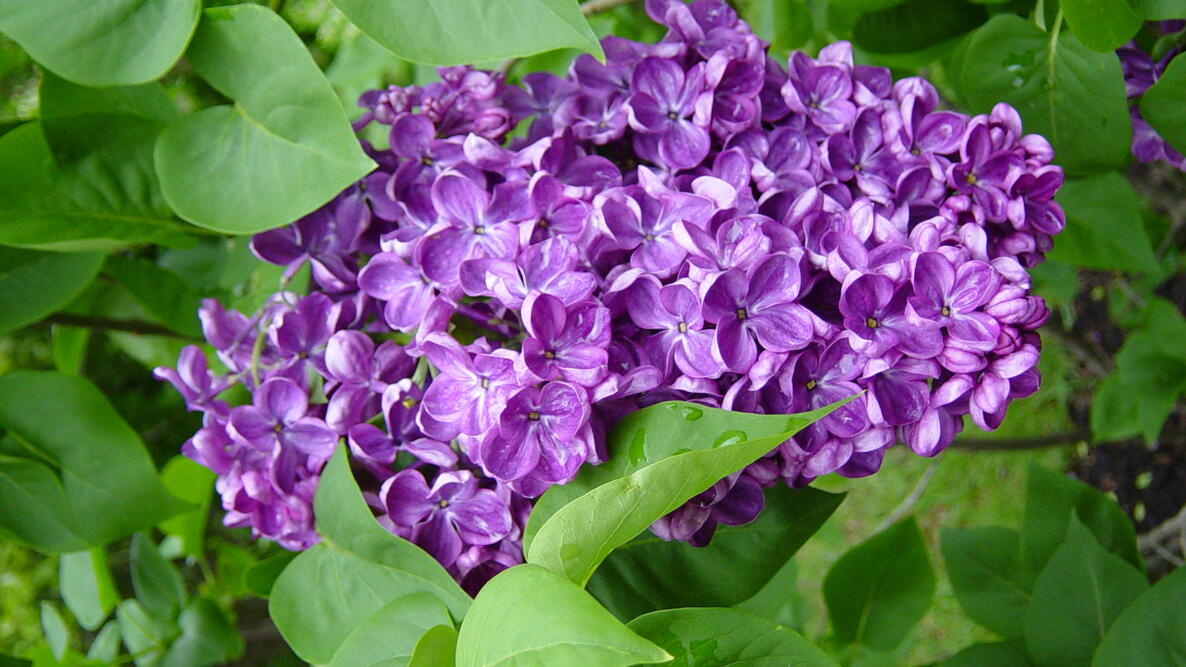
Caption
Huge blooms, wonderful scent.
Image Credit:
Wally Patrick
Botanical Name
Syringa spp.
Grown as
Toxicity
Sun Exposure
Water Needs
Height
Spread
Soil pH
Resilience
Plant Type
Types
For early flowers, try Syringa x hyacinthiflora hybrids; they bloom 7 to 10 days before S. vulgaris. Its fragrant blooms attract butterflies and hummingbirds.
The most common and fragrant lilacs are of the S. vulgaris variety:
- Try ‘Charles Joly’, a double magenta flower, an early bloomer.
- Mid-season lilacs include ‘Monge’, a dark reddish purple, and ‘Firmament’, a fine blue.
- Late-season beauties include ‘Miss Canada’, a reddish-pink, and ‘Donald Wyman’, a pink-purple flower.
Uncommon types/varieties include …
- S. x ‘Penda’ Bloomerang Purple: flowers in spring, pauses, then flowers again from midsummer through fall.
- Although common lilacs love cold weather, a few thrive as far south as Zone 8, including cutleaf hybrid S. x laciniata, with fragrant, pale lavender flowers, and S. pubescens ssp. patula ‘Miss Kim,’ with pale, lilac-blue blooms that fade to white.
Small Lilacs
For gardeners, especially those in urban spaces, who just don’t have the room for the traditional larger lilac, there are compact varieties! They’ll even grow in a container on your patio or balcony.
- ‘Baby Kim’ grows only 2 to 3 feet high (and 3 feet wide) in a nicely rounded shape with purple flowers that attract butterflies. Extended hardiness from Zones 3 to 8.
- ‘Little Lady’ (S. x) is a compact lilac that matures to 4 to 5 feet tall and wide with dark pink buds that open to lilac-pink flowers. Hardy in Zones 2 to 7.
- ‘New Age Lavender’ and ‘New Age White’ (S. vulgaris) are super-compact, growing from 4 to 5 feet tall and wide, and bred for mildew resistance. Their fragrant flowers attract butterflies and hummingbirds. Hardy to Zone 4.


Comments
I got a new, small, bush last year(miss Kim) and a mouse or mole routed through the roots leaving it the appearance of being dead. We planted what was left again with little hope but it did start putting out leaves about half way through the summer. Since we believed it was dead we got another Miss Kim and it seems quite healthy but I am not sure if we should be wrapping it for winter or if that would encourage a mouse or whatever to move in again or if lilacs even need/want to be protected like that? Help for a newbie to lilacs?
I have a very old lilac bush my mothers she got it from my grandmother well it has something on its trunk blueish green scales and dying what can I do to save it and the leaves are powdery
I bought a lilac bush at a fair about 7 years ago. I
t was about 4 feet tall. My son planted in a sunny place that gets sun all day. It is healthy and gets very small blooms every year but looks like it hasn't grown an inch since it was planted. Our town is known for lilac's and they grow all over town. I don't understand why mine won't grow.
It’s possible it’s a miniature variety. Are leaves 3 inches or about 1 inch. If no longer than approx 1 inch. It’s a miniature variety
My lilac is about 5 years old and has never bloomed and although it has grown, not as it should have. I would say it is about 3 to 4 foot high for a 5 year old bush. I planted it where i had removed an above ground pool and was wondering if the sand that was used to level the pool on installation could be the reason. I don't see any sand, so it has worked it's way into the dirt. Any suggestions?
I am trying to find out what is going on with my old fashion lilac. I started it from a sapling about 15 years. It has four off shoots that are probably 10 years old. This year the flowers again where huge and gorgeous. But I have now noticed the density of the leaves is really sparse they are yellowing with some brown spots. I don't know what to do.
Just planted in spring but now leaves have brown spots - help
I planted seedlings 3 yrs ago, some are 6' tall and some 3' tall, I haven't pruned them yet and haven't had any flowers yet, should I prune them back a little will that help?
Thank you
Frank

Are you fertilizing these plants? Too much nitrogen will favor leaf formation over flowers. Do not fertilize. They do like soil with a pH of 6.0 to 7.5, though. Do a soil test—even a simple one—and see if the pH is within the range.
- « Previous
- 1
- 2
- …
- 10
- Next »
📣The Gardening Club Just Got Better! 3 Deliveries, 10% Store Discount, and more!

You need to protect the lilac from early or late-season freezes by covering them. You can use plastic, or bed sheeting, burlap, tarps, or whatever is large enough BUT you have to keep the covering from touching the lilac. Contact with the cover means contact with the freeze, so avoid contact. Use frame (often homemade) or stakes or, for example, a ladder and drape the cover over the plant. Clothes pins will sometimes hold the cover in place. You should not need to leave the cover on if no freeze is forecast.