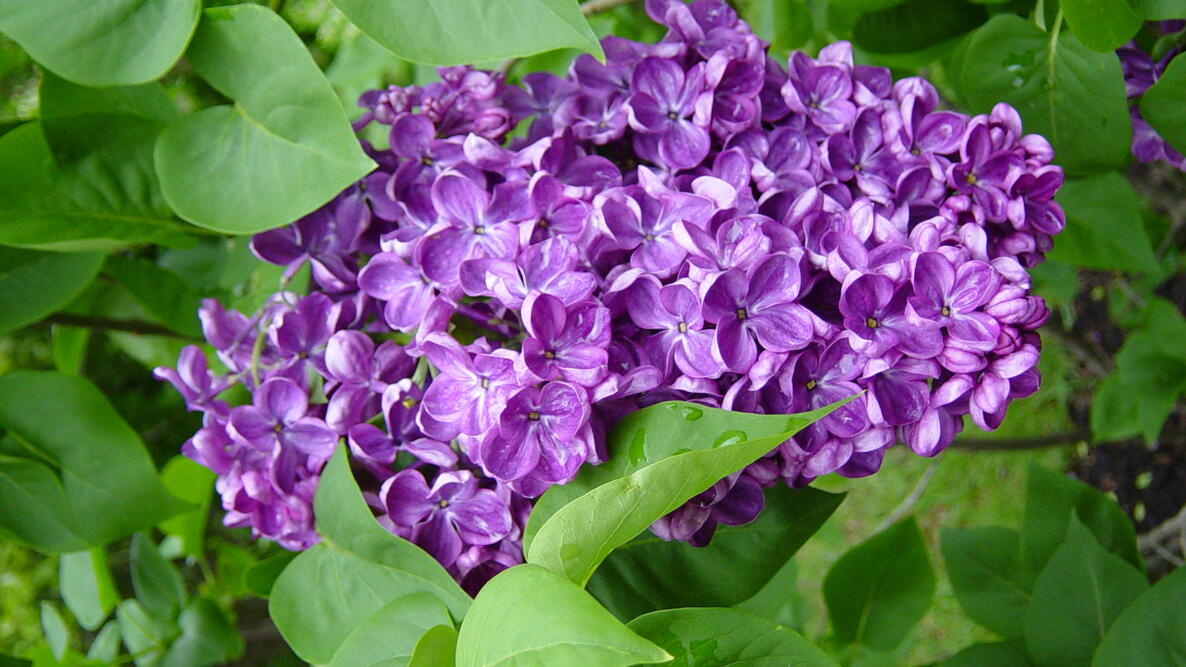
Caption
Huge blooms, wonderful scent.
Image Credit:
Wally Patrick
Botanical Name
Syringa spp.
Grown as
Toxicity
Sun Exposure
Water Needs
Height
Spread
Soil pH
Resilience
Plant Type
Types
For early flowers, try Syringa x hyacinthiflora hybrids; they bloom 7 to 10 days before S. vulgaris. Its fragrant blooms attract butterflies and hummingbirds.
The most common and fragrant lilacs are of the S. vulgaris variety:
- Try ‘Charles Joly’, a double magenta flower, an early bloomer.
- Mid-season lilacs include ‘Monge’, a dark reddish purple, and ‘Firmament’, a fine blue.
- Late-season beauties include ‘Miss Canada’, a reddish-pink, and ‘Donald Wyman’, a pink-purple flower.
Uncommon types/varieties include …
- S. x ‘Penda’ Bloomerang Purple: flowers in spring, pauses, then flowers again from midsummer through fall.
- Although common lilacs love cold weather, a few thrive as far south as Zone 8, including cutleaf hybrid S. x laciniata, with fragrant, pale lavender flowers, and S. pubescens ssp. patula ‘Miss Kim,’ with pale, lilac-blue blooms that fade to white.
Small Lilacs
For gardeners, especially those in urban spaces, who just don’t have the room for the traditional larger lilac, there are compact varieties! They’ll even grow in a container on your patio or balcony.
- ‘Baby Kim’ grows only 2 to 3 feet high (and 3 feet wide) in a nicely rounded shape with purple flowers that attract butterflies. Extended hardiness from Zones 3 to 8.
- ‘Little Lady’ (S. x) is a compact lilac that matures to 4 to 5 feet tall and wide with dark pink buds that open to lilac-pink flowers. Hardy in Zones 2 to 7.
- ‘New Age Lavender’ and ‘New Age White’ (S. vulgaris) are super-compact, growing from 4 to 5 feet tall and wide, and bred for mildew resistance. Their fragrant flowers attract butterflies and hummingbirds. Hardy to Zone 4.




You need to prune your lilacs drastically, to eye level or even lower. After you cut them down you'll get lots of new shoots and these will develop into new flowering branches. You may not have any flowers next spring but the reward will be great the following years.
we would like to cut the flowers and enjoy them inside the home, but they very quickly look like they are dehydrated and droop. what can we do /or add to the water in the vase to allow us to keep them more than just overnight.
Here are a few tips. Pick lilacs when the flower cluster is half open. Use pruners or clippers to cut the stem a couple of inches up the center. Put the lilacs in a bucket with cool water covering the stems and leaves all the way up to the flowers. After a few hours arrange the lilacs in a vase and keep them out of direct sunlight.
I grew up with lilacs in the yard and hoping to have that again. Will a lilac tree grow in Georgia.
Korean lilac varieties do not require the long cold periods before flowering that common lilacs do. ‘Miss Kim’ (Syringa patula) is a southern favorite that will do well in Georgia.
All of my neighbors have great lilac bushes ( I live in northern RI and have a river one house over and the river run off in back of my house). After admiring the bushes one of my neighbors gave me a cutting of the bush - a small stem with leaves and a flower at the end. How do I get it to grow roots so I can plant it outside? I currently have it in a clear vase with water in a sunny window.
My Miss Kim lilac is about 4 -5 yrs old and has always bloomed well. This year 2/3 of the plant didn't leaf or bloom but there is a small bud on the end of each cane ( branch). Are they dead or dying? What should I do?
I'm in a similar situation as this poster.
I have Korean lilacs that have performed beautifully the last 5-6 Springs. Now, all of a sudden, they are not doing so well. There's about 1/3 of the blooms, they are not leafing out as they should, and I have buds but no flowers. I've check for dead wood - although there is some, it's very minimal.
I have pruned sparingly in the past after flowering, but I did not do so last year. We had drought conditions last summer, a late & wet spring, and some late frost. We haven't mulched but my hubby did build up some soil around the base of the foundation, and this is a foundation shrub.
My neighbor's Korean lilacs did beautifully this year, and she has the exact same plants from the same nursery with the same exposure and similar heavy clay soil conditions.
I intend to cut out dead wood and prune back all flowers and buds as recommended, plus fertilize which I also haven't done this year. I'm hopeful that will help. However, I am concerned because of the lack of leafing. Is something else going on?
Any advice, ideas or recommendations are welcome.
Thank you.
I live in Vancouver Washington and I was given a WHITE lilac tree. It is very puny, about 4-5 ft. tall. It has been in a large pot for about 3-4 years. Lots of mildew & few blooms. It has many suckers around the bottom that have come up.
I want to put it into the ground. Please, any suggestions > I am a novice gardener.
I am gonna try and pot a lilac plant for indoor use for a couple years due to I love lilacs but can't plant outdoors in my apt complex.. Any suggestions??
- « Previous
- 1
- 2
- …
- 10
- Next »
📣The Gardening Club Just Got Better! 3 Deliveries, 10% Store Discount, and more!

Comments