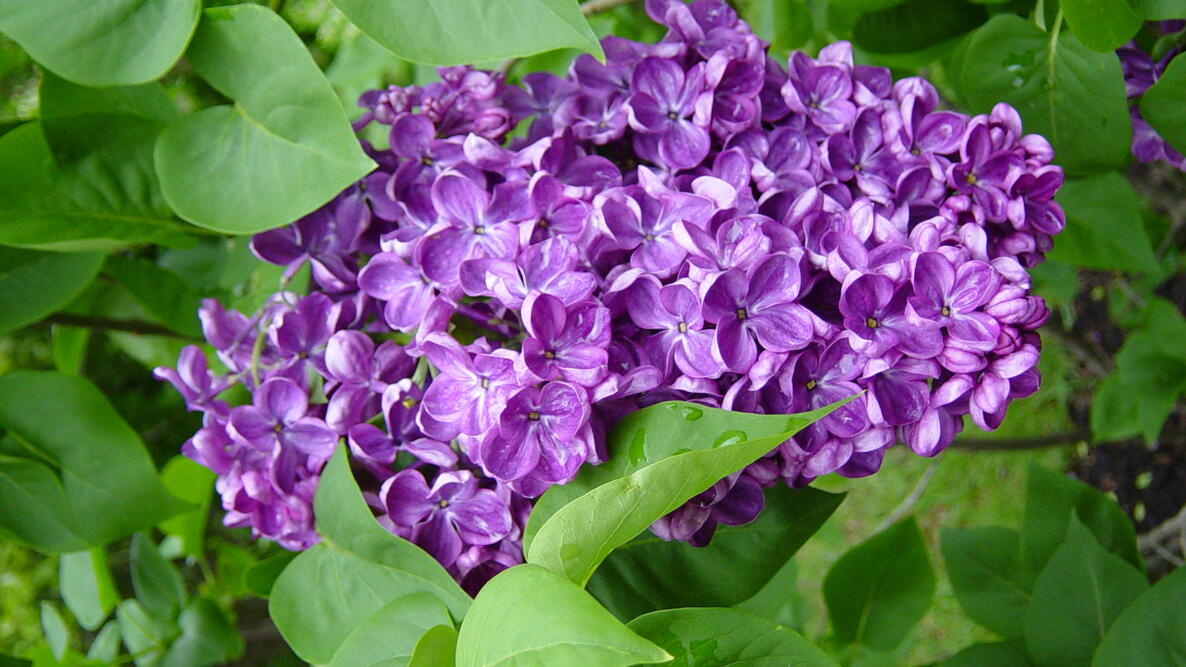
Caption
Huge blooms, wonderful scent.
Image Credit:
Wally Patrick
Botanical Name
Syringa spp.
Grown as
Toxicity
Sun Exposure
Water Needs
Height
Spread
Soil pH
Resilience
Plant Type
Types
For early flowers, try Syringa x hyacinthiflora hybrids; they bloom 7 to 10 days before S. vulgaris. Its fragrant blooms attract butterflies and hummingbirds.
The most common and fragrant lilacs are of the S. vulgaris variety:
- Try ‘Charles Joly’, a double magenta flower, an early bloomer.
- Mid-season lilacs include ‘Monge’, a dark reddish purple, and ‘Firmament’, a fine blue.
- Late-season beauties include ‘Miss Canada’, a reddish-pink, and ‘Donald Wyman’, a pink-purple flower.
Uncommon types/varieties include …
- S. x ‘Penda’ Bloomerang Purple: flowers in spring, pauses, then flowers again from midsummer through fall.
- Although common lilacs love cold weather, a few thrive as far south as Zone 8, including cutleaf hybrid S. x laciniata, with fragrant, pale lavender flowers, and S. pubescens ssp. patula ‘Miss Kim,’ with pale, lilac-blue blooms that fade to white.
Small Lilacs
For gardeners, especially those in urban spaces, who just don’t have the room for the traditional larger lilac, there are compact varieties! They’ll even grow in a container on your patio or balcony.
- ‘Baby Kim’ grows only 2 to 3 feet high (and 3 feet wide) in a nicely rounded shape with purple flowers that attract butterflies. Extended hardiness from Zones 3 to 8.
- ‘Little Lady’ (S. x) is a compact lilac that matures to 4 to 5 feet tall and wide with dark pink buds that open to lilac-pink flowers. Hardy in Zones 2 to 7.
- ‘New Age Lavender’ and ‘New Age White’ (S. vulgaris) are super-compact, growing from 4 to 5 feet tall and wide, and bred for mildew resistance. Their fragrant flowers attract butterflies and hummingbirds. Hardy to Zone 4.


See some of the advice above and also the questions and answers below. It may take a few years for a young lilac bush to bloom. Add some lime and compost to the soil this spring and make sure that the bushes get plenty of sun (afternoon sun is best). If the bushes are close to a lawn that is fertilized they may get too much nitrogen from the lawn fertilizer. Nitrogen promotes leaf growth.
I live in So. Cal, Zone 10b. Are there any lilac varieties that can do well in this climate? If not, I am looking for a purple or blue fragrant flowering plant or bush. Do you have any suggestions?
When I lived in the north bay area, north of San Francisco, I was told we need to put a bag of ice at the base of the lilac in the winter at least once, since it needs a cold season to bloom properly. I did this and my bush flowered fine.
Some lilacs (genus Syringa) are hardy to USDA Zones 8 or 9, but we haven't found any information that indicates that these would flourish in Zone 10. We suppose that it might be possible for lilacs hardy to Zone 9 to get by in a protected area of Zone 10, given the right conditions. However, we'd suggest that you contact your county's Cooperative Extension to find out if there are certain cultivars that can survive in your area.
As an alternative, there is a bush called "California lilac," which is actually a different genus called "Ceanothus." These have fragrant flowers which resemble those of Syringa lilacs. There are a few species and cultivars of Ceanothus available that do fine in Zone 10. The Cooperative Extension or a local nursery should be able to recommend varieties that will thrive in your area.
To find contact information for your Cooperative Extension, see:
http://www.almanac.com/content/cooperative-extension-services
Yes there are...I don't know which variety I had but it was a beautiful, large, and fragrant bush in lavender. I lived in Rosemead, Ca, just outside of LA.
My neighbor just gave me two bareroot shoots from a plant he divided. Are lilacs deer resistant or should I plant them in a fenced area?
Though NO plant is truly deer-resistant, lilacs fall into the "Seldom Severely Damaged" camp so they're a good choice. As far as a fence goes: Deer will usually chose a different plant to eat, however, all bets are off in a very severe winter so it depends on your climate.
my lilac bush lost all its leaves. Is it ok
You didn't mention where you're from, but lilacs will drop leaves in the fall and leaf out in the spring. This is normal.
Hi, i live in azle texas, i have a northern lilac bush that looks fine, but has not bloomed, this is the 3 year. when can i expect it to bloom, or is it not going to do to the fact that this is really a plant for the northern United States?
- « Previous
- 1
- 2
- …
- 10
- Next »
📣The Gardening Club Just Got Better! 3 Deliveries, 10% Store Discount, and more!

Comments