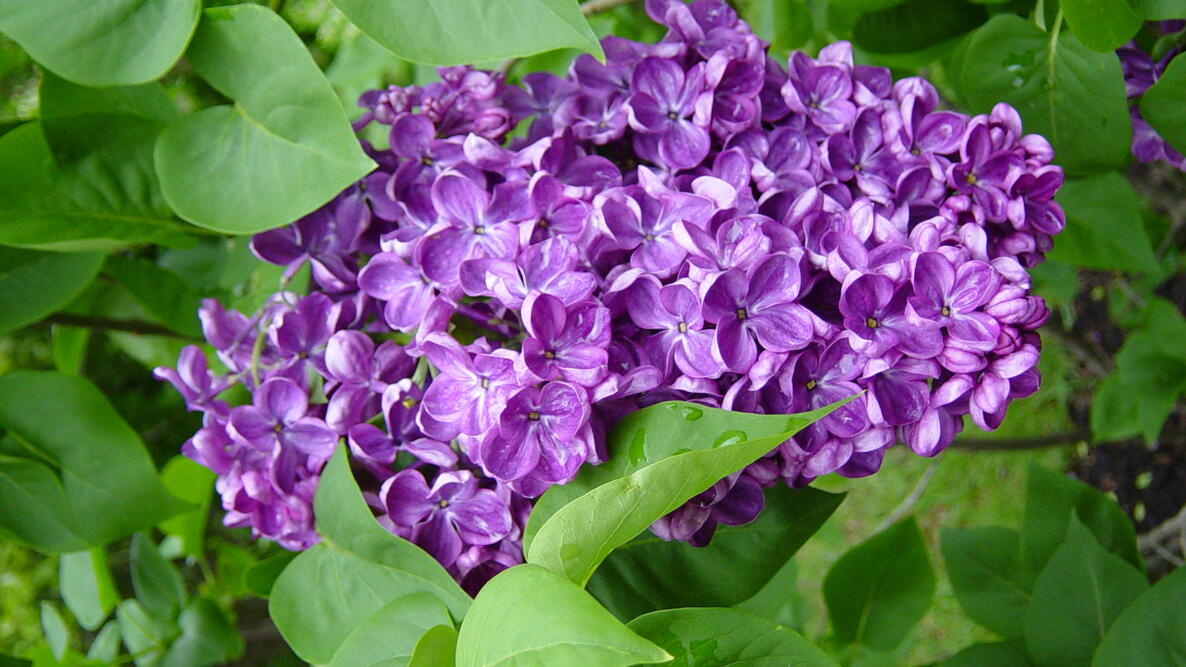
Caption
Huge blooms, wonderful scent.
Image Credit:
Wally Patrick
Botanical Name
Syringa spp.
Grown as
Toxicity
Sun Exposure
Water Needs
Height
Spread
Soil pH
Resilience
Plant Type
Types
For early flowers, try Syringa x hyacinthiflora hybrids; they bloom 7 to 10 days before S. vulgaris. Its fragrant blooms attract butterflies and hummingbirds.
The most common and fragrant lilacs are of the S. vulgaris variety:
- Try ‘Charles Joly’, a double magenta flower, an early bloomer.
- Mid-season lilacs include ‘Monge’, a dark reddish purple, and ‘Firmament’, a fine blue.
- Late-season beauties include ‘Miss Canada’, a reddish-pink, and ‘Donald Wyman’, a pink-purple flower.
Uncommon types/varieties include …
- S. x ‘Penda’ Bloomerang Purple: flowers in spring, pauses, then flowers again from midsummer through fall.
- Although common lilacs love cold weather, a few thrive as far south as Zone 8, including cutleaf hybrid S. x laciniata, with fragrant, pale lavender flowers, and S. pubescens ssp. patula ‘Miss Kim,’ with pale, lilac-blue blooms that fade to white.
Small Lilacs
For gardeners, especially those in urban spaces, who just don’t have the room for the traditional larger lilac, there are compact varieties! They’ll even grow in a container on your patio or balcony.
- ‘Baby Kim’ grows only 2 to 3 feet high (and 3 feet wide) in a nicely rounded shape with purple flowers that attract butterflies. Extended hardiness from Zones 3 to 8.
- ‘Little Lady’ (S. x) is a compact lilac that matures to 4 to 5 feet tall and wide with dark pink buds that open to lilac-pink flowers. Hardy in Zones 2 to 7.
- ‘New Age Lavender’ and ‘New Age White’ (S. vulgaris) are super-compact, growing from 4 to 5 feet tall and wide, and bred for mildew resistance. Their fragrant flowers attract butterflies and hummingbirds. Hardy to Zone 4.



I think my husband was to heavy on the weed killer a year ago and it is now affecting my lilacs and everything i planted. They started out with buds in early spring but then shriveled up. i have nothing! there is still green IN the branch when i cut on off. can i cut the entire bush down and give it a fresh start. it is about 15 years old and big. arghhh i want to save it somehow. help!!

The lilac that has been affected probably will recover eventually. Be sure to prune the lilacs in the spring, right after flowering (or shriveled up buds!). If you wish to rejuvenate an old lilac, we'd advise a three-year plan. Cut out a third of the branches to the base each year.
i live in Oklahoma, and have two cutleaf lilacs growing rather postive, but with this heat and drought i am wondering if they will surviv e, even with regular watering, temps reach around a 103 above
Cutleaf lilacs are tough and grow well in warm climates. Keep watering and your lilacs should be fine.
I live in northern Ca. and I received a lilac bush as a gift. It is still in a pot and seemed to be doing great until our 105 degree weather hit for about 10 days. I did put some lime in it last fall but now I am seeming what looks like rust on the leaves. Could you please tell me what causes this?
There is a mite that produces a slightly rusty color on the leaves and may cause some leaf rolling. For control, use Bayer Advanced Tree and Shrub Insect Control. Perhaps bring a sample to your local garden center or cooperative extension for a diagnosis. Here are other common lilac diseases:
http://extension.psu.edu/plant-disease-factsheets/all-fact-sheets/lilac-diseases
I bought a miss kim lilac bush from a local garden centre here in Calgary 5 days ago, I transplanted it to the ground and have been watering it quite a bit. It is developing yellow tips on the leaves and spreading to the rest of the leaf, it actually looks like it is dying. We are having a heat wave here with no rain, what do you suggest??
Although yellowing leaves can be a sign of one of several problems, our best guess would be overwatering. Too much water can rot lilac roots, which in turn causes yellowing leaves. In general, lilacs don’t do well in wet areas.
When planting a lilac, make sure that the area has good drainage, air circulation, and sunlight. Water the lilac immediately after planting, and then 2 to 3 times per week for the first month. After that, provide about 1 inch [about 2.5 cm] of water per week (just one deep soak once per week is good, to reach the lilac’s deep roots). Water a little more during hot weather.
We have a very old lilac and it's main stem is on it's side and others are coming out of it. It has one other main stem about 8 inches away. Almost like two plants. They reach up to just under the second story window in the dining room. It looks like it was chopped down at one time to about 4 feet, then all the rest of the growth on top of that. How would you prune it since it is already July 4th? Is it too late to prune this year to still have flowers for next year? It is my mother-in-laws and she is 92. She would probable get upset if it was too drastic. but whatever if it needs it.
For your old lilac tree we suggest a three-year plan. This allows the lilac to bloom every year. In late winter of year one remove one-third of the old canes (down to the ground), remove half of the remaining old wood in year two, and the rest of the old wood in year three. Then, follow a normal pruning schedule. Every spring after bloom, remove any dead wood. Prune out the oldest canes (down to the ground). Remove the small suckers. Cut back weak branches to a strong shoot. Cut back tall canes to eye height.
- « Previous
- 1
- 2
- …
- 10
- Next »
📣The Gardening Club Just Got Better! 3 Deliveries, 10% Store Discount, and more!

Comments