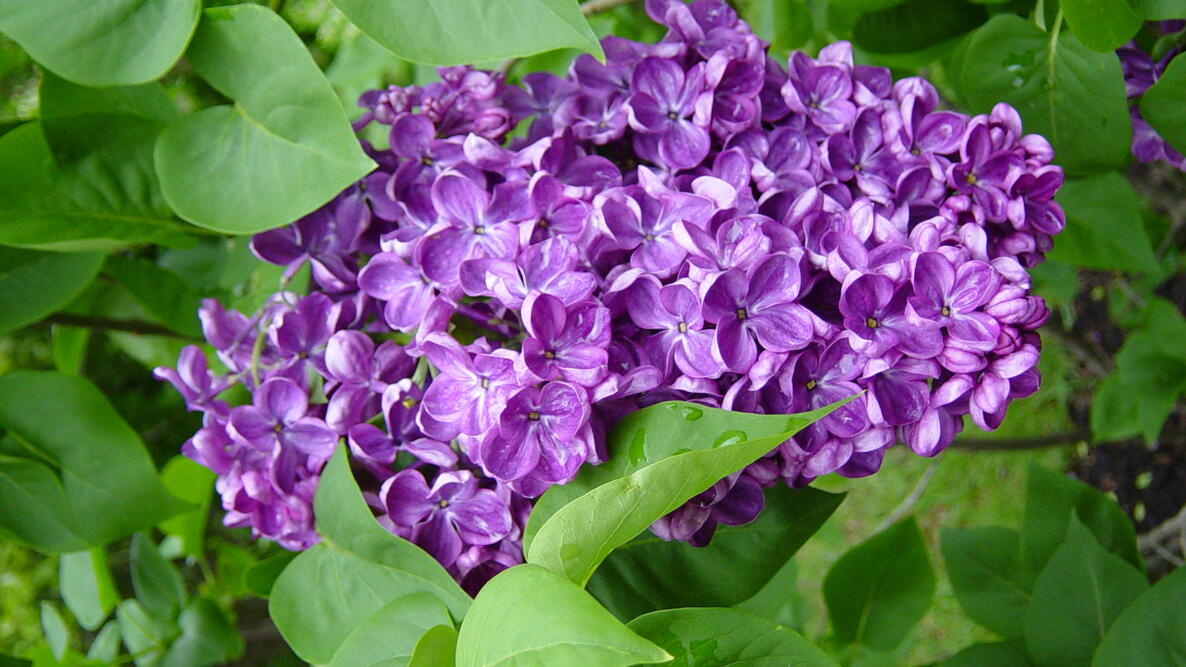
Caption
Huge blooms, wonderful scent.
Types
For early flowers, try Syringa x hyacinthiflora hybrids; they bloom 7 to 10 days before S. vulgaris. Its fragrant blooms attract butterflies and hummingbirds.
The most common and fragrant lilacs are of the S. vulgaris variety:
- Try ‘Charles Joly’, a double magenta flower, an early bloomer.
- Mid-season lilacs include ‘Monge’, a dark reddish purple, and ‘Firmament’, a fine blue.
- Late-season beauties include ‘Miss Canada’, a reddish-pink, and ‘Donald Wyman’, a pink-purple flower.
Uncommon types/varieties include …
- S. x ‘Penda’ Bloomerang Purple: flowers in spring, pauses, then flowers again from midsummer through fall.
- Although common lilacs love cold weather, a few thrive as far south as Zone 8, including cutleaf hybrid S. x laciniata, with fragrant, pale lavender flowers, and S. pubescens ssp. patula ‘Miss Kim,’ with pale, lilac-blue blooms that fade to white.
Small Lilacs
For gardeners, especially those in urban spaces, who just don’t have the room for the traditional larger lilac, there are compact varieties! They’ll even grow in a container on your patio or balcony.
- ‘Baby Kim’ grows only 2 to 3 feet high (and 3 feet wide) in a nicely rounded shape with purple flowers that attract butterflies. Extended hardiness from Zones 3 to 8.
- ‘Little Lady’ (S. x) is a compact lilac that matures to 4 to 5 feet tall and wide with dark pink buds that open to lilac-pink flowers. Hardy in Zones 2 to 7.
- ‘New Age Lavender’ and ‘New Age White’ (S. vulgaris) are super-compact, growing from 4 to 5 feet tall and wide, and bred for mildew resistance. Their fragrant flowers attract butterflies and hummingbirds. Hardy to Zone 4.




The best time to prune is after the bloom passes. See above also (repeated here for expediency):
- If your lilac is old and in really bad shape, remove one-third of the oldest canes (down to the ground) in year one, half of the remaining old wood in year two, and the rest of the old wood in year three. Another option for old lilacs is to chop the whole thing back to about 6 or 8 inches high. It sounds drastic, but lilacs are very hardy. The downside to this option is that it takes a few years to grow back. The upside is less work and more reward, as the lilac will grow back bursting with blooms.
- It must be recognized that severe pruning results in the loss of blooms for one to three years. For these reasons, a wise pruning program aims to avoid severe and drastic cuts by giving the bushes annual attention.
If you are referring to the flowers, yes, you can do that.
Most of our helpful input is above on this page. Consider the suggestions for compost in spring and well-rotted manure after bloom and other care tips. Great grandmother would be happy with your success.
Hi Denise,
Red-tinged leaves can be a sign of a nutrient deficiency. The exact nutrient that the plant is lacking is hard to identify, so a good cure-all is to amend the soil with aged compost. We hope this helps!
Lilacs need chilling hours during the winter so they're not meant for most Southern climates, whether in the ground or a container. It's not to say it can't be done but most lilacs require over two thousand hours of temperatures below 45 degrees F. in order to bloom. They need the cold to set the buds for next year's bloom. We'd suggest asking your local nurseries about varieties that have low-chilling requirements. From what we read, some lilacs that don't need as much chilling are: ‘Lavender Lady’, ‘Blue Boy’, ‘Dark Knight’, ‘Miss Kim’, ‘Betsy Ross’ or ‘White Angel’ (‘Angel White’) lilac. Lilacs need a neutral soil so you'll probably need to add lime.
Planting a lilac shrub in a container is doable but not recommended. Lilacs grow best when their roots are free to spread out. As you said, lilacs can’t tolerate acidic soil, and the same goes for soil in pots. Most commercial potting soils contain at least some pH lowering peat moss. So you'll need to add 1 cup of dolomite lime to every 2 cubic feet of potting soil. Also, note that lilacs can't overwinter inside. They need those chilling hours and must go outside.
Better yet, look for a similar plant that thrives naturally in Georgia such as Syringa laciniata (cut leaf lilac).
- « Previous
- 1
- 2
- …
- 10
- Next »

Comments