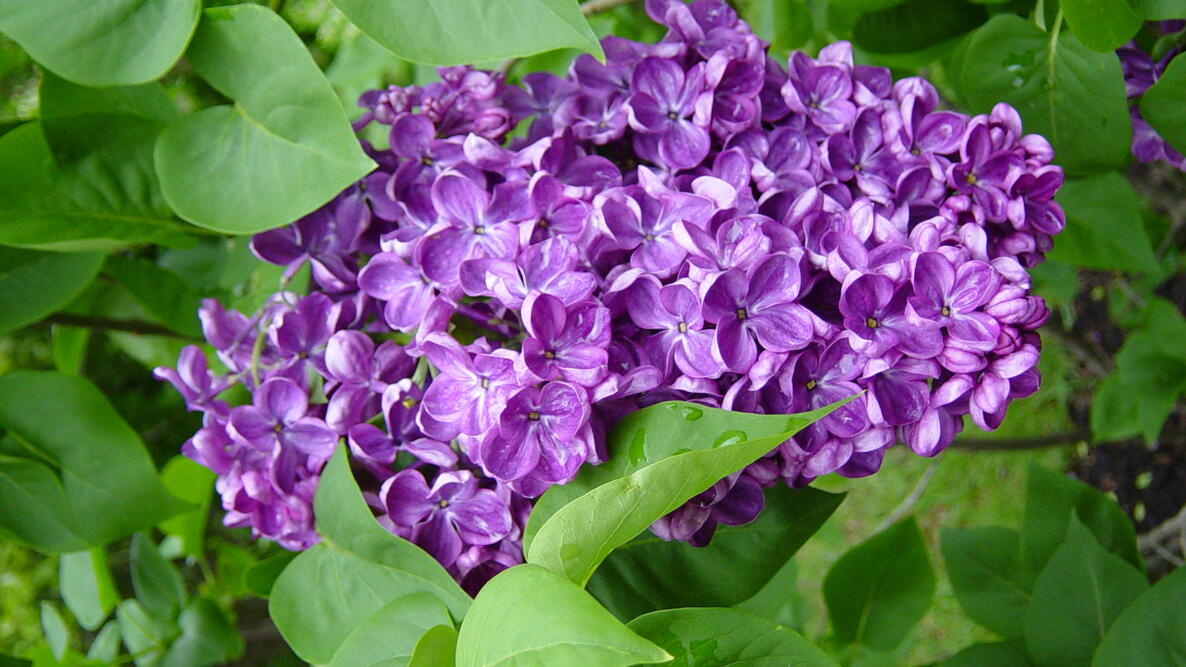
Caption
Huge blooms, wonderful scent.
Image Credit:
Wally Patrick
Botanical Name
Syringa spp.
Grown as
Toxicity
Sun Exposure
Water Needs
Height
Spread
Soil pH
Resilience
Plant Type
Types
For early flowers, try Syringa x hyacinthiflora hybrids; they bloom 7 to 10 days before S. vulgaris. Its fragrant blooms attract butterflies and hummingbirds.
The most common and fragrant lilacs are of the S. vulgaris variety:
- Try ‘Charles Joly’, a double magenta flower, an early bloomer.
- Mid-season lilacs include ‘Monge’, a dark reddish purple, and ‘Firmament’, a fine blue.
- Late-season beauties include ‘Miss Canada’, a reddish-pink, and ‘Donald Wyman’, a pink-purple flower.
Uncommon types/varieties include …
- S. x ‘Penda’ Bloomerang Purple: flowers in spring, pauses, then flowers again from midsummer through fall.
- Although common lilacs love cold weather, a few thrive as far south as Zone 8, including cutleaf hybrid S. x laciniata, with fragrant, pale lavender flowers, and S. pubescens ssp. patula ‘Miss Kim,’ with pale, lilac-blue blooms that fade to white.
Small Lilacs
For gardeners, especially those in urban spaces, who just don’t have the room for the traditional larger lilac, there are compact varieties! They’ll even grow in a container on your patio or balcony.
- ‘Baby Kim’ grows only 2 to 3 feet high (and 3 feet wide) in a nicely rounded shape with purple flowers that attract butterflies. Extended hardiness from Zones 3 to 8.
- ‘Little Lady’ (S. x) is a compact lilac that matures to 4 to 5 feet tall and wide with dark pink buds that open to lilac-pink flowers. Hardy in Zones 2 to 7.
- ‘New Age Lavender’ and ‘New Age White’ (S. vulgaris) are super-compact, growing from 4 to 5 feet tall and wide, and bred for mildew resistance. Their fragrant flowers attract butterflies and hummingbirds. Hardy to Zone 4.



I am not sure but my lilac has dry ends on 3/4 of the stems this year-I have had them before-it visually looks like a spent bud-open with nothing in it-they snap right off-I don't know why one has to trim back the spent flowers every year-My aunt has been gone for many years-she always had large full lilac bushes-they are still that way at her place-house is gone but lilacs are still there-never get pruned or treated in any other way-they are gorgious-I even took one to plant at my home-whats up with the dry ends and whats your feelings on my aunts lilacs-never been touched-
The past few winters have been very mild (I'm in Maryland, zone 7a) and my lilacs are barely putting out any flowers. Is there anything I can do to encourage blooming despite this?

There are five main reasons that lilacs fail to bloom: insufficient sunlight, too much nitrogen fertilizer, improper planting (planted too deeply), improper pruning (pruning at the wrong time) or winterkill of the flower buds. Also, lilacs will typically not bloom the season after a harsh pruning, so you may need to wait until next year before you see flowers. If nothing works, you might take a sucker from your lilac bush and try growing it in a new location.
We are outside Philadelphia & want to plant lilacs Any suggestions as to which types work bests & when is then best time to plant?
Thanks
On variety, it depends on whether you want a tree, shrub, border, etc. A classic is the common lilac (Syringa vulgaris). It's 7 to 15 feet tall and spreads 6 to 12 feet once grown. For a smaller lilac, consider the Persian lilac tree. Then there is the ‘Miss Kim’ (Syringa patula), a hardy compact shrub (five feet high by five feet wide). April and May are good times for planting. Enjoy the lovely lilac blooms!
My mom has a lilac bush that has been outside her bedroom window for at least 50 years. We are selling the homestead. I would like to known if you can take a cutting from the lilac bush and put in my
yard so I can always think of mom with the lovley lilacs of my childhood?
My Mom has a lilac bush that has been near her bedroom window ever since I can remember it must be at least 50 years old?. We are selling her house but I would like to know if you can take a cutting from this and plant in my yard to remember her by?
Established lilacs such as this will have smaller off shoot plants growing around the perimeter of the bush. You can easier dig up some of the smaller lilacs plants growing around the main bush. The roots are not very deep - less then 6". Don't feel timid to only dig up a lilac plant that is a foot high - you can easily replant ones that are 3 to 4 feet high - just looked for slender upright growth.
These replanted lilac bushes will be smaller and resemble a small flowering tree until they begin to fill out over the years.
I moved an established lilac bush which was over 6' x 6' without in sections without damaging it (it was over 20 years old). Lilacs are really a single bush but a cluster of bushes which lend themselves to be relocated in desired.
My Aunt gave me a lilac cutting eight years ago. It has only bloomed once. The bush is still very small. What do I need to do?
The usual reasons that I lilac languishes is: too much shade or too much nitrogen. Move the plant if needed and make sure you fertilize correctly. One way to get your hydrangea blooming is to drive a spade into the ground around the lilac--about where its foliage ends. Do this in a circle around the lilac about 6 times.
- « Previous
- 1
- 2
- …
- 10
- Next »
📣The Gardening Club Just Got Better! 3 Deliveries, 10% Store Discount, and more!

Comments