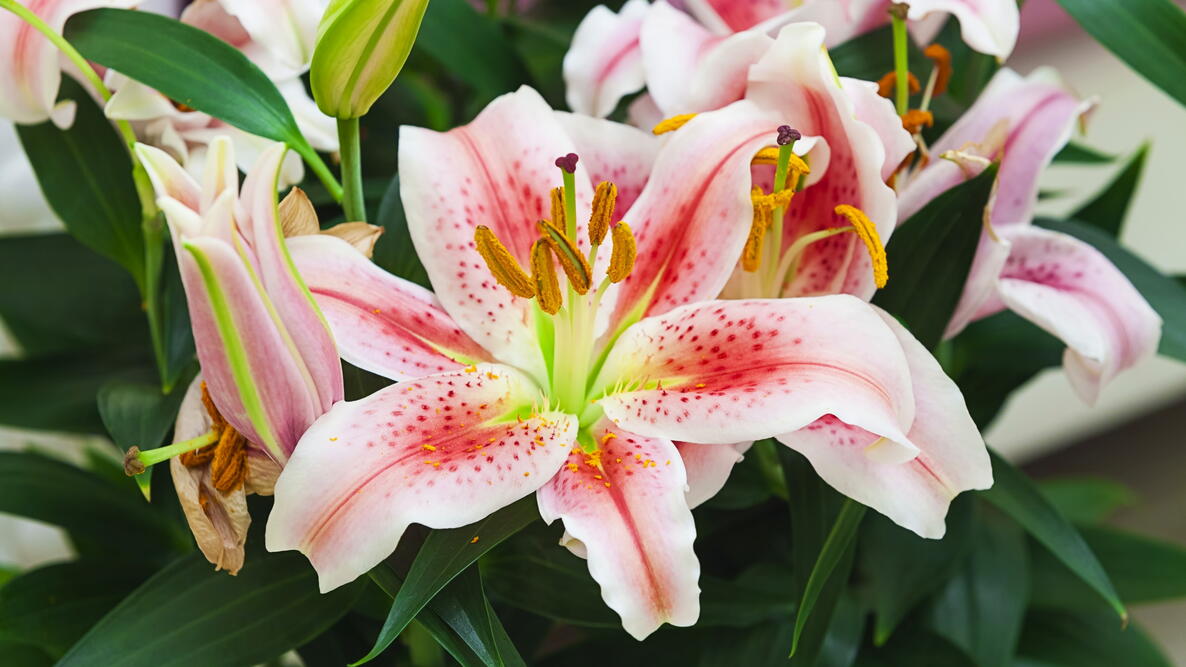
With stunning star-shaped flowers, lilies add elegance and fragrance to any garden. Enjoy their colorful blooms from spring through the first frost by blending early-blooming, mid-season, and late-blooming lilies into your garden. Learn more about choosing, planting, and growing lilies.
Everyone loves lilies! Grown from bulbs, lilies are perennials that require minimal care if planted correctly. Most lilies do well in containers and look spectacular in a vase.
True lilies belong to the genus Lilium and grow from plump, scaly bulbs. Several popular lily species exist, including Orientals, Asiatics, Orienpets, and Species types.
We say “true” lilies because there are also plants, such as daylilies, peace lilies, and canna lilies, which have the term “lily” in their common name, but they’re not actually lilies at all. They do not grow from bulbs but are in a different plant genus. Water lilies aren’t lilies at all, and neither is lily-of-the-valley.
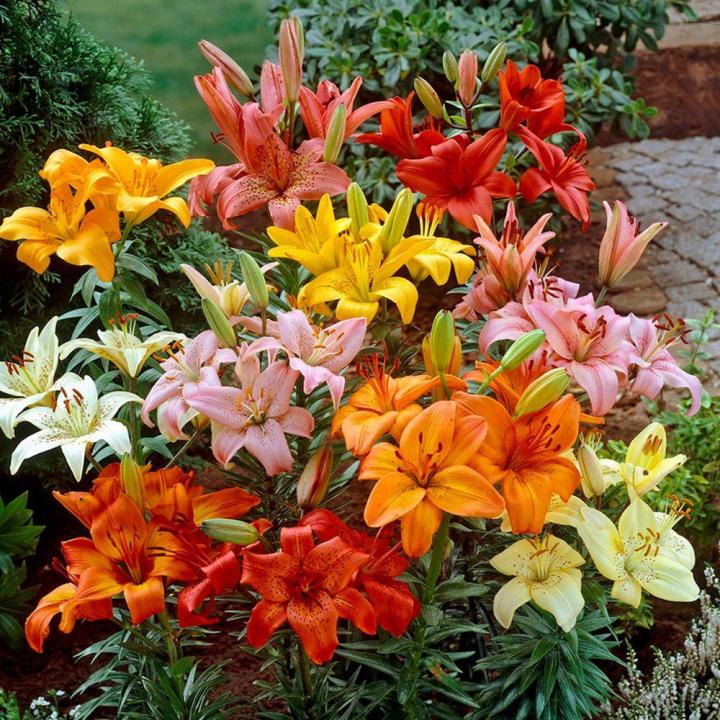
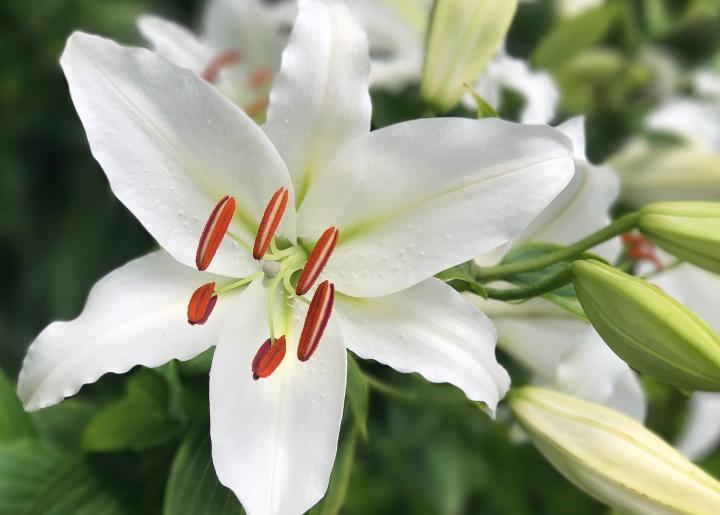
With 8,000 or so varieties, lilies parade an endless range of colors, shapes, heights, and bewitching scents. Lilies have six plain or strikingly marked tepals (“petals”) and are often trumpet-shaped, sitting atop a tall, erect stem with narrow, long, lance-shaped leaves. They come in many beautiful colors, including pink, gold, red, orange, and white.
Most lilies also take readily to containers at home in formal and naturalistic settings. Plus, they make excellent cut flowers!
To create a sequence of lily blooms in your garden, remember that Asiatics generally flower first, followed by Orienpets and then Oriental varieties.
- Asiatic lilies (Lilium sp.), or Asiatic hybrids, are the earliest to bloom (usually in May or June), right after peonies. They are also the easiest to grow, as long as they are planted in well-draining soil, not waterlogged. They are the shortest type of lily (about 2 to 3 feet tall) and come in many colors, from pastel to tropical. Hybrids come in pure white, pinks, vivid yellows, oranges, and reds; heights are from 1 to 6 feet. Intense breeding has erased much of the Asiatics’ fragrance, but despite their lack of perfume, they are a favorite with floral arrangers.
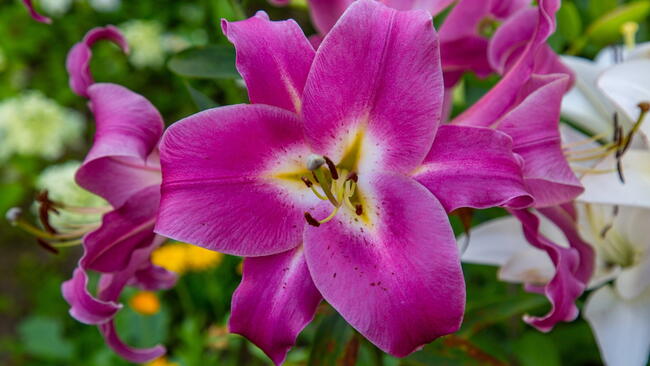
- Oriental lilies (L. sp.), or Oriental hybrids, have that famously intoxicating fragrance. They are tall and stately (4 feet) and tend to grow more slowly. Oriental hybrids bloom in mid- to late summer, just when Asiatic lilies are beginning to fade. Orientals are always a striking choice, producing masses of huge white, pink, red, or bi-color blooms. They make wonderful cut flowers that fill even the largest rooms with spicy scents.
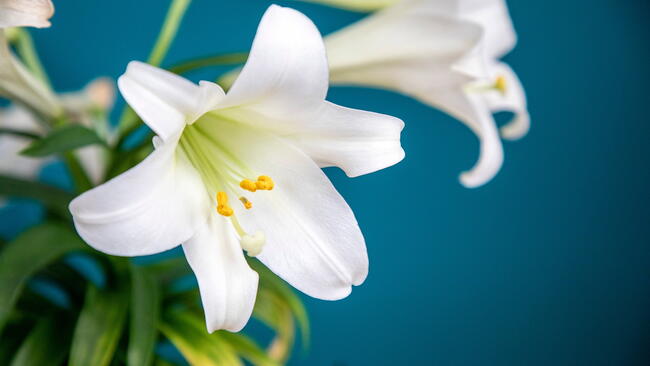
- Easter lilies (L. longifolium) are most commonly grown indoors as a holiday plant. As their name suggests, they are typically forced into bloom around Easter, in March or April. Outdoors, they are better suited for warmer regions of North America, where they can be planted in the garden after blooming has finished. These are generally hardy to Zone 5 (and to Zone 4 if given 1 to 2 feet of mulch in autumn for winter protection). Learn more about Easter Lilies.
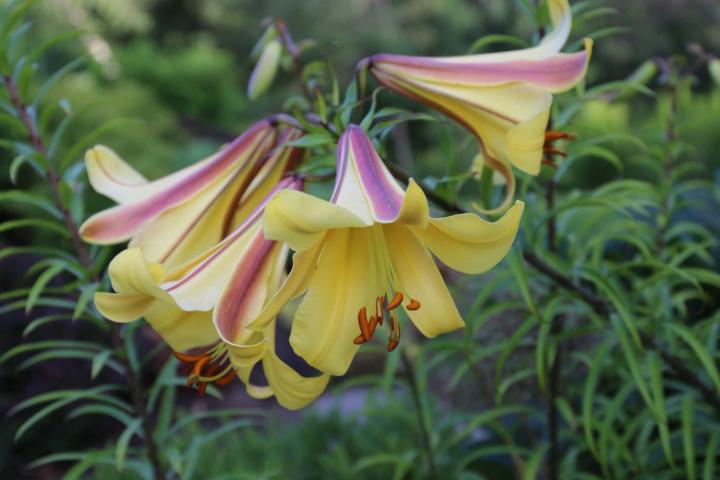
- Trumpet lilies (L. sp.), or Trumpet hybrids, are similar to oriental lilies, producing many blooms with a nice scent. Their flowers tend to be smaller and more closed (like a trumpet) than those of the other lilies.
There are other lilies out there, of course, such as tiger lilies (L. henryi) and Turk’s cap lilies (L. superbum), as well as hybrids like “Orienpet” (Oriental + Trumpet) and “LA” lilies (Easter + Asiatic). Browse through your favorite online gardening retailer’s catalog to find what you like best!
Planting
Lilies need lots of sun. For dependable blooms, lilies should get 6 to 8 hours of direct sunlight daily (aka “full sun”). If it’s too shady, the stems will attempt to lean toward the sun or get spindly and fall over.
Also, a well-draining site is critical. Water trapped beneath the scales may rot the bulb. How can you tell if your site drains well? After a good rain, find a spot that is the first to dry out. Enrich the soil with leaf mold, compost, or well-rotted manure to encourage good drainage. Learn more about soil amendments and preparing soil for planting.
Most popular varieties prefer acidic to neutral soil, but some are lime-tolerant or prefer alkaline soils (e.g., Madonna lilies).
When to Plant Lilies
Lilies are commonly planted in the fall but can be planted in the spring in areas with harsh winters.
- In the fall, plant at least 4 weeks before your first fall frost date. Bulbs planted in the autumn will have well-established roots in the spring. The bulbs benefit from a winter chill to produce big blooms.
- In the spring, plant them as soon as the threat of frost has passed.
- Container-grown lily plants can be planted anytime during the early summer.
- Buy the bulbs close to planting time. Because lily bulbs don’t go dormant, they will deteriorate over time, so don’t plan to buy bulbs in the fall and wait until spring to plant them.
How to Plant Lilies
- Loosen the soil to a depth of 12 to 15 inches.
- Plant lilies three times as deep as the bulbs are high. The deep planting encourages the developing stem to send out roots to help stabilize the plant and perhaps eliminate the need for staking. Also, deep planting keeps lily bulbs cool when temperatures soar.
- Set the bulb in the hole, pointy side up.
- Fill the hole with soil and tamp gently. (Got critters? Bury the bulbs in wire cages to protect them from getting eaten.)
- Space bulbs at a distance equal to three times the bulb’s diameter (usually about 8 to 18 inches apart, depending on the variety).
- If space allows, plant lilies in groups of three to five for visual appeal; crowding leads to poor circulation and gray molding.
- Water thoroughly at the time of planting.
Growing
How to Care for Lilies
- During active growth, water the flowers freely, especially if rainfall is less than 1 inch per week.
- Keep lilies mulched so that their roots are cool. The mulch should feel moist but not wet. Read more about mulching.
- Apply a high-potassium liquid fertilizer every 2 weeks from planting until 6 weeks after flowering.
- Apply a thin layer of compost each spring, followed by a 2-inch layer of mulch.
- Stake tall lilies.
- Lilies do not bloom more than once per season, but you can remove the faded flowers so that the plants don’t waste energy making seeds.
- After the lily blooms, you can also remove just the stem itself. However, do NOT remove leaves until they have died down and turned brown in the fall. It’s very important not to cut back the leaves until the end of their season because they help provide nourishment to the bulb for next season’s blooms.
- Cut down the dead stalks in the late fall or early spring.
- Before winter, add 4 to 6 inches of mulch, simply to delay the ground freeze and allow the roots to keep growing. Leave the mulch until spring, once the last hard frost has passed. See your local frost dates. See your local frost dates.
- If your region doesn’t have snow cover, keep the soil moist in winter.
- When lily shoots grow through the mulch in the spring, start to remove it gradually.
- Divide plants every 3 to 4 years as new growth begins in the spring. Just lift the plants and divide the clumps. Replant the new bulbs, adding some compost.

Types
There are many types of lilies that bloom at different times. With careful planning, you can enjoy lilies all summer long by planting bulbs from different varieties.
Learn more about the various types of lilies, including Asiatic lilies, Trumpet lilies, and Oriental hybrids.

More Like This


Each year, your oriental lilies may produce a few more stalks from bulblets that form around the mother bulb. The general recommendation is to divide them every three or four years, in the fall--when the flowers have faded and the leaves are turning yellow. Observe the plants over the summer; if you think that they are suffering in vigor, or the bloom display is not as spectacular, you can try dividing them in fall. Otherwise, it might be best to wait a year or two more.
Asiatic lilies bloom from May to September, depending on the variety, from zones 9 to 4.
However, the bulbs are planted in the fall for bloom at this normal time. As an alternative, you could cold store the bulbs over the winter to plant in the spring. Asiatic lily bulbs needs to be "precooled" at least 6 weeks at 40 degrees F.
- « Previous
- 1
- 2
- …
- 10
- Next »

Comments