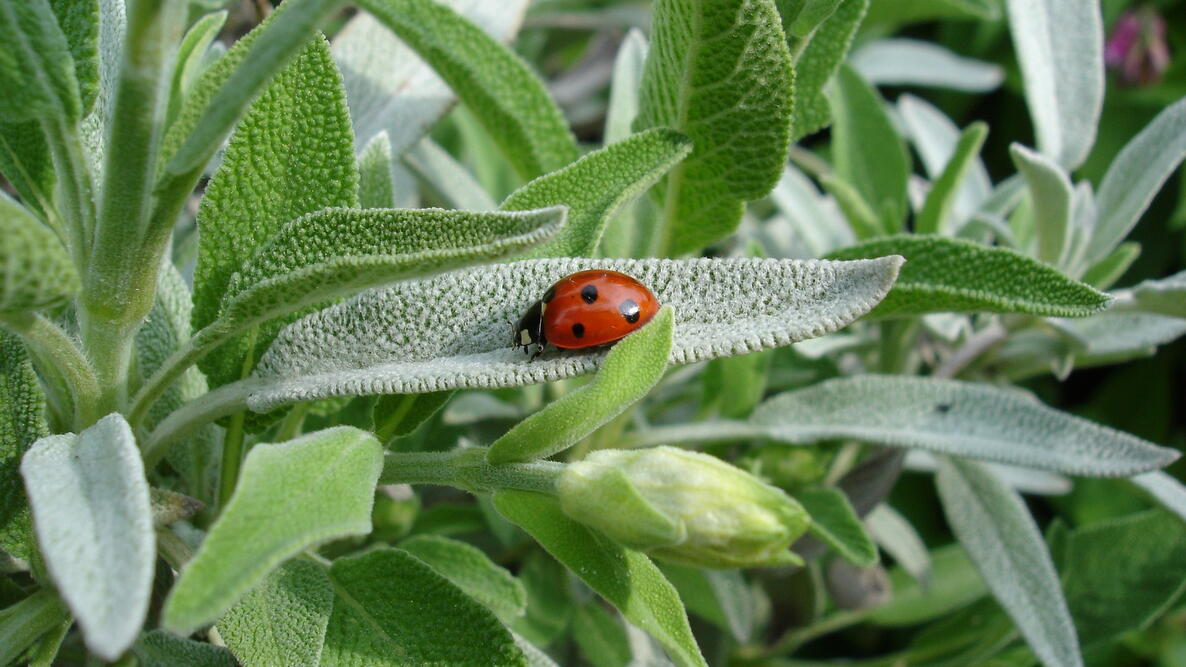
Caption
Sage is a useful herb that can be easily grown in your garden.
Growing
How to Grow Sage
- Be sure to water the young plants regularly until they are fully grown so that they don’t dry out. They’ll need a consistent moisture supply until they start growing quickly.
- Prune the heavier, woody stems every spring.
- It’s best to replace the plants every few years so they remain productive.
- You can grow sage from cuttings!

Types
- ‘Berggarten’, a robust plant with very large silver-gray leaves
- ’Tricolor’ sage, for a bit of color in the garden (yellow, mauve, and sage green)
- ‘Icterina’ has green leaves with yellow edges


More Like This
Comments

Hi, Pat: Our sagest (sorry) advice on this is No! Leave the blooms on. You can use them in cooking (e.g., float on a soup), plus bees love them! Thanks for asking!
Hi, Don: The best thing to do at this stage is just to leave it alone and let it continue to get established. When you do pinch leaves, remember that the plant will normally branch from the bud. For this reason, be sure to always take leaves from all around the plant rather than just the top, lest it become top-heavy from new growth. Obviously you will want to harvest before it flowers, but otherwise you just want to spread out your pinchings to help retain its bushy shape. Thanks for asking!
Hi, Sebastian,
Sage plants can grow to be 24 to 36 inches high/wide, so space accordingly...when the plants mature. If you plan to transplant them, you can start them in a pot of almost any size. BTW, one source suggests that sage germinates poorly, even with fresh (ready) seeds. If you seed, cover lightly, with 1/8 inch of soil and keep moist until they sprout. (This can take as long as 3 weeks.) Transplant the seedlings two to three weeks before the last frost date.
We hope this helps!
It sounds like your plant can go into its main pot at the next transplanting. Put it outdoors after the last expected frost. You might want to harden it off, since this cultivar is a bit sensitive to cold. Introduce it to the outdoors for increasing periods (such as 2 hours, then 3 hours, etc.; in a protected spot, then a less protected spot closer to where it will be, etc.) each day for about a week or so.
You can use a deep, 12- or 14-inch-wide pot to give your plant lots of room when it spreads (on average, sage will have a 12-inch-wide spread at maturity). Tricolor isn't as hardy as some sages, so you'll need to bring it indoors in winter. Therefore, consider the weight of the pot as well. Plastic is lighter than terra cotta (be sure, though, that it has a drainage hole in the bottom). Terra cotta, although beautiful, wicks away moisture faster, so you should monitor watering more closely with these pots.
A sage plant usually gets woody after a few years, so people often replace it then.
- « Previous
- 1
- 2
- …
- 10
- Next »

Hi Ashley,
Your cutting is probably dying. Try again. Best time to start a sage cutting is in the middle of the summer before the plant blooms. Cut off a young shoot below the leaf crown. The cutting should have at least three pairs of leaves. Plant the cutting into a pot with mixed soil and compost. Make sure to keep the soil moist. You can also put a cutting into a glass of water to root. It will take about 2 weeks for the roots to develop.