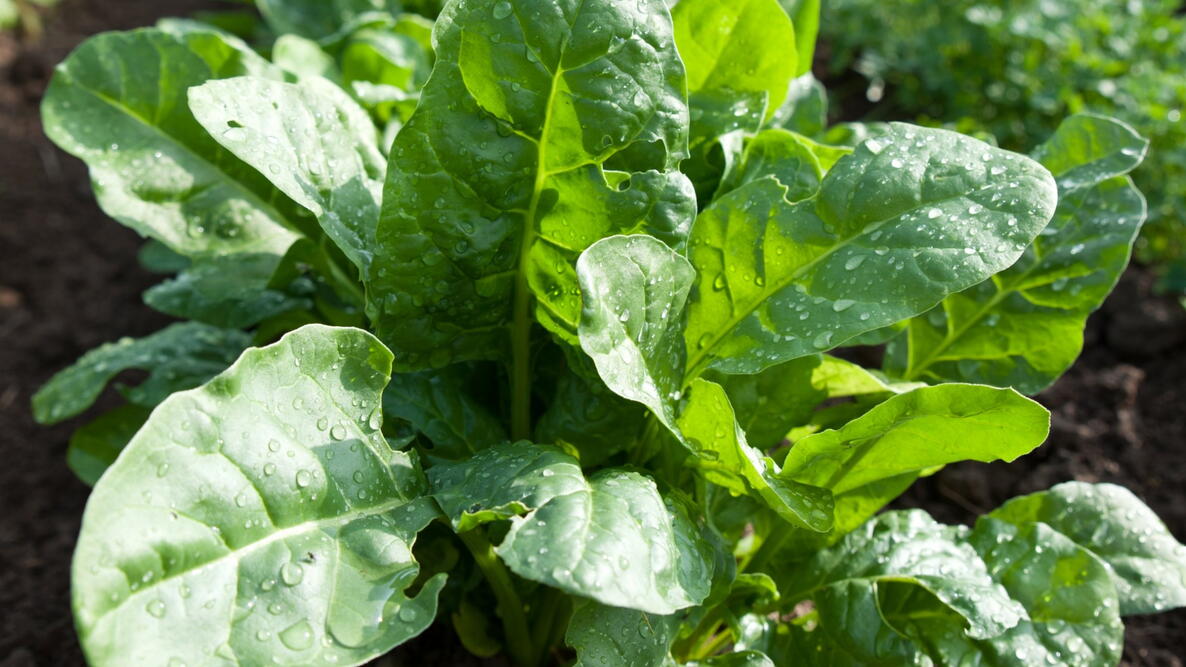
Harvesting
- Harvest a few outer leaves from each plant (so that inner leaves can develop) when leaves reach the desired size or harvest the entire plant, cutting the stem at the base.
- Don’t wait too long to harvest or wait for larger leaves. Bitterness will set in quickly after maturity. Be aware of day length and heat: Increasing daylight (about 14 hours or longer) and warmer seasonal temperatures can cause spinach to bolt (develop a large stalk with narrower leaves and buds/flowers/seeds), which makes the leaf taste bitter.
- If spinach starts to bolt, pull the plant and use the leaves. Or try to slow the bolting: Pinch off the flower/seed heads, keep the soil moist, and provide shade.

Photo by Deyan Georgiev/Shutterstock.
How to Store Spinach
Fresh spinach leaves are good for up to a week. Too much moisture hastens their demise, so store fresh spinach unwashed and don’t wash until ready to use. Pat dry with a paper towel and put in a freezer bag with the towel to absorb moisture.
Given its short shelf life, spinach is perfect for freezing. Wash, trim off ends and yellowing leaves, blanch, and pack into freezer bags. See how to freeze spinach.
Types
There are four main types of spinach suited for spring and fall plantings.
- Baby-leaf-style spinach is tender, with small leaves. The variety ‘Baby’s Leaf’ is good for containers; ‘Catalina’ is heat-tolerant and resistant to downy mildew.
- Malabar spinach (Basella alba), a vine, and New Zealand spinach (Tetragonia tetragonioides), a perennial, are two leafy greens that resemble common spinach; both are heat-tolerant. Grow them in the summer when common spinach can’t take the heat.
- Savoy spinach has curly, crinkled, dark-green leaves—an example is the variety ‘Bloomsdale’. The ‘Winter Bloomsdale’ variety is a crinkled-leaf, fall variety, tolerant to mosaic viruses.
- Semi-Savoy has slightly crinkled leaves and can be difficult to seed. ‘Melody’ is resistant to cucumber mosaic virus and downy mildew; mildew-resistant ‘Remington’ will grow in spring, summer, or fall; ‘Tyee’ can be planted in spring or fall and is resistant to downy mildew.
- Smooth- or flat-leaf (also called plain leaf) varieties have spade-shaped leaves. ‘Giant Nobel’ is a plain leaf variety and an heirloom that is slow to bolt; ‘Nordic IV’ is bolt-resistant.

More Like This

Comments

Hi Lora,
Spinach can be harvested by cutting the outer leaves off periodically and allowing new ones to grow from the center. Spinach is an annual, so once it's done producing leaves, you'll want to pull up the stalks and toss them in the compost. Spinach can actually be planted for two crops a season in most areas--one in the spring, and one in late summer/early fall. When the days start to cool off a little, try planting new seeds for a fall harvest!
Certainly try them—and let us know how each goes.
Hi Fayez,
Unfortunately, spinach is a cool-season crop and does not tolerate hot temperatures well (especially temperatures as high as 35°C / 95°F). When grown in hot weather, spinach tends to "bolt"—in other words, it will spend all of its energy quickly producing flowers and seeds, rather than the tender, edible leaves.
Heat-tolerant greens that are similar to spinach include New Zealand spinach (Tetragonia) and Malabar spinach (Basella), but you should be aware that these are NOT related to the spinach (Spinacea oleracea) that's commonly grown in temperate gardens. Perhaps your school would allow you to grow one of these warm-weather greens instead?
Basically if your spinach looks healthy, then it is probably happy. But if you suspect a problem, a good place to start is to get your soil tested. The results will tell you if your soil has any deficiencies. You might check your county's Cooperative Extension Service (see http://www.almanac.com/content/cooperative-extension-services ), which may offer information on this topic. In general, spinach likes quite a bit of nitrogen and moist, not soggy, soil. A soil pH of between 6.2 to 6.8 also helps. Nutrient deficiencies may appear as yellow or pale leaves, stunted or distorted growth, purpling or bronzing of leaves, leaves dropping early, or other symptoms. Hope this helps!
- « Previous
- 1
- 2
- …
- 10
- Next »

Hi Patti, Here is a great source for spinach. This company carries the original and heirloom spinach seeds so I think you'll find a variety to suit you!
https://www.rareseeds.com/store/vegetables/spinach