Image Credit:
Pixabay
Botanical Name
Citrullus lanatus
Grown as
Toxicity
Sun Exposure
Water Needs
Height
Spread
Soil pH
Bloom Time
Flower Color
Special Features
Resilience
Plant Type
Planting
When to Plant Watermelons
- In cool climates with short growing seasons, start seeds indoors 2 to 3 weeks before your last frost date. Plan to transplant seedlings into the garden about 2 weeks after that date or when the soil has warmed to at least 65°F (18°C).
- In warmer climates with long growing seasons, sow seeds directly outdoors 1 to 2 weeks after your last frost date, as long as the soil temperature has warmed to at least 65°F (18°C).
- Young watermelon plants can also be bought from nurseries. Plant these after there is no longer a chance of frost; they are very tender. Watch the local forecast and err on the side of caution! Consider laying black plastic over your planting area to warm the soil even more.
- Tip: Starting with young plants can result in an earlier harvest (usually up to 2 weeks earlier), so consider buying young plants, particularly if you live in a cooler climate.
Choosing and Preparing a Planting Site
- Amend soil with aged manure, seaweed, and/or compost before planting. Watermelons are heavy feeders, meaning they need soil that is fertile and has a high nutrient level. Learn more about soil amendments and preparing soil for planting.
- Watermelons do best in loamy, somewhat sandy, well-drained soil. They can struggle in soil that contains too much clay and doesn’t drain well.
- Watermelons prefer a soil pH between 6.0 and 7.5 (“slightly acidic to neutral”).
- Watermelons need A LOT of space—up to 20 square feet per plant. Their vines need room to sprawl, so plant them in a place where they won’t crowd out other crops.
- Growing the vines in raised rows, known as hills, ensures good drainage and will hold the sun’s heat longer.
- Plan to space the plants 2-3 feet apart in a 5-foot-wide hill.
- If you’re growing in traditional rows, space them at least 6 feet apart.
How to Plant Watermelons
- Sow seeds 1/2 to 1 inch deep outdoors or 1/4 to 1/2 inch deep in seed-starting pots indoors.
- Tip: To allow for more root growth, use larger starting pots than you would for most seeds. Also, consider using compostable pots that can be cut away or planted directly in the garden, as this will minimize the risk of damaging seedlings’ tender roots during transplanting.
- If direct seeding outdoors, sow 4 to 6 seeds per hill, eventually thinning to 2 to 3 seedlings.
Transplanting Seedlings
- Handle watermelon seedlings with extreme care when you transplant. Their roots are very fragile, so try not to disturb the soil when removing them from pots.
- After transplanting, cover the plants with row covers to keep pests at bay. Remember to remove the row covers when you see both male and female flowers on the vine, as pollinators will need to access the flowers.
- Find even more tips for planting melons in your home garden.
Growing
Watering Watermelons
- Watering is very important—from planting until fruit begins to form. While melon plants are growing, blooming, and setting fruit, they need 1 to 2 inches of water per week.
- Keep soil moist but not waterlogged. Water at the vine’s base in the morning, and try to avoid wetting the leaves and avoid overhead watering. Reduce watering once fruit is growing. Dry weather produces the sweetest melon.
Fertilizing
- If you choose to fertilize (and many do), make sure it delivers more nitrogen than phosphorus and potassium, as this will encourage leaf and vine growth. However, after flowering begins, use a fertilizer with less nitrogen to instead encourage flowers and fruit. We like to use a seaweed-based fertilizer.
Flowering and Fruiting
- Vines produce male and female flowers separately on the same plant. They often begin producing male flowers several weeks before the females appear. Do not be concerned if the male flowers fall off. The female flowers (which have a swollen bulb at the base) will stay on the vine and bear fruit.
- Blossoms require pollination to set fruit, so be kind to the bees!
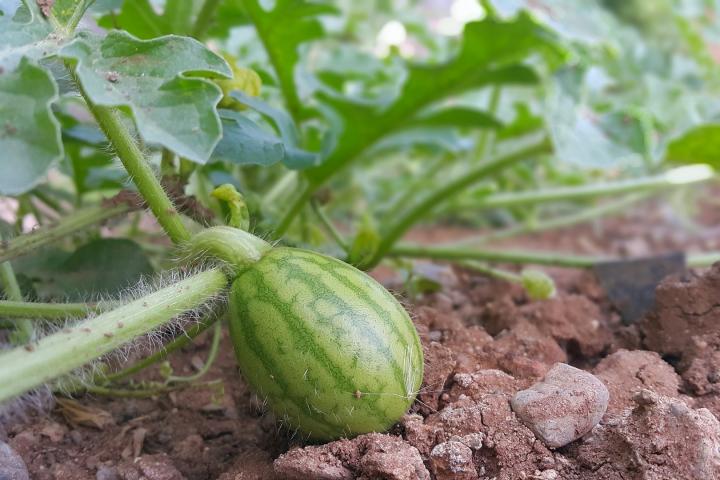
- As the fruit is ripening, prevent rotting by gently lifting it and putting cardboard or straw between the fruit and the soil.
General Watermelon Care Tips
- Mulching with black plastic or straw around the plants will serve multiple purposes: it will warm the soil, hinder weed growth, and keep developing fruits off the soil.
- Pruning generally isn’t necessary for watermelon plants, but vine productivity may be improved if you do not allow lateral (side) vines to grow and stick to the main vine. When the plant is young, just cut off the end buds as they form (before the side shoots become vines). You can also pinch off some blossoms to focus the energy on fewer melons (though it’s challenging to kill off a potential fruit).
Types
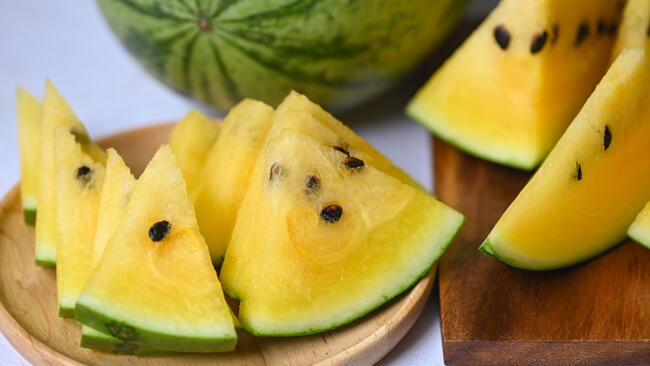
- ‘Golden Midget’: 70 days to maturity. Bears petite, yellow-skinned, 3-pound melons with pink flesh. Good for northern gardeners.
- ‘Sugar Baby’: 80 days to maturity. Produces 10-pound melons with bright red flesh. This variety of smaller fruit can be planted just 4 feet apart.
- ‘Sweet Beauty’: 80 days to maturity. A 2004 All-America Selection. Bears 6-pound, oblong melons with red flesh.

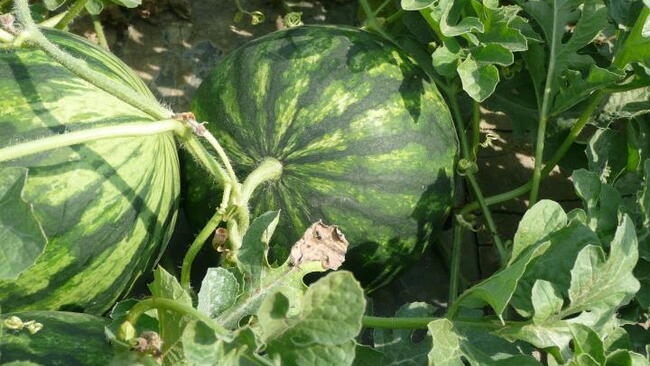

I just planted My sugarbaby watermelons outside. But I forgot to add compost to the mixture. Do you think it will be alright and grow big and healthy? It is my first time growing this and I just read the instructions on the back of the seed package. I hope they will be alright.

Compost is only one of the factors involved in your plants growing big and healthy. Once the plants firmly establish themselves in the soil, you can sprinkle compost around the stems. Do that a few times during the growing season, increasing the amount each time.
Next time, put down and mix compost into your soil FIRST. (Have you started a compost pile? are you aging manure in a pile for use next season?? These are things you can do year round--and so always have healthy soil for your plants.)
OK, I am a first time watermelon grower. My question is #1 I don't have compost can I use regular potting soil ,if not can I use regular garden soil ? I live in central Fl. and the soil here is very sandy #2 I'm only growing some for me and my husband and maybe a couple of neighbors so can I plant my seeds along my fence? #3 Can I make the hills a little closer than 3 to 7 feet apart? Is there anything else other than whats on the package that I should know?
You can use the soil you describe but you probably will not have great results. Sand does not hold water; water filters through it. "Water"melon plants need quite a bit of water as they grow; if there is no soil to hold the water around the plant's roots, you will be watering all the time (almost literally).
If you are going to buy regular potting soil, as you describe, ask at the place you buy it if they have compost. It usually is available in 20- to 40-pound or so bags. (You do not have to use fresh from the farm compost.) You can mix the compost with potting soil. How much?? Maybe 50-50. The goal is to have "soil" with ingredients that hold moisture. (This is desirable for almost any plant, certainly edibles. Many tropicals or types of plants that you see thriving around you in the sandy soil would not do well in compost because they like the dryness that sand enables.)
As to the fence and hills, sure. Those decisions are secondary to the soil. And, by the way, sun. Do not plant the watermelon in shade. It needs about 8 hours of sun per day.
We hope this helps. Good luck!
is it okay to plant it on a base ?
Your question is not clear, but by "base" if you mean a stump or other firm surface, no. The roots need some place to go.
I have had a garden for two years. Planted Crimson Sweet both years,have gotten 5 melons last year 4 this year. I look for the bottom side to turn yellow or cream, I had 2 that were almost the same green color all over. But when I cut them open, only 3 of all of them were red inside, all the others were pink. What did I miss to know when to pick the ripe ones.
The main ways to check and see if your watermelon is ripe is by checking the tendril (the one little vine that looks like a piggy tail closest to the watermelon). The tendril should be completely brown. Also there is another leaf that you should check on the vine. It is called the spoon leaf. This leaf is just a small cup shaped leaf and if it is also located near the watermelon. This leaf should also be brown and dead. If both of those leaves/vines are dead then the watermelon should be ripe. I hope this helps :)
Lots of gardeners have a difficult time determining when watermelons are ripe. Use a combination of the following tips:
light green, curly tendrils on the stem near the point of attachment of the melon turn brown and dry
the surface color of the melon where it was once powdery or slick takes on a dull look
the skin resists penetration by a fingernail and is rough to the touch
the bottom of the melon (where it lies on the soil) turns from light green to rich yellow
We are first timers and have a beautiful watermelon plant. There are blooms, and some fruit has started. The only problem is, our fruit will get about thumb size, and the bloom will turn brown, and a few days later the fruit starts to turn black. This has happened with all 6 watermelons. We are in a severe drought this year, and I water my plant 3 times a day. Am I over watering or is it something else? Is there a way to save future fruit that may come on this plant? Nothing else is planted, just this one plant. We are hoping to get at least 1 watermelon off this plant since our daughter brought it home from school in early April.
- « Previous
- 1
- 2
- …
- 10
- Next »
📣The Gardening Club Just Got Better! 3 Deliveries, 10% Store Discount, and more!

Comments