Primary Image

Image Credit:
M.Vich/Shutterstock

More Like This

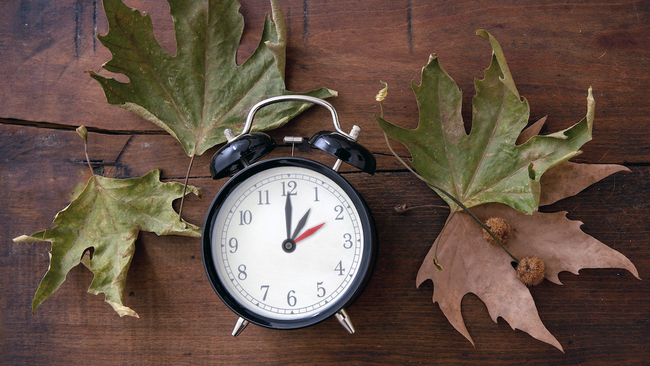




I like that extra hour. The fussing and complaining every time we have to change is getting tiring and old, why not just leave Daylight Saving Time as it is, and it is not Daylight Savings Time, it is Daylight Saving Time. KEEP DAYLIGHT SAVING TIME, PERIOD.
I wish they would pass this bill instead of fooling around and fighting all the time. Daylight Savings should be kept permanent. It would make life so much easier for everyone.
We need to stay in the daylight savings time. Changing twice a year is a pain. We could use the extra light and time.
Why mess with the clocks at all? Why don't people get up earlier or later as it suits them, same with going to bed? Schools can be scheduled to be open during daylight hours, with an allowance for travel, in each particular season. As far as more play time is concerned, since we're no longer an agrarian society, our children have too much time off in the summer anyway that would be better spent on reading, writing and arithmetic. Noon (the 'meridien') is the time when the sun is at its highest point in the sky. Leave it that way.
changing the clocks ruins my sleep pattern I have if I have.... at the moment.
Most people are just Happier coming home to more light, when people are happier they seem less agitated, and less depressed .
Personally I prefer a permanent Daylight Savings Time!
The light is best used end of the day... not everyone gets up early to the point of using the time in the morning... having more light at the end of the day in winter is far more useful for the majority of people. And the whole notion that Standard Time is "right" by some biological sense is goofy... what time of day is what hour is a human notion... the sun doesn't tell us "This is 6am"; some human came up with the definitions and passed it on.
When the clocks change back in the fall it is sad because it is an hour of light lost... for many months it means most of us leave a first shift work day in darkness.
I'm living in Turkey that switched to permanent DST a few years ago. Turkey is located around longitude of 39 degrees (corresponds to a little bit of north of mid USA). During winter children are having hard time waking up and going to school while the sun is not set yet and everywhere is still dark. Also many working class people are facing depression because of going to work while it is still dark like night. It becomes worse in bigger cities like Istanbul or Ankara (consider New York for example).
Yes, children get some outdoors play time in the evening but it is not that useful because going that north, winters start to be really cold for outside play, especially in inner regions. I wonder if that worths waking the children and working people up in the dark.
Another very important point is, in winter while permanent DST allows business owners to save energy while it causes households to consume more energy. Because households need to use their lights when preparing for school or work in the morning. Permanent DST in winter is more like transferring where energy is spent from businesses to households. It is not that energy friendly when you transfer energy consumption of a single business to many households of their works. But it still goods look if you only consider the profitability of businesses, where workers spend more instead of them.
The process of switching clocks forward and back unfortunately still make sense in a number of northern locations in the US. In certain locations further south, not so much. The problem is complicated by the fact that by going by geography some locations in the US (such as Indiana and Michigan which should both be in the Central Time Zone) are in the wrong time zone.
Example where it makes sense: NYC. Its shortest daytimes sees the sun rises at about 7:20 AM and set at roughly 4:30 PM. Its longest daytimes see the sun rise at about 5:30 AM and set at about 8:30 PM. If we use DST year round, the sun would rise at 8:20 AM during the winter. If we use EST year round, the sun will rise at about 4:30 AM. When the US had DST year round in the 70s, a common objection raised was that children were going to school in the dark during the winter.
Examples where changing the time does not makes sense: Dallas. Its shortest daytimes sees the sun rises at about 7:30 AM and set at roughly 5:40 PM. Its longest daytimes see the sun rise at about 6:20 AM and set at about 8:40 PM. If we use DST year round, the sun will rise at about 8:30 AM during the winter. However, if we use CST year round, the sun will rise at about 5:20 AM in the summer and set at about 7:40 PM. Dallas, like most of Arizona is typically very hot in the summer. The temperatures aren't quite as high as most of Arizona but it experiences higher humidity. For states such as Texas and Oklahoma, which experiences these hot summers, staying on CST year-round makes the most sense.
In short, based on geography the practice of changing the clocks forward and back should be kept in certain areas but not others.
Let's stop changing the clocks let's leave to daylight saving time all year round
- « Previous
- 1
- 2
- …
- 10
- Next »
📣The Gardening Club Just Got Better! 3 Deliveries, 10% Store Discount, and more!

Comments