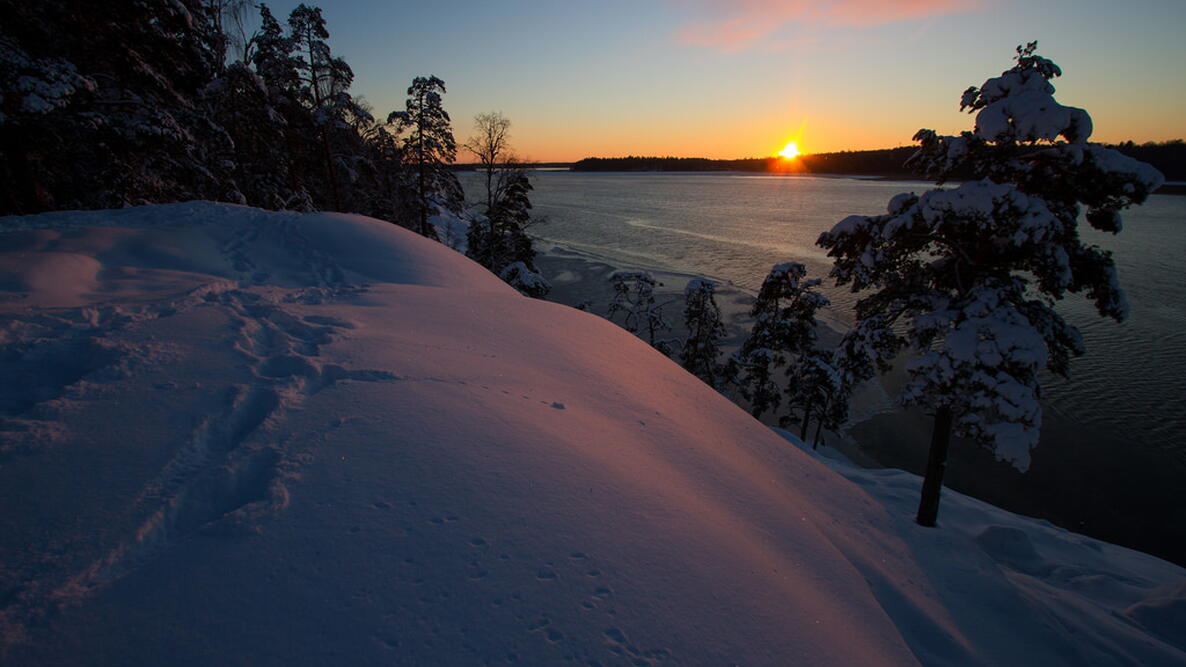
Does it feel darker this time of year? Many folks think it’s darkest on the winter solstice. But it’s actually in early December! Bob Berman explains this phenomenon.
To most of us in North America, this is a dark time of year—and you’re right. The sunsets come exceedingly early. It might surprise you to learn that the earliest sunsets come several weeks before the winter solstice, not on the solstice, as many would guess.
This puzzles people, but it’s actually a reliable yearly sequence.
- First comes the earliest sunset, in early December.
- Then there’s the winter solstice half a month later—on December 21 in the Northern Hemisphere—the day with the fewest minutes of daylight.
- Finally, another 2 weeks later, in early January, we get our murkiest morning—the latest sunrise.
In early December, North America slam-bangs at the low point of afternoon sunshine. And since far more people are awake and aware of things at 4:30 PM than they are at 6 in the morning, in a very real sense, you can forget about the solstice and the official “shortest day of the year” in terms of daylight.
The Darkest Time of Year
So far as what most folks actually experience, early December is the darkest time of the year.
For example, in Boston, the Sun started setting at 4:13 PM on December 3 and won’t start setting later, at 4:14 PM, until December 15.
Of course, the degree of darkness varies, depending on how far north you live. The time the clock reads at sunset also depends on how far east or west your home sits relative to your standard time zone.
- For northern latitudes, the earliest sunsets of the year happen around December 7. Think about 40 degrees latitude, so New York City, Philadelphia, Kansas City, Denver, and Reno.
- If you live in the southernmost U.S., or a comparable latitude (about 25 or 26 degrees N. latitude), your earliest sunsets are actually in late November.
- Drive just an hour east from where you are right now, and the Sun sets 10 minutes earlier. That’s because going east around the Earth’s curve makes your western horizon rise up to block the Sun sooner.
- Go a mere 35 miles east, and the sun sets 5 minutes earlier.
In my region, which is the rural Northeastern US, the very earliest sunsets happen for those who indeed live both north AND east—namely, along the upper coast of Maine.

Your Sunset Time?
Test this out yourself! See when your sun starts setting. Try putting in 2 days ago, and then today, and 1 week from now!
→ See the Almanac’s Sunrise & Sunset Calculator.
Why is the earliest sunset well before the winter solstice?
Simply put, it all reflects the reality that tropical sunsets hardly vary throughout the year, while polar sunsets change wildly through the seasons. If you lived smack on the equator, like in Quito, Ecuador, your minutes of daylight would never budge throughout the year, not even by one second.
By contrast, our northern friends in Canada and Alaska experience the most radically short days in December.
But wherever you live, before the winter solstice starts, the afternoons will start getting brighter!
More Like This


Yes, you've made an excellent point, and it's true. That's why I said "for most of us" -- because virtually all these sky events have latitude-dependent deviations. My favorite happens for our friends in the far north, like in Fairbanks. Here in the lower 48 and Hawaii, the Harvest Moon rises only 20 - 25 minutes later each night for several nights surrounding the September equinox, instead of the normal 50 minutes later the rest of the year. We don't usually mention it, but in the far north the Moon at that time can actually come up EARLIER on successive nights! For most events in our calendar (like the visibility dates for Mercury) I do the calculations based on where the majority of us live, or else I use our headquarters in Dublin, New Hampshire. —Bob Berman
Let's be totally clear: December 8 is not the darkest night. It's the darkest DAY. As we explained, this means that it's the gloomiest afternoon, the earliest sunset. And since far more people are awake and aware at 4:15 PM than at 6 AM, it's the afternoon darkness that gets widely noticed by the most people, and that's the date when you experience that.
For "darkest night" honors I'd pick the winter solstice, December 21, which has the longest night. For maximum darkness, I'd also want the Moon to be absent. Happily, if you're a darkness-fan, like a vampire, an insomniac, or maybe a cat burglar, this year the solstice happens a whole week after the full moon, and on that night the Moon won't even rise until midnight, leaving the first half of the night quite dark indeed! –Bob Berman
- « Previous
- 1
- 2
- …
- 10
- Next »

Comments