Welcome, fall! The autumnal equinox—also called the September equinox or the fall equinox—arrives on Tuesday, September 22. Not only do temperatures drop, but plant life slows down, and so do we. Read about the first day of fall, plus some fun facts and folklore.
When Is the First Day of Fall 2026?
The fall equinox and the first day of autumn arrive on Tuesday, September 22, 2026, at 8:04 P.M. EDT in the Northern Hemisphere. The equinox occurs at the same moment worldwide. Curious what time 8:04 P.M. EDT is where you live? Try our Time Zone Converter.
| Year | Autumnal Equinox (Northern Hemisphere) | Autumnal Equinox (Southern Hemisphere) |
|---|---|---|
| 2026 | Tuesday, September 22 at 8:04 P.M. | Friday, March 20 |
| 2027 | Thursday, September 23 at 2:00 A.M. | Saturday, March 20 |
| 2028 | Friday, September 22 at 7:44 A.M. | Sunday, March 19 |
| 2029 | Saturday, September 22 at 1:37 P.M. | Tuesday, March 20 |
Note: Dates listed above are based on Eastern Time (UTC-5). Due to time zones, the date of the equinox may differ by +/- one calendar day in your location.
What Is the Autumnal Equinox?
The autumnal equinox is an astronomical event that marks the start of autumn (or fall). In the Northern Hemisphere, the autumnal equinox occurs in September; in the Southern Hemisphere, it occurs in March.
What Is an Equinox?
During an equinox, the Sun crosses what we call the “celestial equator”—an imaginary extension of Earth’s equator line into space. The equinox occurs precisely when the Sun’s center passes through this line.
For those in the Northern Hemisphere, when the Sun crosses the equator going from north to south, this marks the autumnal equinox; when it crosses from south to north, this marks the vernal equinox. In the Southern Hemisphere, it’s the reverse.
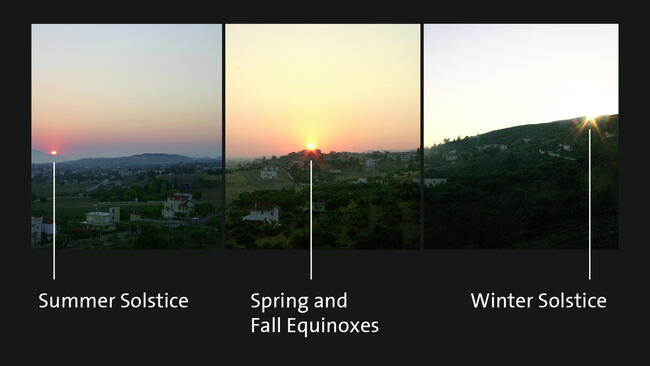
After the autumnal equinox, days become shorter than nights as the Sun continues to rise later and nightfall arrives earlier. This ends with the winter solstice, after which days start to grow longer once again.
The word “equinox” comes from the Latin aequus, meaning “equal,” and nox, “night.” On the equinox, day and night are roughly equal in length. (See more about this below.)

The Harvest Moon and Its Connection to Fall
One of our favorite pieces of trivia surrounding the autumnal equinox involves its relationship with the Full Moon. Curiously, the Full Moon that occurs nearest to the autumnal equinox is always called the Harvest Moon. Why is that?
Surprise, surprise: the name has to do with farming! Around the fall equinox, the Full Moon rises around sunset for several nights in a row, traditionally providing farmers with just enough light to finish their harvests before the killing hard frosts of fall set in.
Typically, the Moon rises about an hour later each night, but around the time of the fall equinox, the angle of the Moon’s orbit and the tilt of the Earth line up just right and cause the Moon to rise only about 20 to 30 minutes later each night for several nights in a row!
An Astronomical Moon Name
The Harvest Moon is one of only two Moon names that are astronomical terms and aren’t tied to one specific month. Because the Full Moon nearest to the equinox is always called the Harvest Moon, either September’s or October’s Full Moon can take on the name. (The other astronomical Moon name is the Hunter’s Moon, which is the Full Moon that directly follows the Harvest Moon. It can occur in either October or November.)

Fall Foliage
Note that fall foliage isn’t due to current weather conditions. This is a common misconception. Leaves change color because of the amount of daylight and photosynthesis. Learn more about autumn leaves.
Signs of Autumn: Nature, Weather, and Traditions
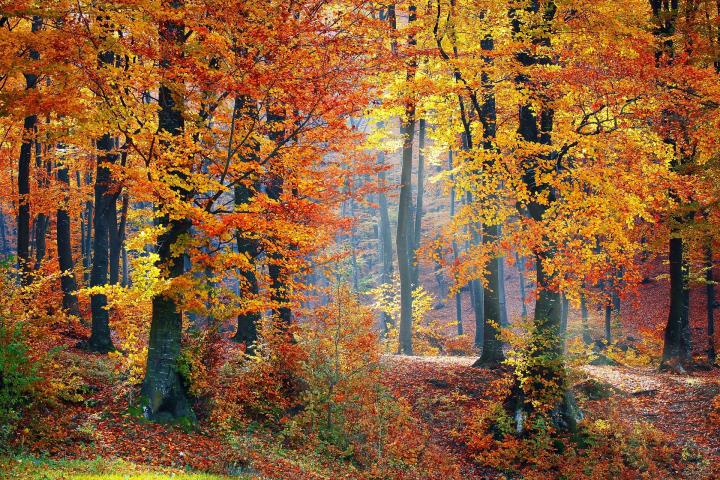
What are your local signs of fall? In many regions of the Northern Hemisphere, the landscape silently explodes with vibrant colors of red, yellow, and orange. The leaves begin to drop off the trees, providing endless hours of jumping into leaf piles for kids—and raking up for parents!
Trees snapping and cracking in the autumn indicate dry weather.
Fall also brings some wonderful holidays, including Halloween and Thanksgiving, which carry us through the season until temperatures begin to drop, nights begin to get longer, and all the woodland critters start storing up for the long haul of winter.
And don’t forget about the end of Daylight Saving Time, when we “fall” back, setting our clocks back 1 hour and regaining an hour of precious sleep!
Plants and trees are slowing down to get ready for the colder season ahead as sunlight decreases. In the garden, asters and chrysanthemums bloom beautifully as orange pumpkins and corn mazes abound.
Football season is warming up, and so is sweater weather.
Also, notice the arc of the Sun across the sky each day as it starts shifting south. Birds and butterflies migrate along the path of our Sun!
Of course, you can easily notice the later dawns and earlier sunsets. See our sunrise/set tool for your area!

Fall Weather
It is the summer’s great last heat,
It is the fall’s first chill: They meet.
–Sarah Morgan Bryan Piatt
Another definition of fall is: nights of below-freezing temperatures combined with days of temperatures below 70°F (21°C). From here on out, the temperatures begin to drop.
→ Find 12 months of long-range weather predictions in the latest edition of The Old Farmer’s Almanac!

Ancient Autumn Equinox Celebrations Around the World
The fall equinox has been a day of celebration for cultures since ancient days, when people tracked the transitions of Earth’s journeys around the Sun.
- At Machu Picchu in Peru, an ancient stone monument called Intihuatana—meaning “Hitching Post of the Sun”—serves as a solar clock to mark the dates of the equinoxes and solstices.
- In Mexico, the Mayans built a giant pyramid called Chichén Itzá. On the equinoxes, the light looks like a snake slithering down the pyramid’s steps.
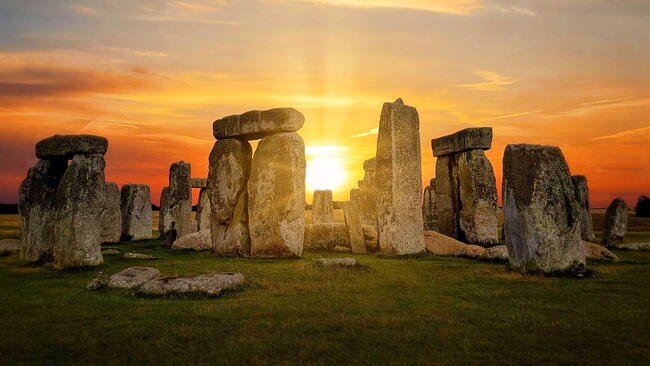
- In England, Stonehenge was also built with the equinoxes and solstices in mind.
See Six Ancient Sites Aligned With the Equinoxes and Solstices.

Enjoy Autumn!
Wishing a colorful, cool, cozy autumn to all our Almanac readers. Tell us your favorite things about the fall season below!
To learn more about all four seasons and see when they begin, see the First Day of Seasons.
Frequently Asked Questions
-
Are Day and Night Perfectly Equal on the Equinox?
Some say that during an equinox, day and night are equal. Well, not exactly. It depends on where you live.
On the equinox, the center of the Sun is indeed above the horizon for 12 hours. However, sunrise is said to begin when the upper edge of the Sun’s disk becomes visible above the horizon (which happens a bit before the center rises) and ends when the entire Sun has set. In this case, daylight is still a bit longer than nighttime.
Not only that, but the Sun is actually visible when it is below the horizon, as Earth’s atmosphere refracts the Sun’s rays and bends them in an arc over the horizon. Yes, you can see the Sun before the edge actually reaches the horizon! This causes daylight to be longer than 12 hours as well.
However, they are very close to equal (the total lengths may differ by only a few minutes).
Did you know our rise/set tool now provides day length? In Dublin, New Hampshire, USA—home of The Old Farmer’s Almanac—our day length on the equinox is 12:08 hours.
See our Sunrise/set calculator for day length in YOUR area.
-
Is the Autumnal Equinox Really the First Day of Fall?
Based on the astronomical definition of seasons, yes, the autumnal equinox does mark the first day of fall. Astronomical seasons are based on the Sun’s position in the sky. According to the meteorological definition of seasons, which is based on temperature cycles and the Gregorian calendar, the first day of fall is usually considered to be September 1 in the Northern Hemisphere (March 1 in the Southern Hemisphere).
-
Can You Balance an Egg on the Equinox?
There’s a bit of folklore that says you can stand an egg on its end on the equinox. Well, yes, it’s true (and fun to try). But it’s possible not only on the equinox. See more about equinox facts from Almanac astronomer Bob Berman.
Sources
- National Weather Service — The Seasons (Equinoxes and Solstices) Page
- NASA — Experience the Equinox

More Like This


The English word "autumn," meaning the season between summer and winter, or the third season of the year, is thought to trace back to the Latin autumnus. However, no one really knows how the Latin word developed. The Oxford English dictionary says the Latin autumnus was also written as auctumnus and is "of doubtful etymology." Several etymology sources mention the word could possibly have come from augeo or auctum, meaning "to increase" or augment. Some say the word may have ultimately come from an Etruscan word. Autumnus may be interpreted as "season of increase."
For one, there will be an lunar eclipse on September 27; for more details, see: http://www.almanac.com/astronomy/eclipse-dates
For astronomical events during the current month, see: http://www.almanac.com/astronomy/skywatch
Also, check the Sky Map and highlights discussion for the current month: http://www.almanac.com/content/sky-maps-star-charts-september-2015
- « Previous
- 1
- 2
- …
- 10
- Next »

Comments