Do you ever look at your beautiful plants and see something fuzzy and gray? It might be gray mold (Botrytis), a common but nasty fungus that can strike your garden when you least expect it. It affects many parts of the plant: leaves, flowers, stems, and fruit. Luckily, with a few simple steps, you can identify, prevent, and treat this fungus before it spreads.
What Is Gray Mold?
Gray mold is a pesky fungal disease caused by the fungus Botrytis cinerea. It’s not picky about its host—this pathogen can go after many different garden plants, from flowers to vegetables. Once it shows up, gray mold spreads fast, riding along on the wind, splashed water, garden tools, or even your hands.
A quick note so the terms don’t get confusing:
The fungus itself is Botrytis cinerea.
The disease we see on plants is called gray mold.
Commonly Affected Plant Parts:
Leaves: Small brown or water-soaked spots that may develop fuzzy gray mold
Flowers: Wilting, browning, or fuzzy coating on petals
Stems: Gray mold can rot stems at the base or nodes
Fruits: Soft spots, rotting, and gray spore growth on tomatoes, strawberries, grapes, and other fruits
Gray mold caused by Botrytis fungus on strawberry fruits. Credit: Floki
Why It Happens:
This develops when plants and their environment create the perfect storm for infection. This pathogen thrives in cool, damp, and stagnant conditions, especially when plants are stressed or damaged.
High humidity keeps leaves and stems moist, which allows fungal spores to germinate and spread.
Poor airflow prevents that moisture from evaporating, leaving a lingering damp layer on foliage and flowers.
Excessive watering—or water that splashes onto leaves—further increases surface moisture and can even spread spores from one plant part to another.
Decaying plant material (fallen leaves, old blossoms, pruned stems) acts as both food and a breeding ground, where the fungus produces more spores ready to infect healthy tissue.
Together, these factors weaken plants and make them vulnerable to infection. Even healthy plants can fall victim if conditions stay wet and stagnant long enough, since Botrytis is an opportunistic fungus that attacks wherever there’s soft, damaged, or aging tissue.
Identification
How Gray Mold Spreads
Early recognition is key to stopping gray mold early. Here’s how it progresses:
Generally, small spots that appear water-soaked will form on the leaves. These might appear white at first.
These spots will then change color from gray to brown, eventually covering most of the leaf. The brown coloration is what often causes people to confuse gray mold with brown mold.
Under really humid conditions, grayish webbing may appear on the leaves. This webbing contains structures that contain fuzzy spores. Spores become active and are released with no activity at all.
Petals, stems, and buds can also become infected.
Eventually, all of the infected parts of the plant will be covered by a fuzzy gray growth.
Symptoms to Watch For
Gray, fuzzy mold on leaves, stems, flowers, or fruit
Wilting, browning, or softening of plant tissue
Rapid spread under cool, humid conditions
Small spots that enlarge quickly if untreated
Tip: Check plants regularly, especially during damp weather or in areas with dense foliage.
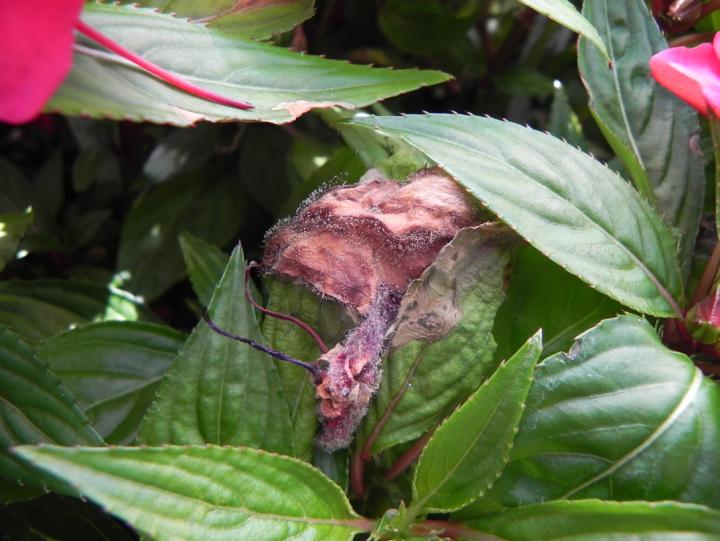
The fuzzy gray spores characteristic of Botrytis infect an impatiens plant. Photo Credit: Francesca Peduto Hand, The Ohio State University.

Control and Prevention
4. Control and Treatment
If gray mold appears, quick action is essential:
Prune Affected Areas: Cut away infected leaves, stems, or flowers using clean tools; dispose of infected material (don’t compost).
Use Fungicidal Treatments: Organic options like copper sprays or neem oil can help—follow instructions carefully.
Improve Airflow and Reduce Humidity: Thin crowded plants and remove excess foliage; avoid overhead watering.
Rotate Crops: Avoid planting susceptible plants in the same location year after year.
Monitor Regularly: Inspect plants daily in damp conditions and treat early.
Extra Tips:
Handle plants when dry to prevent spore spread.
Keep mulch away from stems to avoid moisture buildup.
Clean garden tools regularly to prevent spreading spores.
Companion planting with basil or marigolds may reduce fungal pressure.
Prevention
Stopping gray mold before it starts is the most effective approach:
Space Plants Properly: Ensure good air circulation by avoiding overcrowding.
Water Strategically: Water at the base, not overhead, and do so in the morning to allow leaves to dry.
Remove Debris: Clear fallen leaves, rotting flowers, and decaying fruit promptly.
Frequently Asked Questions (FAQ) About Gray Mold (Botrytis)
Q: Can gray mold kill my plants?
A: It can damage and weaken plants, especially young or stressed ones, but with prompt prevention and treatment, serious damage is usually avoidable.
Q: How can I prevent gray mold in my garden?
A: Ensure good air circulation, water at the base of plants, remove debris promptly, choose resistant varieties, and maintain overall plant health.
Q: What treatments work against gray mold?
A: Organic fungicides like copper sprays or neem oil are effective. Prune infected plant parts, improve airflow, reduce humidity, and monitor plants regularly.
Q: Can I eat fruits affected by gray mold?
A: No, any fruits showing signs of gray mold should be discarded, as the fungus can penetrate deeply and spoil the tissue.
Q: Does gray mold only affect certain plants?
A: Gray mold can infect a wide range of plants, but it’s most common on tomatoes, strawberries, grapes, and roses in home gardens.
While gray mold can be a persistent challenge, early prevention and prompt treatment keep your garden healthy. By monitoring your plants, maintaining airflow, and using simple control measures, you can protect your garden from this common fungus and enjoy thriving plants all season long.
Catherine Boeckmann is the Executive Digital Editor of Almanac.com and a Purdue University Extension Master Gardener. She loves helping readers find practical, trustworthy answers—whether they’re figu...
<a title="View user profile." href="/author/editors">The Editors</a>Mon, 08/08/2016 - 14:13
It appears that the problem might be powdery mildew. To find out how to prevent and control this fungal disease, go to our powdery mildew page.
Reply to comment
<span>Patty Heiney</span>Sun, 07/19/2015 - 19:38
I have a petunia in a hanging pot and I noticed it has black spots on leaves and around small blooms. I don't know if they are bugs of some kind also found a small green worm or maggot on another bloom. Any suggestions on what to put on my plant? Some of my plant leaf ends are a pale light green is this not enough water?
Reply to comment
<a title="View user profile." href="/author/editors">The Editors</a>Wed, 07/22/2015 - 12:10
Black specs might be "frass"...caterpillar poop. You may have a worm eating your plants. Blast the leaves with insecticide spray.
Reply to comment
<span>Amy Kramarsic</span>Sun, 07/19/2015 - 18:04
I have a hydrangea plant has brown leaves and are falling off.We think it may have over watered.Is there any way I can save plant?
Reply to comment
<a title="View user profile." href="/author/editors">The Editors</a>Wed, 07/22/2015 - 12:14
Are the hydrangea leaves turning brown around the edges? Usually, this is a moisture issue. Sometimes, the plant can be root-bound, too.
Gently dig the plants early in the morning to check for both conditions. If needed, lightly loosen the roots with your hand. You can also soak the root ball in water until it's moistened through. Make sure you maintain uniform moisture for your hydrangeas.
Location can also be an issue. If they're getting sun burnt, they'd do better with light shade.
I bought a spider plant all of the leaves are yellow and the tips are black and appear to be bent like an edge.
Could you please help?
Reply to comment
<a title="View user profile." href="/author/editors">The Editors</a>Tue, 03/10/2015 - 10:00
It sounds like your plant may be getting too much sun. Move it to a cooler spot in the house; be sure it is not close to heat vents or on top of the television.
Reply to comment
<span>Twiggs1221</span>Wed, 09/10/2014 - 23:00
I have peonies that seem to have this gray mold on the leaves. It hasn't turned brown or wilted the leaves, but I've noticed that my hydrangea that is next to it doesn't look too good. I have 3 others in my gardens and they all look great still. Could whatever is on the peonies have affected my hydrangea too? Its not as green and lush as it should be and the edges of the leaves look like their browning. I live in zone 7 and my peonies are well passed bloomed. I usually wait til fall to cut the foliage down. Should I have cut that down sooner? And do you think I should move the peony because it is rather close to the hydrangea? When I put the hydrangea there it wasn't as big as it is now.
Reply to comment
<a title="View user profile." href="/author/editors">The Editors</a>Thu, 09/11/2014 - 11:53
It's probably powdery mildew from humid conditions. It isn't pretty but it won't hurt the peony this late in the year. Cut it back in the fall and dispose of the leaves. Make sure your peony has good air circulation next year. It may be a good idea to move it away from the hydrangea. Go to our peony page for more information. www.almanac.com/plant/peonies
Reply to comment
<span>Sande Sanders</span>Sat, 07/26/2014 - 01:01
I have a question about my garden and I think it is probably related to this article about gray mold. I recently moved to a northern California coastal town. Long growing season, very temperate climate. I'm living in my RV and am surrounded by asphalt, so I container garden, allot. I'm trying to keep the pots wet enough so that the plants don't wilt from the heat, but its humid here.
My sage plants turn yellow and get brown spots. My squash gets spots, turn brown and die. The gray webbing takes over. yuck,but the plant keeps trying. I have tomatoes near the squash, one looks like it rotted from too much water, but I don't water until the top few inches are dry. That's every other day here.
Any suggestions? I thought the plants were getting sunburned, maybe that's the damaged entry point for the gray mold. Some one suggested shade cloth. But doesn't that seem weird with tomatoes?
It appears that the problem might be powdery mildew. To find out how to prevent and control this fungal disease, go to our powdery mildew page.