Primary Image
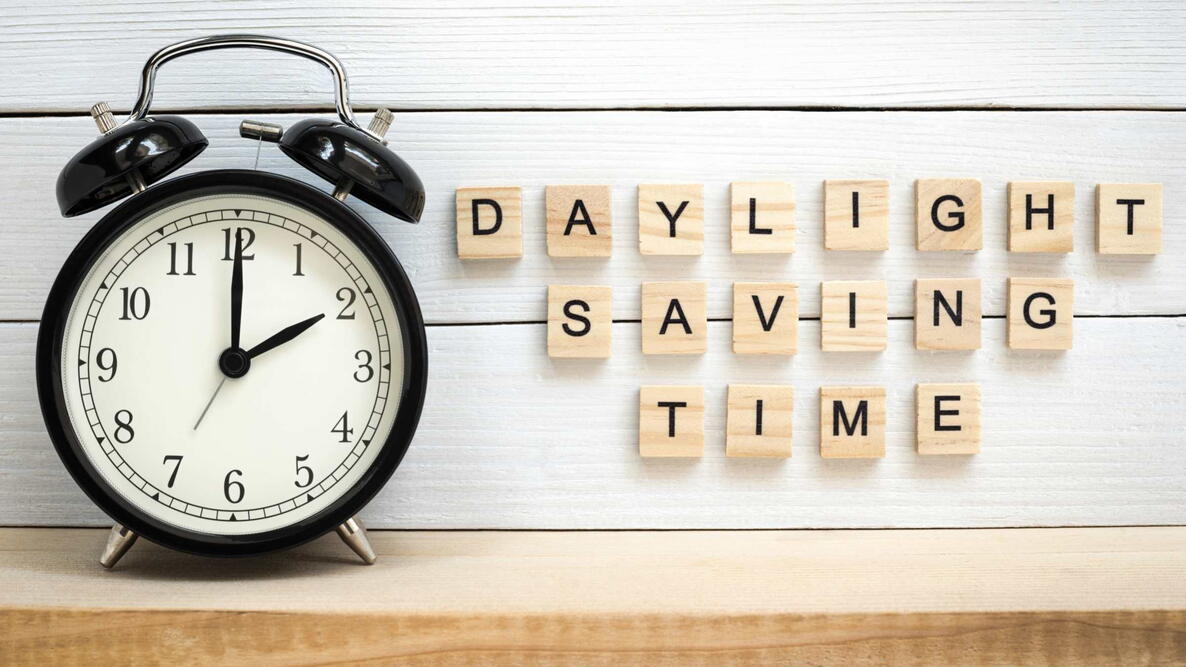
Image Credit:
SIAATH/Shutterstock
Frequently Asked Questions
-
Do we gain or lose an hour during Daylight Saving Time?
When Daylight Saving Time starts in spring, we set the clocks forward and lose an hour. When it ends in fall, we set the clocks back and gain an hour. -
What time do the clocks change?
Clocks change at 2:00 A.M. local time in most of the United States, a time when few people are working, traveling, or doing business. -
Will my phone change automatically for Daylight Saving Time?
Most smartphones, computers, and other devices that are connected to the internet update themselves if you have them set to update date, time, and time zone automatically.You might still need to change the time by hand on things like appliances, cars, or wall clocks. -
Does Canada change clocks on the same day as the United States?
Some parts of Canada still change their clocks on the same schedule as the United States. However, provinces and territories set their own time rules, and several of them stopped changing clocks in 2026.
British Columbia, Alberta, Manitoba, and the Northwest Territories will not turn their clocks back on November 1, 2026. Yukon and Saskatchewan also use one time year-round.
Other parts of Canada, including most of Ontario and Quebec and the Atlantic provinces, continue to observe seasonal time changes.
Sources
- U.S. Navy Office — Daylight Saving Time
- U.S. Department of Transportation — Daylight Saving Time
- U.S. Library of Congress — Daylight Saving Time (DST)
- U.S. Department of Transportation — Uniform Time
- National Institute of Standards and Technology (NIST) — Daylight Saving Time Rules

More Like This



I like DST ...as you get more sunshine after working hours...i wish they kept it thru winter. A lot of people get mild to moderatle de pression from fewer light hours in winter. Life is not so hard to change a clock. twicw a year now.
it can only work when the northern hemisphere is closest to the sun. If it stayed the same year round our sunlight would be early in the morning before anybody was out of bed.
If you want to go by sun time, then eliminate time zones which do not follow the sun. That would mean that correct time would change whenever you moved to a new place other than true north or south of where you started. But you would still change time in respect to day or night which changes whenever you travel north or south. You would also have the seasons changing as you went north or south. I think I will keep the present system.
There is no different season for north south east west. An far as time zones r u eduacated. Any were in the us when the sun sets directlt above ur head it is noon apparently uv growed up with modern civilization which i grew up living with lat 1800 early 1900. North south east west different seasons my god man no matter were u r. Fall will arrive all over watcj the trees animals grass insects or ur not from a place u have to know it to survive
If you travel from New York City to Sydney Australia in December you will go from winter to summer. From freezing temperatures to upper 90s and maybe even 100s. You obviously have no clue how seasons and hemispheres work. Go back to school and leave the conversation to tje adults.
Standard or DS time, the system we use of 24 hours of equal length is from Babylon and nothing good ever came from Babylon...
The Jewish system divided the day by the position of the sun, hence mid-day always being when the sun is overhead and midnight halfway through the night. Sunset began the day and ended it. This is the pattern of nature, and of God, if you will...
Such a pattern, implemented today would give shortened hours during the winter, and longer hours during the summer, with daytime and nighttime hours most nearly equal at the equinoxes, but work times proportional to the days length, year round. The effect would be to have longer work days in the summer and shorter in the winter; this is cow-time...
With modern electronics, clocks could be made to accurately make the constant changes, or eliminated in favor of the sun-dial... For scientific purposes the ideal second could be retained for precision measurement, but that kind of precision doesn't really fit our life rhythms; that's why we are so screwed up, forced into cycles that are unnatural, Babylonian.
I expect that near 100% will object to the implementation of this system, but it is essentially the system we will all revert to, if ever the SHTF.
I understand and appreciate all of the arguments against DST, but I like it. I can't sleep well after sun rise, and though retired now, I used to enjoy the extra daylight after work to get outside. For those people with 9to5 jobs, extra daylight after work for outside sports activities is a big deal.
Back in the 70's, Richard Nixon kept the nation, as I remember, on DST all year. The main complaint was that children were forced to wait for the morning bus in the dark, which was believed to be not as safe. We went back to ST during the winter.
NO, I don't like DST. An unnecessary inconvenience.
Since daylight saving time is roughly 7 to 8 months long, hasn't it become the new "standard" time? And why aren't the start and stop times equi-distant from the solstice? We change the clocks 6 to 7 weeks before the winter solstice but don't change them back until 10 to 11 weeks after the winter solstice. Maybe we should just split the difference by changing the clocks a half hour and be done with it.
I think it's useless. It does not change the amount of daylight or dark.
- « Previous
- 1
- 2
- …
- 10
- Next »
📣The Gardening Club Just Got Better! 3 Deliveries, 10% Store Discount, and more!

Comments