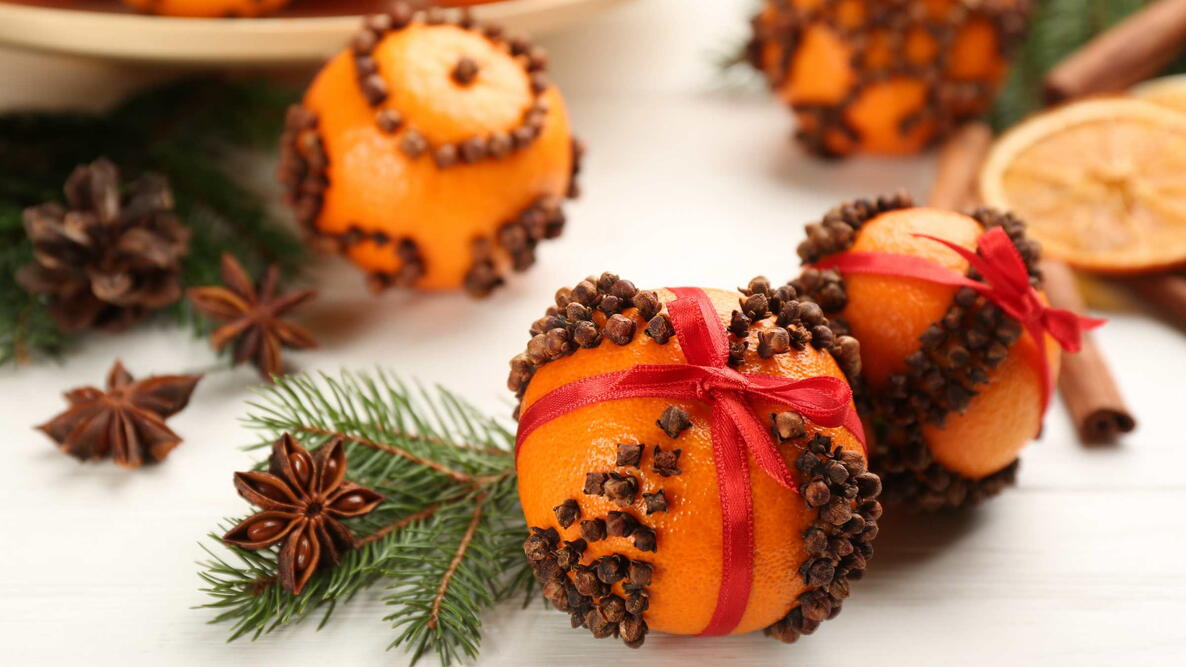
Here’s how to make pomander balls, which are oranges pierced by cloves. As the fruit dries, it releases a lovely fragrance. Orange pomanders make beautiful Christmas gifts, ornaments, and air fresheners.
Pomander Ball History
Medieval herbalists used pomanders—mixtures of fragrant, dried herbs in cloth bags or perforated boxes—to ward off illness or bring strength and good fortune.
The term pomander comes from the French phrase pomme d’ambren, which translates to “apple of amber.” This is because of the object’s round shape and the addition of ambergris, an aged substance from the bile duct of a sperm whale that is sometimes included. During the Black Death in Europe, people used highly fragrant pomanders of ambergris to try to mask and purify the bad air, but this proved ineffective.
Nowadays, pomander balls are simpler—usually an orange (such as a navel orange or a blood orange) or other citrus fruit studded with cloves and dusted with spices. See our recipe below!
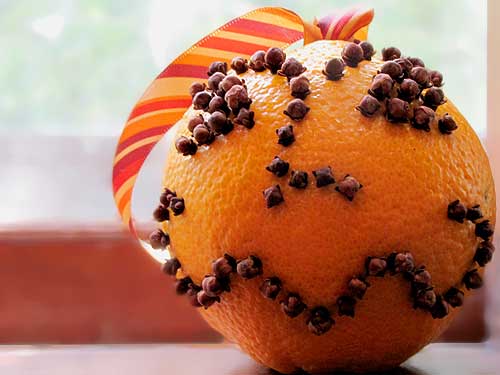
How to Make Orange Pomander Balls
- Take firm oranges and stud them with whole cloves. That’s it!
- You can use a toothpick to create premade holes, which is helpful for children as poking holes with cloves can be painful for their little hands (and ours).
- Be creative and arrange the cloves in diamonds, circles, or other patterns. As the orange dries, it will release a delicate, spicy fragrance.
- For a more robust aroma, cover the entire orange with cloves and then roll it in a mixture of spices. Leave the orange in the mix for a week, turning once daily. We recommend using spices such as:
- 1 teaspoon ground cinnamon
- 1 teaspoon ground cloves
- 1 tablespoon ground nutmeg
- 1 tablespoon allspice
- 1/4 cup powdered orris root
- To hang your pomander, run a long wire through the orange; make a knot at the bottom and a loop at the top for hanging. Or you can tie a red ribbon around your pomander for a festive look!
How to Make Pomanders Last
To make your pomanders last, store them in a paper bag for a few weeks. Use a lot of cloves, which are a natural preserving agent. The cloves will draw out the juices and shrink in size. Dusting with cinnamon helps, too, as cinnamon functions as an antifungal.
Ideas for Using Orange Pomanders
- Arrange the cloves in unique shapes and patterns. For Halloween, make a jack-o’-lantern; for Thanksgiving, try a turkey; for Christmas, a tree!
- Create a centerpiece for your next holiday meal.
- Give to friends, teachers, and neighbors in a plastic bag with a red ribbon!
- Try putting an orange pomander at the bottom of your Christmas stockings.
- Use small oranges (or other small citrus) to create a fragrant ornament for the Christmas tree.
- Once dried, hang pomanders in your closet or add to your bureau drawers like a sachet.
If you have cinnamon left, try making these Cinnamon Ornaments.
Want more fresh scents in your home? Check out our Old Rose and Lavender Potpourri or learn How to Make Lavender Sachets. See all of our Seasonal Crafts!
Let us know how your pomanders turn out!



Comments