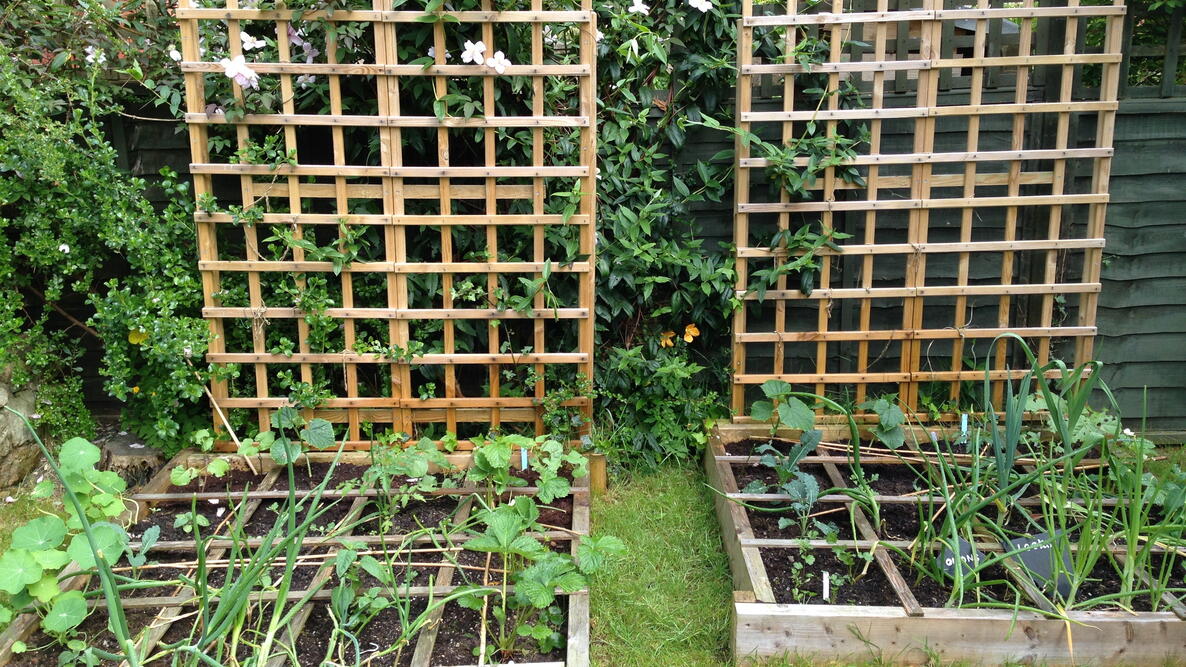
Learn the basics of planning a square-foot garden (SFG). Grow more in less space by densely planting in squares. Find out the pros and cons, whether square-foot gardening really works, the ideal size and depth that a square-foot garden should be, and more tips. Plus, discover six SFG garden plans to reference.
What Is Square-Foot Gardening?
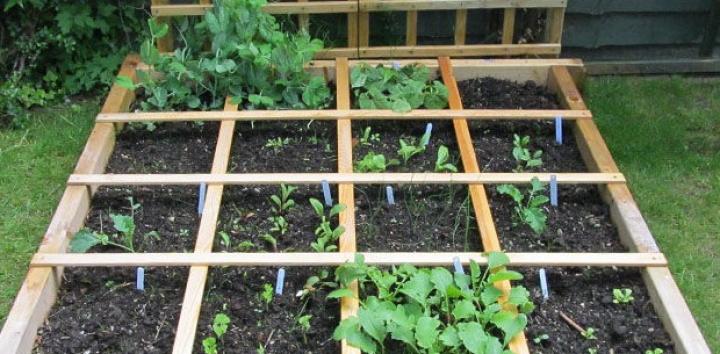
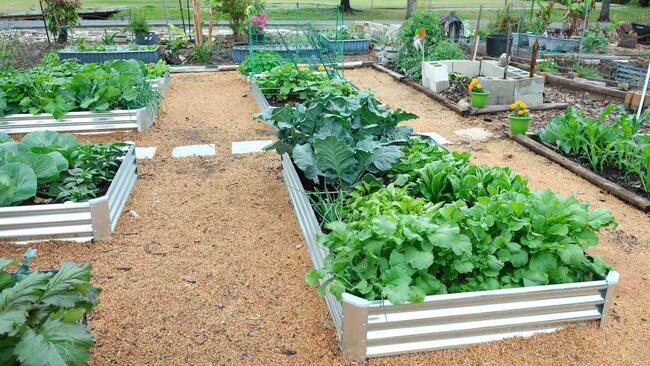
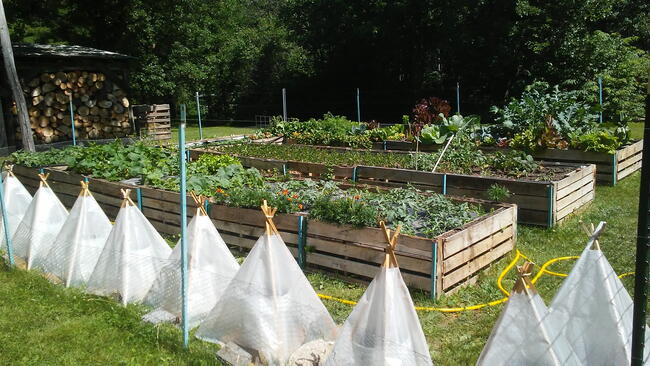
Square-foot gardening (SFG) is a type of raised-bed gardening—basically, a raised box divided into squares. With the square-foot gardening method, you plant in 4x4-foot blocks instead of traditional rows. Different crops are planted in different blocks according to their size; for example, 16 radishes in one square foot, or just one cabbage per square foot. A lattice is laid across the top to separate each square foot.
How Does Square-Foot Gardening Work?
This planting method was developed by American author and TV presenter Mel Bartholomew in the 1970s. It’s a simple way to create easy-to-manage gardens with raised beds that need minimal maintenance time. SFG advocates claim it produces more, uses less soil and water, and takes much less time to maintain than a traditional garden.
Mel Bartholomew had just retired as an engineer and decided to take up gardening as a hobby. It was only natural that he would apply his analytical skills to the problems he encountered. In particular, he found the average gardener was spending hours weeding the big gaps between long rows of plants, creating unnecessary work for themselves. It soon became clear that getting rid of rows and using intensive deep beds could dramatically cut the amount of maintenance the garden required. Add a one-foot square grid on top, making it easy to space and rotate crops.
Square-Foot Garden Size and Layout
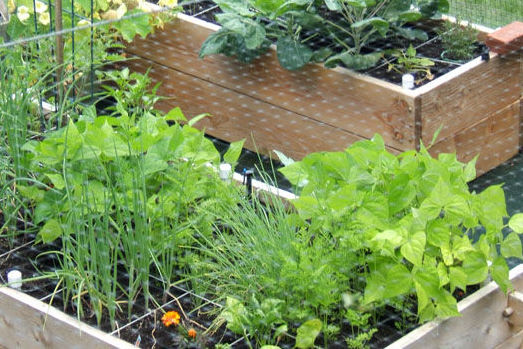
- Typically, SFG beds are at least 4 feet by 4 feet, with a square-foot lattice placed on top to visually separate the crops. That said, the beds can be 2x2 feet or 4x12 feet, but the most common size is 4x4 feet. This allows plants to be placed closer together.
- To keep the planting simple, there are no plant spacings to remember. Instead, each square has either 1, 4, 9, or 16 plants in it, depending on the size of the plant—easy to position in each square by making a smaller grid in the soil with your fingers. As an exception to this, there are a few larger plants that span two squares. Climbing peas and beans are planted in two mini-rows of 4 per square.
How Deep Should a Square-Foot Garden Be?
Beds should be deep—between 6 and 12 inches in depth—to give plants plenty of rich nutrients while still maintaining good drainage.
Square-Foot Gardening Spacing Guide
One of the biggest advantages of square-foot gardening is how simple plant spacing becomes. Instead of measuring rows and guessing distances, each square is divided based on how many plants can comfortably grow within one square foot.
In general, plants are spaced using a simple rule: 1, 4, 9, or 16 plants per square, depending on their size. Larger plants need more room, while smaller crops can be planted more densely. This method not only saves space but also helps reduce weeds and maximize your harvest.
| Plants per Square | Spacing Pattern | Example Crops |
|---|---|---|
| 1 per square | 1 plant in center | Broccoli, cabbage, peppers, tomatoes (1 per square with support) |
| 4 per square | 2 × 2 grid | Lettuce, basil, Swiss chard, marigolds |
| 9 per square | 3 × 3 grid | Beets, spinach, bush beans, garlic |
| 16 per square | 4 × 4 grid | Radishes, carrots, onions |
Quick Tip 🌱: To make spacing easy, lightly press a grid into the soil with your fingers before planting. This helps keep your layout neat and ensures each plant has enough room to grow.
Tips for Success with Square-Foot Gardening
- A specific soil mix, which is water-retentive and nutrient-rich, is used to fill the beds. This provides a weed-free start as well as being water-retentive and full of nutrients. The rich soil enables plants to be grown much more closely than normal, which in turn crowds out weeds.
- Thin with Scissors: Instead of pulling up excess plants (which can disturb the root systems of the plants you want to grow), snip them off with scissors.
- Never walk on the soil in the bed, as this will only compact the soil. Back in the 1970s, this was a revolutionary idea!

Pros and Cons of Square-Foot Gardening
Pros of Square-Foot Gardening
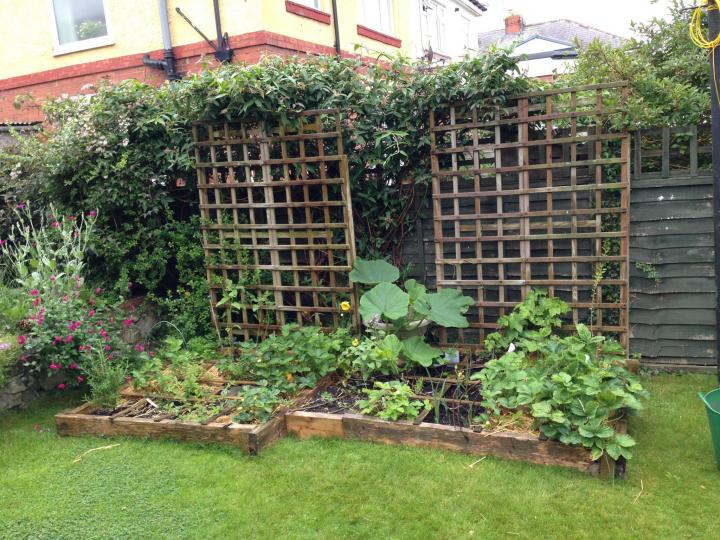
The “pros” for SFG are primarily ease and simplicity. SFG is a great method for new gardeners, people who have little time, the elderly or disabled (SFG gardens can be built at a raised height to make them more accessible), and children. Many schools have embraced the SFG method because it’s easy to install and maintain without becoming an additional burden for the teacher.
Cons of Square-Foot Gardening
- Although many vegetables can be grown in SFG gardens, they struggle to accommodate larger plants (squash, melons, main-crop potatoes, etc.), perennials (globe artichokes, rhubarb), and fruit bushes/trees. Once new gardeners experience the success of SFG gardens, they often want to expand the range of crops they grow beyond the standard SFG crops.
- Originally, a soil mixture of peat moss, vermiculite, and compost (“Mel’s Mix”) was recommended in SFG. While this makes excellent soil for vegetables, two of the three ingredients come from non-renewable sources. Peat takes thousands of years to develop and is a valuable natural sink for greenhouse gases. Vermiculite is mined and is therefore also a non-renewable resource with a significant carbon footprint. In common with many gardeners, we have moved toward using coconut coir instead of peat or vermiculite.
- The specific soil mix and raised beds can be more expensive to set up than alternative methods, even though SFG is easier to maintain.
None of these reasons prevents SFG from being a useful part of a garden, though! You can use 100% recycled compost in the beds instead of Mel’s Mix, gradually build up the number of SFG beds, and combine it with areas of your garden which are set aside for fruit trees and larger crops. Many of the SFG techniques that were revolutionary in the 1980s are now commonly used for vegetable gardening: deep raised beds, not compacting soil, removable covers and plant supports, etc.
Square-Foot Gardening vs. Traditional Gardening
If you’re deciding between square-foot gardening and traditional row gardening, it helps to understand how the two methods compare. While both can produce healthy crops, they differ in space usage, maintenance, cost, and overall efficiency.
Square-foot gardening is designed for simplicity and maximum yield in small spaces, while traditional gardening works well for larger areas and crops that need room to spread. The right choice depends on your space, time, and gardening goals.
| Feature | Square-Foot Gardening | Traditional Gardening |
|---|---|---|
| Layout | Raised beds divided into 1-ft squares | Long rows in the ground |
| Space Efficiency | High (ideal for small spaces) | Lower (requires more land) |
| Plant Spacing | Structured (1, 4, 9, 16 per square) | Measured in rows and inches |
| Weeding | Minimal due to dense planting | More frequent weeding required |
| Water Usage | Efficient and targeted | Can require more water |
| Soil Type | Custom soil mix in raised beds | Depends on native soil quality |
| Setup Cost | Higher upfront (beds + soil) | Lower initial cost |
| Maintenance Time | Low | Moderate to high |
| Crop Variety | Best for small/medium plants | Better for large or sprawling crops |
| Accessibility | Easier (raised beds, less bending) | Harder (ground-level work) |
| Best For | Beginners, small spaces, urban gardens | Large gardens, farming, bulk crops |
Does Square-Foot Gardening Really Work?
Yes, square-foot gardening works for those who have limited space because it allows plants to be situated more closely together. Also, we have definitely found that there is less weeding. If you don’t have a lot of time available to weed, water, and maintain your vegetable garden, then square-foot gardening could be the answer. Finally, SFG has the benefits of all raised beds in that the soil warms more quickly for earlier planting and harvest.
However, there are limitations in what you can grow. As said above, plants that need more space such as corn, potatoes, watermelon, and pumpkins do not fare as well in boxes.
Square-foot gardening was revolutionary when it was first invented, and it’s still a great system for people who are starting out, have limited space, or want a highly organized method to follow. However, you don’t need to follow SFG to benefit from gardening with raised beds and good organization. There’s a great quote: “If the only tool you have is a hammer, you tend to see every problem as a nail.”
SFG works really well for many situations, but it doesn’t fit everything. The success it brings can often lead people on to discovering the delights of fruit trees, using barrels to grow huge crops of potatoes, or managing a greenhouse full of high-value crops. It’s a great stepping stone to the world of growing your own food, and that’s why it’s still going strong 35 years later!

Video: See How to Set Up Your Square-Foot Garden
In this video, we introduce the thinking behind square-foot gardening and explain everything you need to know to set up your own SFG garden beds, including the best soil mix, plant spacing, positioning, companion planting, and supporting structures to use.
Square-Foot Garden Plans (With Examples)
All of the SFG garden plans below were shared by Almanac readers!
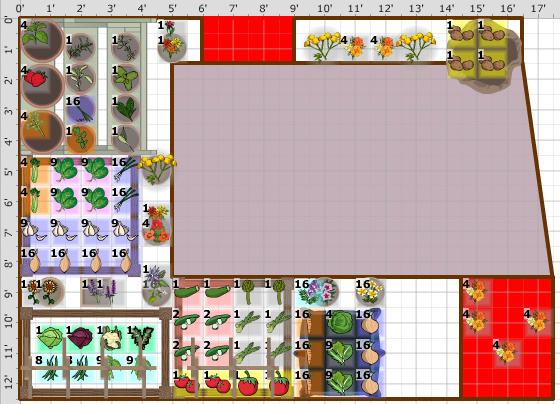
1. Square-Foot Garden for an Apartment
“I live in a small apartment in the city but have a nice-sized patio and wanted to take advantage of my space. This application helped me do it! My patio is outlined because it’s a little bit funny-shaped, but everything within the brown lines fits! The small red area is my back door, and the larger red area is a shrub that I can’t do much with.”
Garden Size: 18’ 7” x 15’ 11”
Garden Location: La Crosse, Wisconsin
Sun or Shade: Partial Shade
Garden Soil Type: Poor Soil
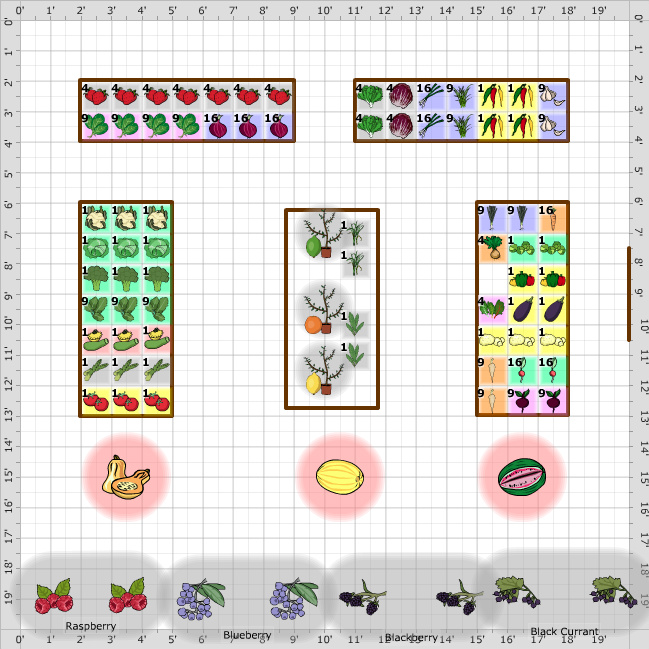
2. Square-Foot Garden for a Home Garden
“This is my ‘chef’s garden’ with lots of different veggies and fruit that we like to eat.”
Garden Size: 19’ 11” x 19’ 11”
Garden Location: Denver, Colorado
Sun or Shade: Partial Shade
Garden Soil Type: Good Soil
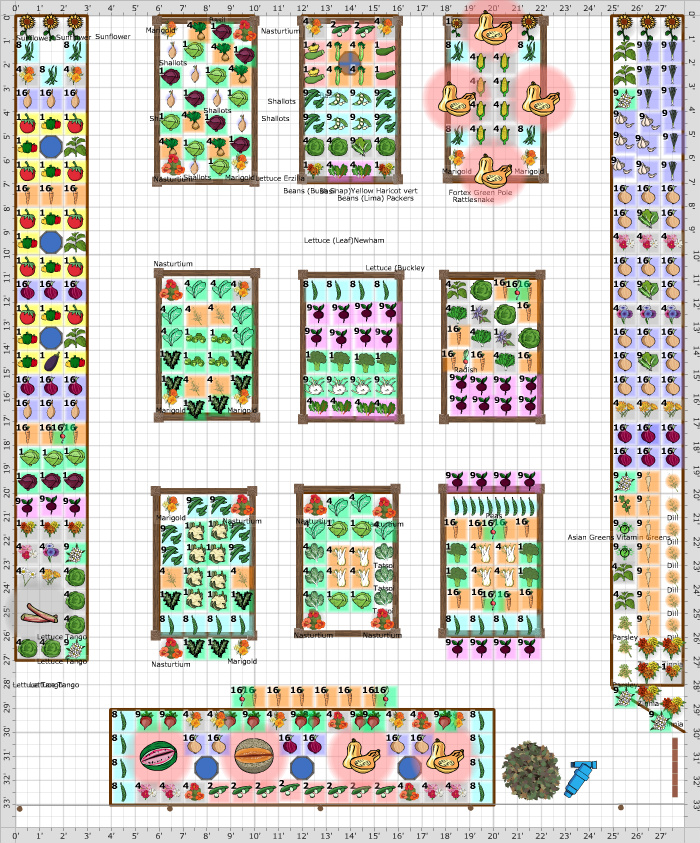
3. Large-Scale SFG Garden
“These are raised-bed gardens with an emphasis on companion planting with the new tool. Soil is so-so, but manure and compost and lime helped and I will add more this year. Wondering about the problem of rotating crops next year, but I hope the benefit of attracting beneficials will override that. I’ve got a three sisters garden (corn, beans, and squash) and onions planted everywhere to help ward off pests. There are all the flowers that attract beneficials that I could fit in. I think it will take a lot of time to plant—but I am looking forward to it! Using the plant list now to organize my seed starts—onions and leeks and shallots are up and waving! I have notes on seed starting on my plant list page. NOTE: Since I wrote this I have made changes due to the groundhog, primarily putting all the onion family and many herbs/flowers where he came in last year.”
Garden Size: 27’ 11” x 33’ 11”
Garden Location: Georgetown, MA 30x30 Town Garden Plot
Sun or Shade: Sunny
Garden Soil Type: So-So Soil
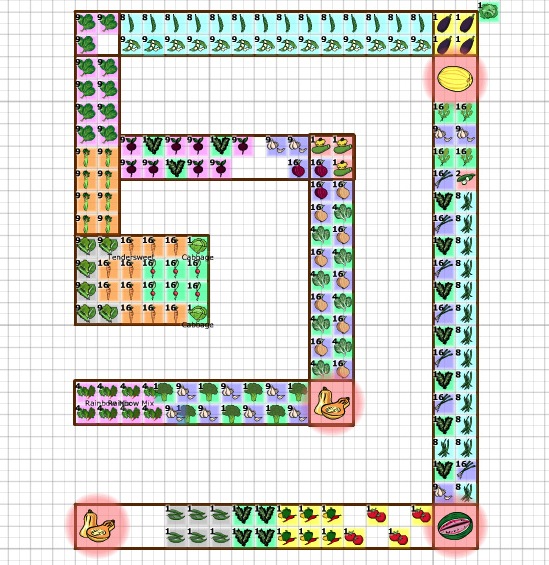
4. Square-Foot Garden Plan for Home Garden
“Organic garden planted in raised beds made using 4-foot fence wire (bent with 1-foot sides and a 2-foot bottom), lined with landscape cloth, then filled with soil made up of Black Gold (a special mix from a Nashville nursery), worm compost, peat moss, coir, several different composts, mushroom compost, and rock dust.”
Garden Size: 29’ 11” x 39’ 11”
Garden Location: Jamestown, TN
Sun or Shade: Partial Shade
Garden Soil Type: Good soil
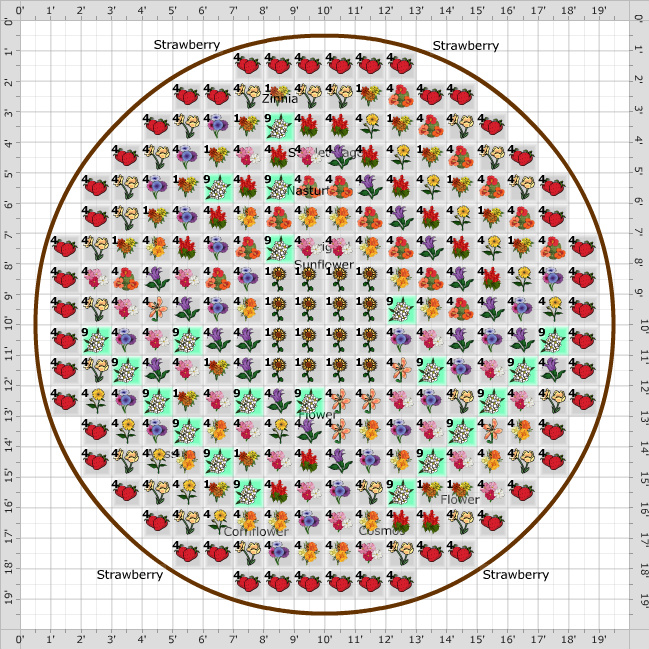
5. Square-Foot Garden for a Front Yard
“Our front focal point garden will have a ring of strawberries and is planned to grow in a “cone” shape to tall sunflowers at the center.”
Garden Size: 19’ 11” x 19’ 11”
Garden Location: Indianapolis, IN
Sun or Shade: Partial Shade
Garden Soil Type: Good soil
6. Square-Foot Garden for a Front Yard
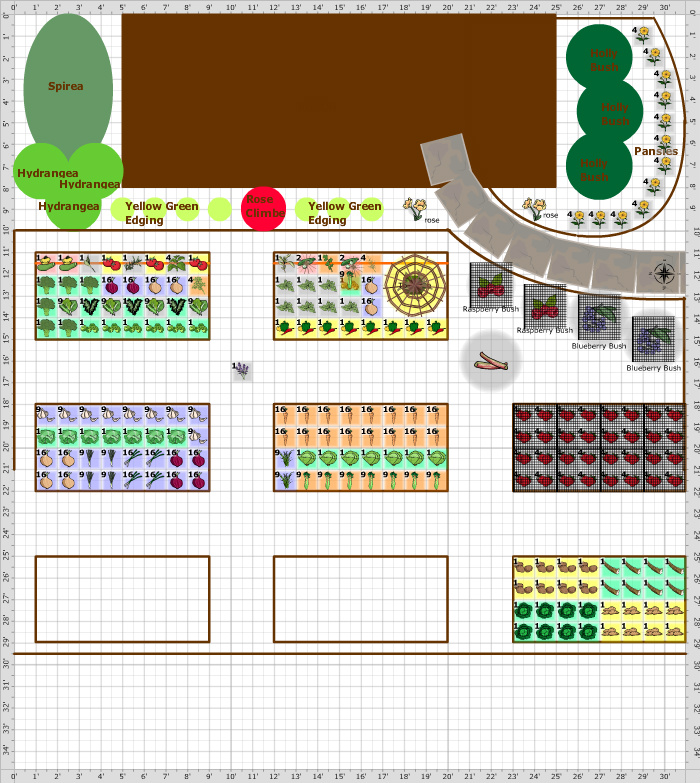
“Organic Vegetable Garden—Some traditional left but moving toward all square foot garden. Heavy clay soil amended for 3 years with horse manure, leaf humus, household compost, sand, wood chips, and fish and organic fertilizer (includes chicken manure and minerals). Soil in square foot gardens according to Mel’s mix.”
Garden Size: 30’ 11” x 34’ 9”
Garden Location: Cleveland, Ohio near Lake Erie
Sun or Shade: Sunny
Garden Soil Type: Good soil, organic
See full plant list and more details about this garden here.
Looking for more garden plans? See layouts for other types of gardens.
Square-Foot Garden Planner
Best of all is that the SFG plants can be part of a larger garden plan that includes more traditional planting layouts and large plants, so there’s the flexibility to combine different methods in a plan for a single garden area.
If you need help designing your vegetable garden, try our Vegetable Garden Planner. We’re offering a free 7-day trial—ample time to play around and plan your first garden! We hope this software works for you.

More Like This
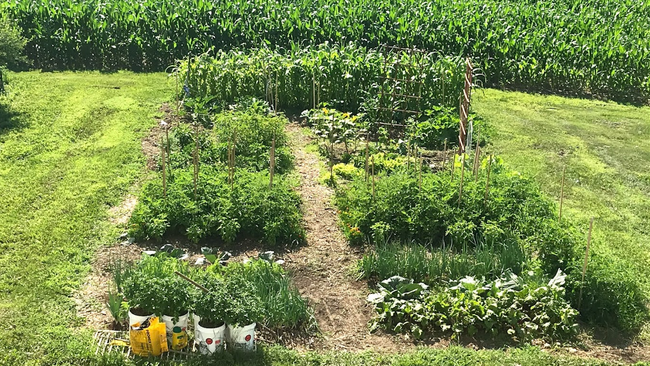

This is an ambitious plan! We salute you! With the understanding that every garden, even for the most experieced among us, we think that a lot of it will work. One consideration: Corn is best pollinated in multiple rows, or blocks. You may not have adequate depth/number of rows to prouce ears. Your beans might be crowded in the space allowed. Crowded plants are not as prolific/heavy producers. The rest sounds feasible. And by "back" row, you mean the north end, correct? We wish you luck! Let us know how it goes.
Consider that your soil is your groundwork, literally. So you want the dirt to be the best it can be—rich in compost, of suitabe pH (depending on the plants you plan to grow), not too sandy (or water and nutrients will run out), not too hard/clay-y (or it will not have the nutrients to support life—never mind that the roots might not break through it).
So...you know best what your current soil is, what grew there before, what you want to grow. You can amend the existing soil—add aged cow or horse manure and compost and mix it up. But consider that you might want to remove some of the existing "bad" soil to make room for this new stuff.
So, to your question: dig it ALL out?! Only you can really tell. Some, probably... Think of it this way: don't set yourself up for the possibility that in six months you'll wish you did something differently. Make it a great garden year from the ground up...now.
Best wishes! Let us know how it grows!

Comments