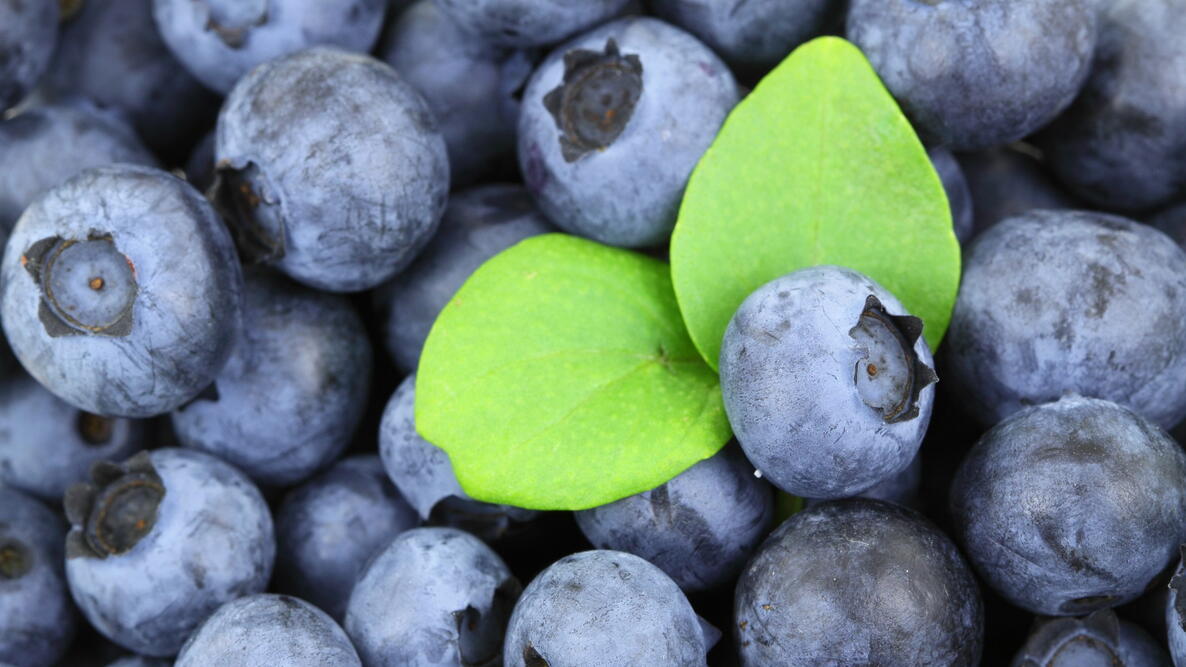
Caption
Blueberries are one of the easiest fruits to grow.
Planting
When to Plant Blueberry Bushes
- Blueberries can be planted in spring—or also in late fall in all but the coldest regions. In Zones 5 and below, it’s best to wait until early to mid-spring to plant.
- If available, 1- to 3-year-old plants are a good choice. These can be bought in containers or bare-root. In either case, buy from a reputable nursery or website.
Choosing and Preparing a Planting Site
- Select a sunny, sheltered spot. While blueberries tolerate shade, better crops are obtained in the sun. At the same time, they should not be exposed to harsh, drying winds.
- Don’t plant blueberries too close to trees, as the trees will block out sunlight and suck up any moisture in the soil.
- If planting multiple bushes, it’s best to plant them in a group rather than scattered throughout your garden. This will bolster berry production and quality.
- Blueberries are a shallow-rooted plant. Therefore, they require soil that holds moisture but also drains well and doesn’t stay wet. Don’t plant blueberries in sites with heavy, clayey soils that stay wet.
- Blueberries thrive in soil that is acidic. The soil pH should ideally be between 4.0 and 5.0; soil that isn’t acidic enough will stunt growth. Soil can be acidified by mixing a small amount of granulated sulfur into the soil several months before planting. Peat moss and pine bark or pine needles are also good additions that will help acidify your soil.
- Mix organic matter into the soil before you set your blueberry bushes. (See more about preparing soil for planting.)

How to Plant Blueberry Bushes
- Tip: Be careful not to plant them too deep. The root ball should be just below the surface (¼ to ½ inch).
- Dig holes about 20 inches deep and 18 inches wide (or about twice as wide and twice as deep as the plant’s roots).
- Space bushes 4–5 feet apart in a row, with at least 8 feet between rows. Prepare a planting mixture of 2 parts loam and 1 part oak leaf mold, peat moss, aged sawdust, or compost, and place a layer of this mixture in the bottom of the hole.
- Set the bush in the hole with the root ball just below the surface with its roots spread out. Pack the hole tightly with the soil.
- Apply fertilizer 1 month after planting, not at the time of planting. Apply ½ ounce of a 10-10-10 fertilizer in a band around the plant 6 to 12 inches from the crown.
Harvesting
Warning: Blueberries are a favorite snack of hungry birds, so it’s recommended that you protect blueberry bushes ahead of time by draping bird netting over your plants.
How to Harvest Blueberries
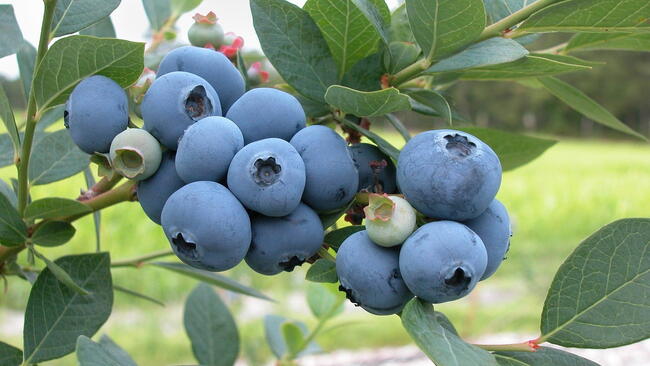
- Blueberries are typically ready for picking between June and August.
- Don’t rush to pick the berries as soon as they turn blue. Wait a couple of days. When they are ready, they should fall off right into your hand.
- If you plant 2-year-old blueberry bushes, they should start to bear within a year or two. (Pick off any flowers that form the first year or two after planting to allow the bush to become established.) Be aware that full production is only reached after about 6 years (depending on variety).
How to Store Blueberries
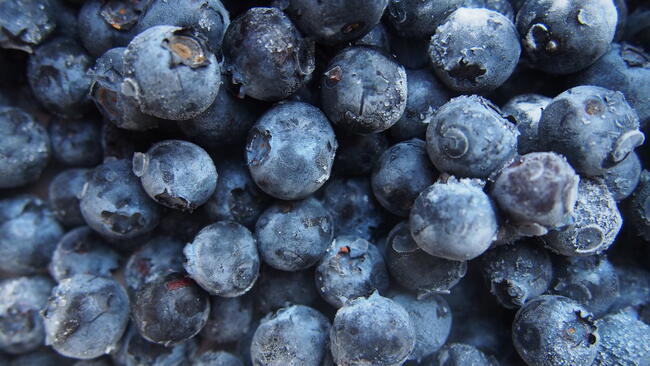
- Blueberries are one of the easiest fruits to freeze. Learn how to freeze blueberries so you can have them all winter long.

Types
There are four types of blueberries: highbush, lowbush, hybrid half-high, and rabbiteye.
The most commonly planted blueberry is the highbush. Most blueberry breeding has focused on this species, so there are many varieties that range widely with regard to cold hardiness and fruit season, size, and flavor.

Blueberries are partially self-fertile, so you will harvest more and larger berries by planting two or more varieties together. Planting more than one variety can also extend the harvest season.

More Like This
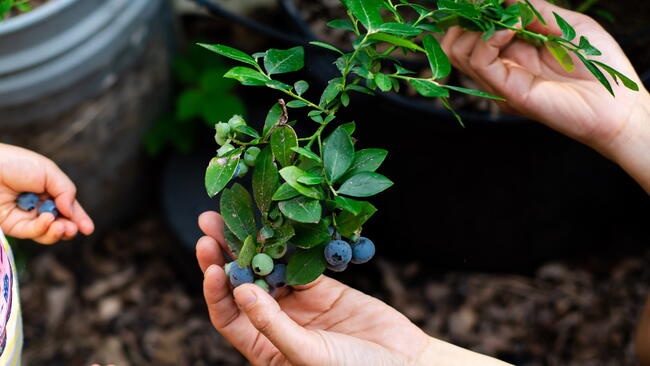
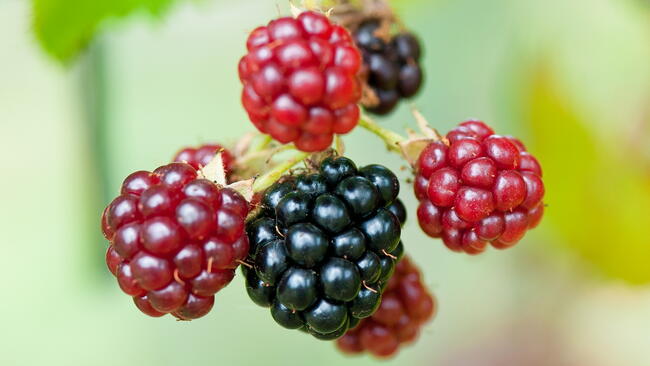
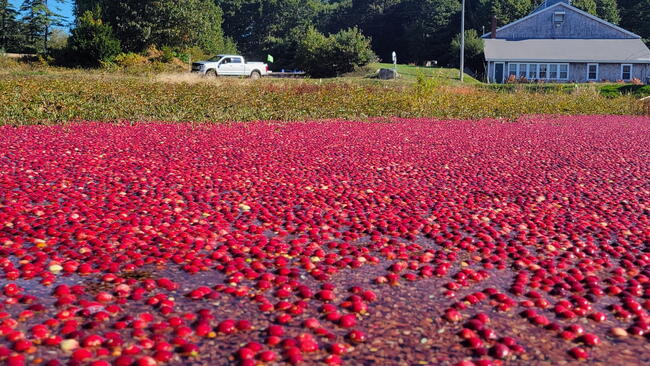

Both blueberries and raspberries grow very well in colder regions. Go to your local garden center and see what varieties they have to offer.
Go to http://hortupdate.unl.edu/Blueberries to read about growing blueberries in Nebraska.
Go to http://hortupdate.unl.edu/Raspberry to read about growing raspberries in Nebraska.
Blueberry plants are self-fertile, so no worries. However, it's always good to have different varieties to aide pollination to ensure you get fruit.
Wanda, Here’s is advice on fertilizing blueberries from the UF extension:
“Blueberries respond best to frequent, light fertilization. They can be killed or damaged by over-fertilization. It is best to be conservative and gradually increase fertilizer rates as you gain experience with your soil type and the kinds of fertilizer you are using.
Do not put fertilizer in the planting hole. After planting, when the soil is well settled from irrigation or rainfall, give un-mulched plants 1 ounce per plant of 12-4-8 (N-P2O5-K2O) with 2% magnesium (Mg). Use ammoniacal nitrogen or nitrogen from urea or organic sources, rather than from nitrate sources. Chlorine levels should be as low as possible, preferably below 2%. A special formulation called “blueberry special” is available in Florida and meets these requirements. Another possibility is “camellia-azalea” fertilizers. Many of these fertilizers are suitable for blueberries, and they are usually readily available in small quantities for home gardeners. Spread fertilizer evenly over a circle 2 feet in diameter with the plant in the center. Repeat this procedure in April, June, August, and October. If plants are heavily mulched, use 1.5 ounces per plant per application rather than 1 ounce because some of the fertilizer will be unavailable for plant uptake. During the second year, use 2 ounces of 12-4-8 per plant per application and spread it evenly over a 3-foot diameter circle. In the third year and beyond, use 3 ounces of fertilizer per plant per application spread evenly over a 4-foot diameter circle, or broadcast in a continuous band 3–4 feet wide, centered on the plant row. These are general guidelines and should be adjusted based on plant performance. Slightly more fertilizer may be required if plants are heavily mulched. However, more often than not, cultivated blueberries suffer more from over-fertilization than from lack of fertilization.”
- « Previous
- 1
- 2
- …
- 10
- Next »

Comments