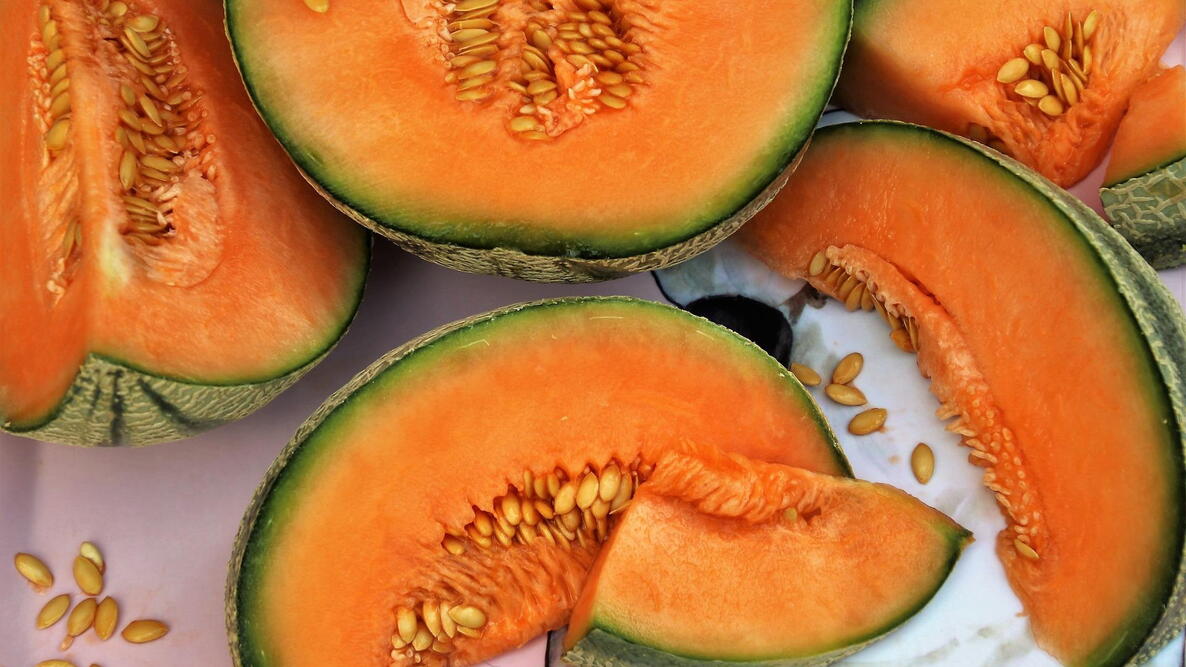
Nothing whispers summer like a chilled slice of sweet, orange cantaloupe juice dribbling down your chin.
Good news: These sun-loving melons are easy to grow—and even easier to devour. Let’s get planting!
Cantaloupes are a type of melon with a tan-green rind. Typically, the rind is covered in a spiderweb-like pattern, though some varieties may also be striped. Inside, the flesh is bright orange and sweet. Their growing requirements are similar to those of other popular melons, such as watermelons and honeydew melons.

Planting
Plant in a spot that gets full sun (6 to 8 hours of direct sunlight per day) with well-draining soil that’s a mix between loamy and sandy. (Growing the plants in raised rows—a.k.a. “hills”—ensures good drainage.) Amend the soil with aged manure or compost before planting. Learn more about soil amendments and preparing soil for planting.
Mulching the planting site with black plastic will serve multiple purposes: It will warm the soil ahead of planting, hinder weed growth, and keep developing fruits clean.
When to Plant Cantaloupes
This warm-season, very tender crop thrives in heat and hates the cold! It thrives in warmer climates with longer growing seasons.
- It’s best started directly from seed. If you live in a warmer climate, you may direct sow seeds outdoors after all danger of frost is well past and when the soil temperature warms to at least 70°F (21°C).
- However, if you’re set on growing cantaloupes in a colder region, you can start seeds indoors 4 to 6 weeks before your last spring frost date. Transplant outdoors 2 to 3 weeks after the last spring frost when the soil is at least 70°F (21°C).
How to Plant Cantaloupes
- Plant seeds 1 inch deep, 18 inches apart, in hills (or hilled rows) about 3 feet apart.
- If you have limited space, vines can be trained up a support, such as a trellis.
- If you plant indoors, use peat pots or soil blocks to avoid root disturbance. Harden off seedlings before transplanting.

Types
- ‘Ambrosia’ – 85 days to maturity. Among the sweetest varieties.
- ‘Athena’ – 70–80 days to maturity. Early variety that produces large, 5- to 6-pound fruits.
- ‘Hale’s Best Jumbo’ – 80–90 days to maturity. Produces 3-pound aromatic melons.
- ‘Minnesota Midget’ – 70–80 days to maturity. Early variety well-suited for gardens in colder regions. Produces 1-pound, sweetly flavored melons.
- ‘Bush Star’ – 90 days to maturity. Bush variety suits gardeners with limited space.

More Like This


High heat might have something to do with it; in high heat, the plant is under a lot of stress. Leaves and fruit may develop sunscald (browning).
Another possibility is that there is poor pollination. In heat, bees are less active. Sometimes a poorly pollinated plant may develop small or misshapen fruits, or fruits that brown.
Overwatering might also be an issue--although you need to make sure the plant gets enough during high heat, it can not sit in water. Let it dry out about an inch or two deep before rewatering; give about 1 to 2 inches of water per week. Cut back on the watering a bit after the fruits appear, to improve flavor.
Check for pests and diseases as well--are there any other signs on the leaves, stems, or roots? Holes, browning, off-color, nodules on the roots, etc.?
If it is poor pollination, there is time to remedy it, since you still have lots of flowers--there are male and female flowers. Heat stress--it depends on the vigor of the plant, whether it will recover; provide some shade, such as with burlap screens, if you have high temperatures again, and lay down a thick layer of mulch. If you have signs of pests/disease, you might bring a sample in to your local garden center for ID and control options.
Yes, you could gently place ripening fruit on mulch or a stone or flower pot so it isn't on the soil; this may help prevent rot and deter pests. There isn't a rule about "when" -- perhaps wait until it's half-way to harvesting size. After your initial fertilization at planting, we would only side dress with a nitrogen fertilizer (21-0-0) after the vines develop runners. Use one to two tablespoons per plant or mound at least 6 inches away from the plants.
Hearts of Gold melons are normally 3.5 to 4.5 pounds. Odd-shaped fruit is generally caused by growing conditions. Bees must deposit pollen on all three lobes of the female flower’s stigma or a misshapen melon develops. Sometimes cold, rainy, or windy weather affects or reduces bee activity.
Fortunately, your melons are close to the right size (3.5 to 4.5 pounds).
Have your melons reached their "days to maturity"?
Let the melons fully ripen before you pick them to get that last surge of flavor. Be patient.
You'll know when it's ripe as the stem will start to separate from the fruit--and then separate cleanly.
The rind will change color and the melons will develop a strong scent at the blossom end, and the leaf closest to the fruit will fade to yellow.
Leave your melons on the vine until they are truly ripe!
- « Previous
- 1
- 2
- …
- 10
- Next »

Comments