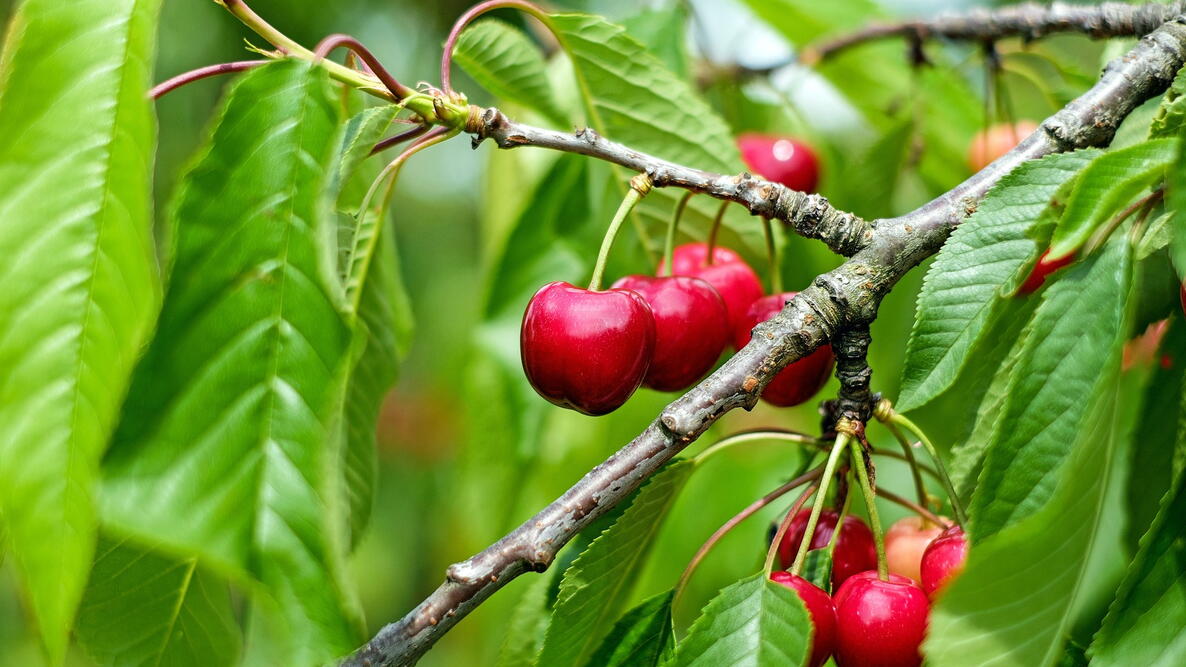
Caption
Cherries are much better picked off a branch at home than from the supermarket.
Types
Sweet Cherries
- Early - ‘Black Tartarian’
- Midseason - ‘Bing’
- Late - ‘Stella’
Sour Cherries
- Early - ‘Early Richmond’
- Midseason - ‘Montmorency’
- Late - ‘Meteor’

More Like This

Far be it from us to tell you that you could not grow anything! You have more success than a lot of people in prime growing areas! Now, about your question: So far as we can tell Prunus avium 'Stella' is dwarf to semi-dwarf (height estimates range from 7 feet to about 15 feet), hardy in Canada to zone 5—although one US vendor says it's hardy to US zone 4 (the north central area), so it might do ok in your area. Stella is also a "universal" pollen source, bless her heart.
We are getting less information about Royal Ann (aka Napoleon): In the US it is hardy to zone 5 (–10 to –20°F) and/or it requires 700 chilling hours below 45°F. Finally! Canadian nurser GreenBarnNursery says Napoleon is hardy to Zone 4 (–30°C).
Every source suggests that both fruits are mouth-wateringly delicious. So it might be worth a try...! And if you get a crop, send us a few! ;-)
Hi Claudette,
In order for your Bing cherry tree to produce fruit, you will need another variety of sweet cherry to cross-pollinate. There are some varieties that are incompatible with Bing cherries, such as Lambert, Royal Ann, Star, and Emperor Francis. Look for varieties that self-pollinate, or that are strong pollination matches with Bing, which include Sam, Rainier, Van, and BlackGold. Plant the trees within 100 feet of each other to ensure they cross-pollinate. As for the tree age, it's hard to tell. Try and get one of similar size to the tree you have. Good luck!
There are quite a few things that could have caused your cherry tree to drop its blossoms. Lack of water, insufficient pollination, and frost damage are some of the most common problems (though the latter seems unlikely in Southern California). However, it could also be the case that your cherry tree is not a self-pollinating variety. Most sweet cherry varieties need to cross-pollinate with another cherry tree to produce fruit. If you know your cherry's cultivar, check online to see if it's a self-pollinating variety, and if it's not, you will need to get an additional tree.
Regarding fertilizer, a 10-10-10 mix is best, applied in early spring.
Apparently it's not uncommon for cherries to leave the tree. Reasons include that the tree has set more fruit than it has water and nutrients to support. Smaller fruit and that which has not been completely pollinated is first to fall. In fact, the fruit left on the tree, the smaller each will be at maturity (no, that does not hold the promise of one giant cherry!). June drop is nature's way of thinning the crop to enable the best fruits to survive.
- « Previous
- 1
- 2
- …
- 10
- Next »

Comments