
Harvesting
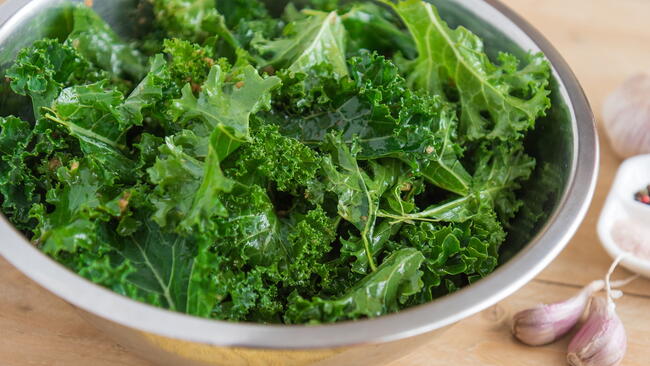
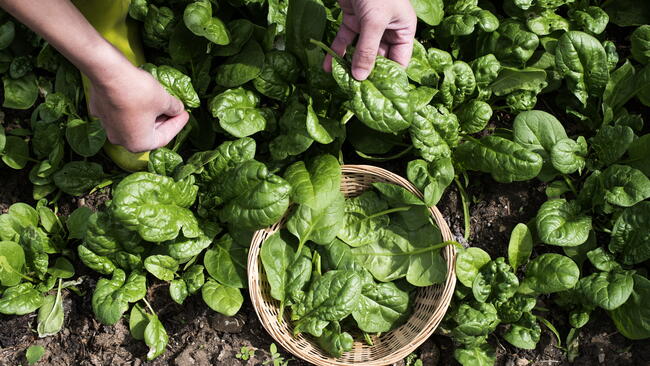
- Kale is ready to harvest when the leaves are about the size of your hand. Pick about a fistful of outer leaves per harvest, but no more than one-third of the plant at one time.
- Avoid picking the terminal bud (at the top center of the plant), which helps to maintain the plant’s productivity.
- Kale will continue growing until temperatures reach 20°F/-7°C. Do not stop harvesting: A “kiss” of frost makes it even sweeter. (See local frost dates.)
- To extend the harvest, protect with row covers or tarps. Or, create a makeshift cover of old blankets propped up by hay bales.

Photo credit: Beeldbewerking/GettyImages
How to Store Kale
Store kale, like other leafy greens, in a loose plastic bag in the refrigerator. It should keep for about 1 week.
Types
- ‘Red Russian’ (or ‘Russian Red’): heirloom; oak leaf-shape, gray-green leaves with deep-purple veins and stem; an early crop.
- ‘Lacinato’ (aka ‘Lacinato Blue’, ‘Tuscan’, ‘Black Palm Tree’, or ‘Cavil Nero’): heirloom, straplike leaves up to 2 feet long on plants that resemble small palm trees; heat tolerant and very cold-hardy.
- ‘True Siberian’: large, frilly, blue-green leaves; cold-hardy; pick all winter in some areas.
- ‘Vates Blue Curled’: hardy variety that is slow to bolt and does not yellow in cold weather. Its eponymous leaves reach 12 to 14 inches on 15-inch plants.
- ‘Winterbor’: resembles ‘Vates’, with 24-inch leaves on 2- to 3-foot-tall plants; baby leaves can be harvested at 28 days; frost-tolerant.


More Like This

Kale plants don't typically form heads (the cabbage-like structure that forms in the center of the plant), but since kale is just a type of cabbage, it can happen! The kale head is edible, but I'm not sure how it will taste—it could be bitter or overly tough. Try a piece raw first, and if that's not very satisfying, try boiling it (here's a corned beef and cabbage recipe to try). Also, note that kale often tastes a bit better after a frost, so if you've got a frost coming soon, wait until afterwards to harvest the plant. Let us know how it turns out!
Plywood may contain/be treated with copper azole. You can learn more about this here: https://www.extension.iastate.edu/smallfarms/toxicity-concerns-about-raised-bed-construction-materials Particle board is not mentioned on that page but we would avoid it. As for the bug spray you need to read the can/container; usually there are advisories on such products. Without knowing what chemicals it contains, we would only be guessing. That said, we would propose that you might be able to transplant the kale and berries. Hard to know how far along they are but if you get a new, safe, clean plot ready and get it done and then provide lots of TLC, you might have a harvest after all. We hope this helps.
Kale is a biennial (2-year) plant, which means that it will produce leaves the first year, and then the next year (or sometimes late the first year), it will form a flower stalk. This stalk eventually forms flowers and then seeds; once the seeds mature, the plant dies shortly after. The act of forming that tall, central flower stalk is called bolting. Sometimes the bolting response in a plant can also be caused by other factors, such as temperature or stress. If your kale plant is bolting, and it is the second year, then the plant will not last much after the seeds form--you may want to pull it up and start over, unless you plan to collect seed (though if the kale is a hybrid, the offspring may not be similar to the parents). Once kale bolts, the leaves take on a stronger flavor, at which point harvesting usually stops. Hope this helps!
If this is edible kale, the yellow flowers are a sign that the plant is bolting. If you have not already, cut the stems that you want and save or cook them. You can cut the flowers for a vase or leave them for appearance, but as an annual, the plant is almost done.
- « Previous
- 1
- 2
- …
- 10
- Next »

Comments