
Harvesting
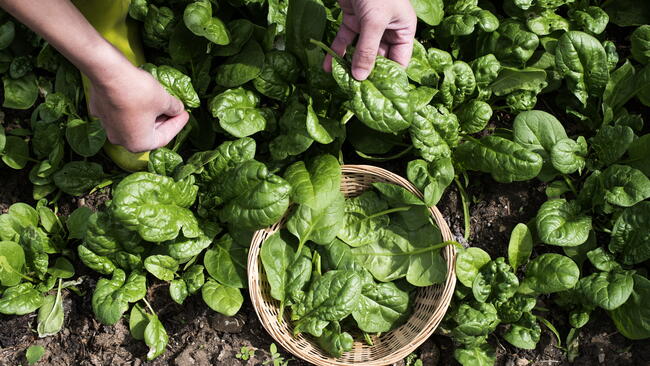
- Kale is ready to harvest when the leaves are about the size of your hand. Pick about a fistful of outer leaves per harvest, but no more than one-third of the plant at one time.
- Avoid picking the terminal bud (at the top center of the plant), which helps to maintain the plant’s productivity.
- Kale will continue growing until temperatures reach 20°F/-7°C. Do not stop harvesting: A “kiss” of frost makes it even sweeter. (See local frost dates.)
- To extend the harvest, protect with row covers or tarps. Or, create a makeshift cover of old blankets propped up by hay bales.

Photo credit: Beeldbewerking/GettyImages
How to Store Kale
Store kale, like other leafy greens, in a loose plastic bag in the refrigerator. It should keep for about 1 week.
Types
- ‘Red Russian’ (or ‘Russian Red’): heirloom; oak leaf-shape, gray-green leaves with deep-purple veins and stem; an early crop.
- ‘Lacinato’ (aka ‘Lacinato Blue’, ‘Tuscan’, ‘Black Palm Tree’, or ‘Cavil Nero’): heirloom, straplike leaves up to 2 feet long on plants that resemble small palm trees; heat tolerant and very cold-hardy.
- ‘True Siberian’: large, frilly, blue-green leaves; cold-hardy; pick all winter in some areas.
- ‘Vates Blue Curled’: hardy variety that is slow to bolt and does not yellow in cold weather. Its eponymous leaves reach 12 to 14 inches on 15-inch plants.
- ‘Winterbor’: resembles ‘Vates’, with 24-inch leaves on 2- to 3-foot-tall plants; baby leaves can be harvested at 28 days; frost-tolerant.


More Like This

Kale is usually treated as an annual, even though it is biennial. When treated as an annual, you can pull up the old stalks and roots, then grow new plants next growing season.
However, depending on your climate, the variety you choose, and how well protected it is over winter, your kale might make it through winter to produce a small harvest in spring before it goes to seed. If you wish to try this, and you live in a cold climate, then cut down any vegetation that has browned and died back, then provide a thick mulch, such as straw, over the kale bed in fall after harvest is over. In spring, uncover the plants when signs of growth emerge.
If they are leaf buds, leave them be. If they are flower buds, then the plant is starting to bolt (form a flower stalk), which can make the leaves taste bitter. When you see a flower stalk forming, snip it off as soon as possible, to delay the flowering process. (The flowers are edible.) It is a sign that you should harvest the leaves as soon as possible before the flavor becomes too bitter.
Kale is a biennial--setting leaves the first year, and flowering the second year before dying. However, in certain cases, kale can bolt the first year if they are under stress, such as high heat at certain stages, or dry soil.
We're not sure where you live but kale taste bitter if it got too much heat. Kale grows best in cool temperatures (60 to 70°F. If you live in a hot climate, you could try a spot with partial shade.
Since you've grown the kale, here's another idea to reduce the bitter taste of your kale. When you prepare kale in the kitchen, put the leaves in a bowl. Add a small amount of olive oil and sprinkle of salt and gently rub the kale to break down its tough cellulose structure. This will make the taste more mellow.
Dinosaur kale is also called Tuscan kale, Italian kale, Lacinato kale, or palm tree kale. It usually grows to 2 or 3 feet high. You would harvest it the same as other kale (see the guidelines under "Harvest/Storage" above). Pick the outer, older leaves, cutting each off at the base of the leaf stem where it connects to the main stem. Leave at least 4 to 6 leaves on the plant so that it can make food for itself, and avoid picking the center small leaves, so that the plant will continue to grow. Enjoy!
- « Previous
- 1
- 2
- …
- 10
- Next »

Comments