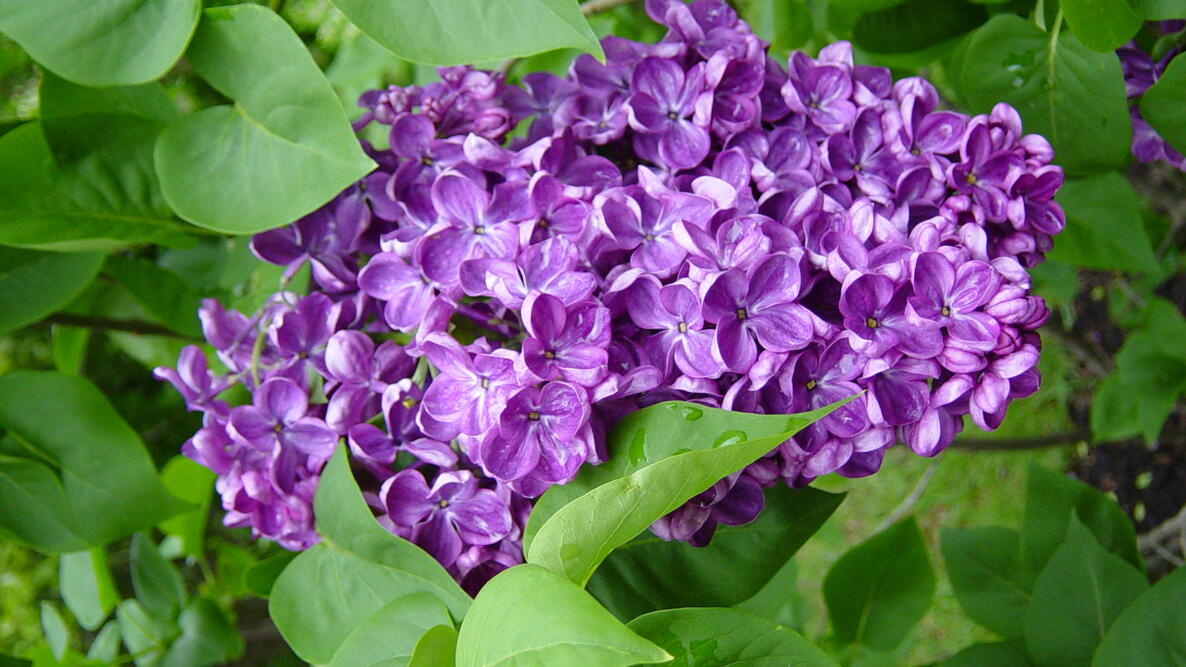
Caption
Huge blooms, wonderful scent.
Types
For early flowers, try Syringa x hyacinthiflora hybrids; they bloom 7 to 10 days before S. vulgaris. Its fragrant blooms attract butterflies and hummingbirds.
The most common and fragrant lilacs are of the S. vulgaris variety:
- Try ‘Charles Joly’, a double magenta flower, an early bloomer.
- Mid-season lilacs include ‘Monge’, a dark reddish purple, and ‘Firmament’, a fine blue.
- Late-season beauties include ‘Miss Canada’, a reddish-pink, and ‘Donald Wyman’, a pink-purple flower.
Uncommon types/varieties include …
- S. x ‘Penda’ Bloomerang Purple: flowers in spring, pauses, then flowers again from midsummer through fall.
- Although common lilacs love cold weather, a few thrive as far south as Zone 8, including cutleaf hybrid S. x laciniata, with fragrant, pale lavender flowers, and S. pubescens ssp. patula ‘Miss Kim,’ with pale, lilac-blue blooms that fade to white.
Small Lilacs
For gardeners, especially those in urban spaces, who just don’t have the room for the traditional larger lilac, there are compact varieties! They’ll even grow in a container on your patio or balcony.
- ‘Baby Kim’ grows only 2 to 3 feet high (and 3 feet wide) in a nicely rounded shape with purple flowers that attract butterflies. Extended hardiness from Zones 3 to 8.
- ‘Little Lady’ (S. x) is a compact lilac that matures to 4 to 5 feet tall and wide with dark pink buds that open to lilac-pink flowers. Hardy in Zones 2 to 7.
- ‘New Age Lavender’ and ‘New Age White’ (S. vulgaris) are super-compact, growing from 4 to 5 feet tall and wide, and bred for mildew resistance. Their fragrant flowers attract butterflies and hummingbirds. Hardy to Zone 4.




The discoloration may be powdery mildew. If you have not pruned your lilac, do it this year after it blooms. This will help air circulation and reduce the risk of the mildew. Or it may be gray mold. This page offers guidance: http://extension.illinois.edu/focus/index.cfm?problem=gray-mold-ibotrytisi
Hi April,
We would recommend replanting. Dig up the lilac bush and select a location with well-draining soil and plenty of sunlight (at least 6 hours). Prepare the soil by mixing in compost or well-rotted manure, and then plant the bush. You can add a 1- to 2-inch layer of mulch around the base of the plant to help it grow a little more before the first frost, as well as to prepare it for spring. We hope this helps!
Hi Jeri,
There are a number of possibilities: It could be Anthracnose, which first appears on lower, older leaves with defoliation progressing upwards; powdery mildew appears in whitish-gray mold patches on leaves and twigs; botrytis gray mold thrives in cool, moist conditions, causing decay of foliage; black spot also thrives in moist conditions, causing defoliation from black spots on leaves. Continue treatment with fungicide, but it may not help. Once foliage drops in fall, carefully rake up and remove all leaves: All of these diseases can overwinter in dead leaves.
Most lilacs you may know are deciduous shrubs. If you're looking for an easy evergreen, consider planting yews or boxwood, A deciduous shrub that keeps its green leaves is the rhododendron.
There are lots of options. See here for a few: https://www.almanac.com/gardening/growing-guides#Flower Nurseries may have many more. Remember, it is important that your plant choices are compatible with lilac conditions, not the least of which is proper pH, but also sunlight needs. See the advice for pH above in the "Planting" section. You should be aware, too, that lilacs send up suckers (see same section above for details), and staying ahead of (removing) these could cause disruption, even uprooting of the bedding plants. For this and other reasons, you will not see too many lilacs with plants bedded beneath them. That does not mean don't do it, but you should be aware of what can happen.
- « Previous
- 1
- 2
- …
- 10
- Next »

Comments