
Caption
Huge blooms, wonderful scent.
Types
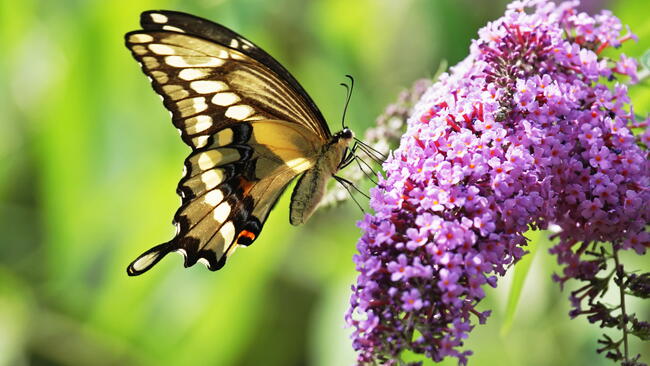
For early flowers, try Syringa x hyacinthiflora hybrids; they bloom 7 to 10 days before S. vulgaris. Its fragrant blooms attract butterflies and hummingbirds.
The most common and fragrant lilacs are of the S. vulgaris variety:
- Try ‘Charles Joly’, a double magenta flower, an early bloomer.
- Mid-season lilacs include ‘Monge’, a dark reddish purple, and ‘Firmament’, a fine blue.
- Late-season beauties include ‘Miss Canada’, a reddish-pink, and ‘Donald Wyman’, a pink-purple flower.
Uncommon types/varieties include …
- S. x ‘Penda’ Bloomerang Purple: flowers in spring, pauses, then flowers again from midsummer through fall.
- Although common lilacs love cold weather, a few thrive as far south as Zone 8, including cutleaf hybrid S. x laciniata, with fragrant, pale lavender flowers, and S. pubescens ssp. patula ‘Miss Kim,’ with pale, lilac-blue blooms that fade to white.
Small Lilacs
For gardeners, especially those in urban spaces, who just don’t have the room for the traditional larger lilac, there are compact varieties! They’ll even grow in a container on your patio or balcony.
- ‘Baby Kim’ grows only 2 to 3 feet high (and 3 feet wide) in a nicely rounded shape with purple flowers that attract butterflies. Extended hardiness from Zones 3 to 8.
- ‘Little Lady’ (S. x) is a compact lilac that matures to 4 to 5 feet tall and wide with dark pink buds that open to lilac-pink flowers. Hardy in Zones 2 to 7.
- ‘New Age Lavender’ and ‘New Age White’ (S. vulgaris) are super-compact, growing from 4 to 5 feet tall and wide, and bred for mildew resistance. Their fragrant flowers attract butterflies and hummingbirds. Hardy to Zone 4.






Lilacs are generally fairly hardy, but if you live in Zone 5 or colder, your new plant may benefit from a little protection as it is becoming established. If your lilac is planted in the ground, not a pot, then you might want to add about 3 to 4 inches of shredded bark or shredded leaves, or compost as mulch to protect the roots and help prevent heaving. Keep any mulch a few inches away from the trunk, though, to discourage rodents from nibbling on the trunk over winter. Remove the mulch in spring after all threat of severe frost has passed.
After any leaves have fallen and the plant is dormant, or if you are expecting a moderate to severe frost, you might also gently wrap the seedling in burlap "cylinder" and fill with mulched leaves or straw. Leave the top of the cylinder open. (If your lilac is grafted, be especially sure to protect the bud union with mulch.) Do not use plastic, as the lack of air circulation may invite disease, and may make the interior too warm. If your plant is by your home's foundation, you might also want to place an A-frame stapled with burlap, or similar protection, over the plant to prevent it from becoming crushed by heavy snow falling from the roof, etc., if that is a possibility in your area. Remove the cylinder and mulch, and the A-frame, in spring, after threat of frost has passed. Hope this helps!
Hi Kelly,
Though the dropping temperatures are not ideal for digging your lilac, it is not impossible. When you dig it out, do your best to keep as many roots on the shrub as possible. Dig a wide circle around it and slowly work it out of the ground making clean root cuts with loppers (in other words, don't just rip it from the ground, be gentle). Wrap the roots in burlap and water it. You can hold it over in a warm mulch pile. Dig a hole into a yard of mulch (many nurseries will deliver material to your property), preferably located in a tucked away area, where wind and snow damage are at a minimum. Bury the roots and about half way up the plant in the mulch. Do not water anymore. The shrub will look like it is dying but hopefully the root zone will live, go dormant, and bounce back in the spring. Only replant when the ground has completely thawed and there is no chance of a late spring frost. Hope this helps . . . best of luck!
Because lilacs must go through a cold dormant period, you should leave your pot outside in a protected area, such as up against the house. Put a thick layer of mulch around the base of the plant. And, before the first hard frost, gently lay a piece of burlap over the plant for added protection. In the spring, take it out of the pot to assess its roots. If they are healthy with a lot of smaller "feeder" roots, go ahead and plant it when the ground has thawed.
Hi Rona,
That sounds like a water-related issue. Insufficient water results in distorted and wilting leaves. As for the spots, sometimes when a plant is stressed it is susceptible to disease. It could be a foliar fungus but it is hard to say without seeing it. It's unlikely fertilizer is to blame. Take a few cuttings of the leaves to a reputable nursery to see if they can identify the problem. And water regularly until late fall. Hopefully it will bounce back after the dormant season.
- « Previous
- 1
- 2
- …
- 10
- Next »

Comments