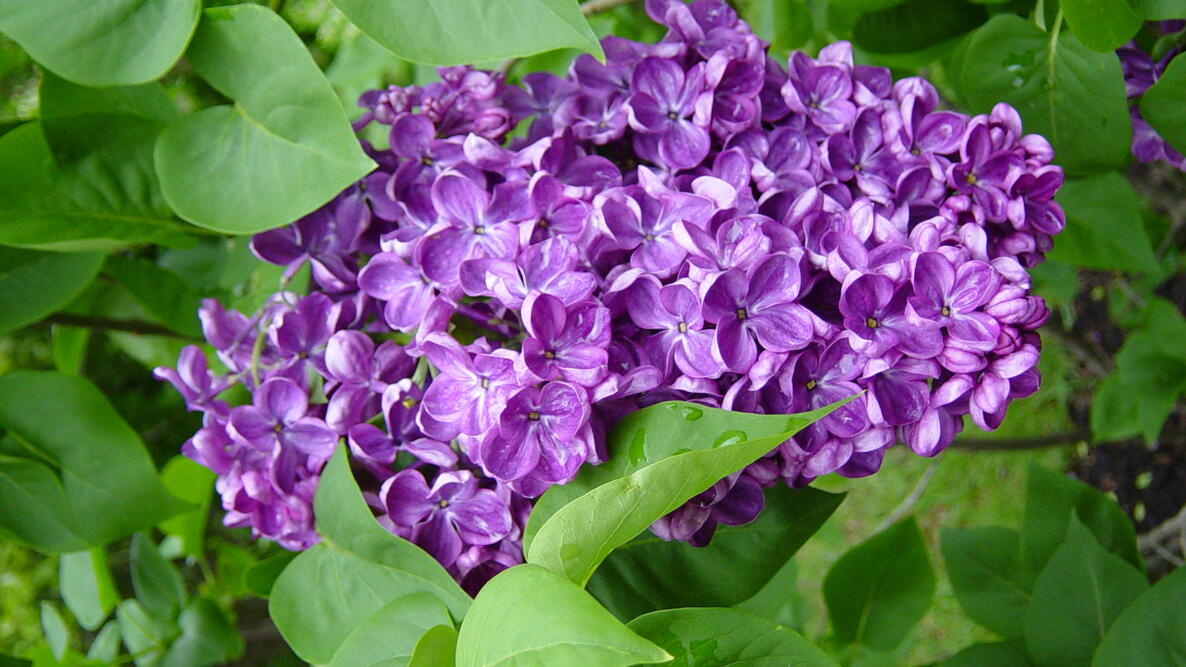
Caption
Huge blooms, wonderful scent.
Types
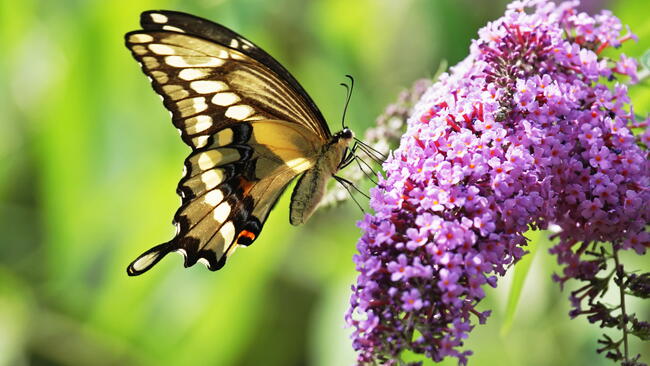
For early flowers, try Syringa x hyacinthiflora hybrids; they bloom 7 to 10 days before S. vulgaris. Its fragrant blooms attract butterflies and hummingbirds.
The most common and fragrant lilacs are of the S. vulgaris variety:
- Try ‘Charles Joly’, a double magenta flower, an early bloomer.
- Mid-season lilacs include ‘Monge’, a dark reddish purple, and ‘Firmament’, a fine blue.
- Late-season beauties include ‘Miss Canada’, a reddish-pink, and ‘Donald Wyman’, a pink-purple flower.
Uncommon types/varieties include …
- S. x ‘Penda’ Bloomerang Purple: flowers in spring, pauses, then flowers again from midsummer through fall.
- Although common lilacs love cold weather, a few thrive as far south as Zone 8, including cutleaf hybrid S. x laciniata, with fragrant, pale lavender flowers, and S. pubescens ssp. patula ‘Miss Kim,’ with pale, lilac-blue blooms that fade to white.
Small Lilacs
For gardeners, especially those in urban spaces, who just don’t have the room for the traditional larger lilac, there are compact varieties! They’ll even grow in a container on your patio or balcony.
- ‘Baby Kim’ grows only 2 to 3 feet high (and 3 feet wide) in a nicely rounded shape with purple flowers that attract butterflies. Extended hardiness from Zones 3 to 8.
- ‘Little Lady’ (S. x) is a compact lilac that matures to 4 to 5 feet tall and wide with dark pink buds that open to lilac-pink flowers. Hardy in Zones 2 to 7.
- ‘New Age Lavender’ and ‘New Age White’ (S. vulgaris) are super-compact, growing from 4 to 5 feet tall and wide, and bred for mildew resistance. Their fragrant flowers attract butterflies and hummingbirds. Hardy to Zone 4.




Hi Judy,
It may be a year or two before they start sending up new growth--that will make them more shrub like. They are probably still getting rooted. In time, you can make some heading cuts to encourage growth, but I wouldn't prune them this year. Give them time to get established.
Brown spots on lilacs may mean Lilac Bacterial Blight. This happens with plants that have been stressed by improper watering or lack of nutrients/fertilization. Be sure to avoid any overhead watering or wetting the foliage; water at soil level. Proper spacing and plenty of air circulation is also important. We would advise calling your landscapers.
Hmm. Have you checked off all of the criteria above: soil pH? compost/manure (note: with lime; also check pH), fertilizer (but not those with high nitrogen), SUN (it is very important that the plants get at least 6 hours of sun per day), water...? Are you pruning them? You could be cutting off the "old wood" that bears the flowers. Are the lilacs getting too much nitrogen? Have your soil analyzed (university coop extensions and other sources do this). Did you clear the ground around them, per above? Are they close to a lawn that you fertilize with, among other things, nitrogen? That can result in little/no bloom.
Then there is this: Try talking to it... But make sure everything else (above) is in order, too.
We hope this helps.
Transplanting puts some stress on just about any plant. Although many sources rave about this plant, it can be vulnerable to blight, Ashley. Have you contacted the nursery that you purchased it from? here some more on that: http://extension.oregonstate.edu/gardening/how-recognize-treat-and-avoid-lilac-bacterial-blight
Here is more advice on the plant—but nothing on the spots. You could contact this Aggie coop extension and get specific advice: http://bexar-tx.tamu.edu/homehort/archives-of-weekly-articles-davids-plant-of-the-week/texas-lilac-vitex-a-hot-summer-texas-superstar-plant/
We hope this helps.
- « Previous
- 1
- 2
- …
- 10
- Next »

Comments