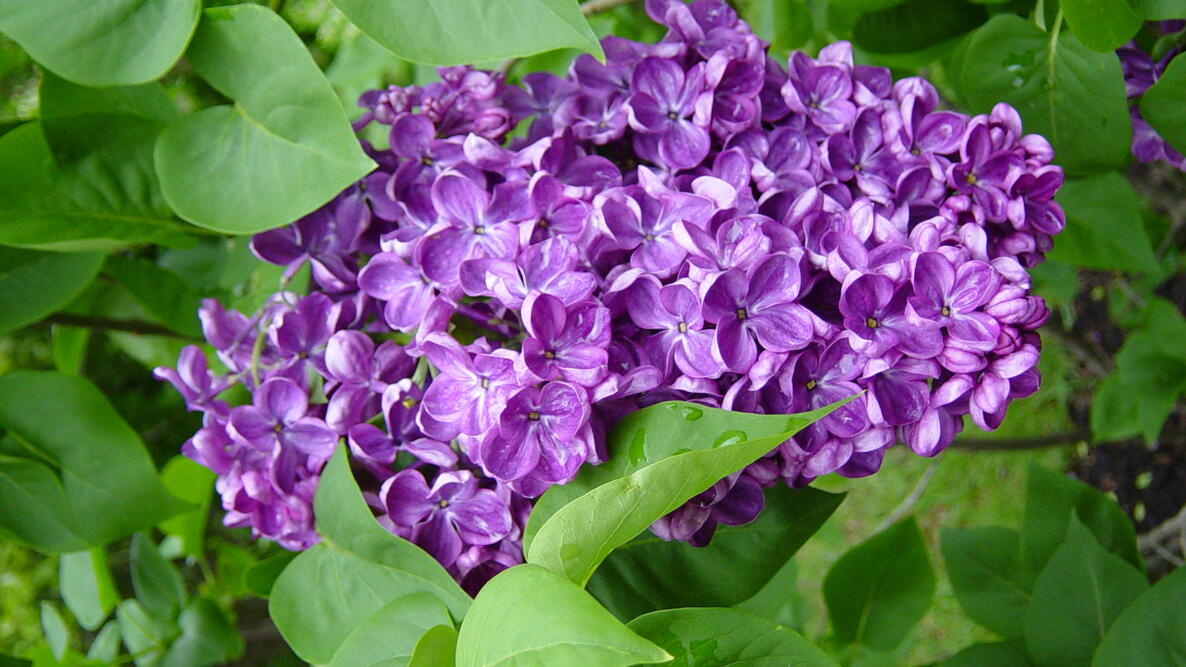
Caption
Huge blooms, wonderful scent.
Types
For early flowers, try Syringa x hyacinthiflora hybrids; they bloom 7 to 10 days before S. vulgaris. Its fragrant blooms attract butterflies and hummingbirds.
The most common and fragrant lilacs are of the S. vulgaris variety:
- Try ‘Charles Joly’, a double magenta flower, an early bloomer.
- Mid-season lilacs include ‘Monge’, a dark reddish purple, and ‘Firmament’, a fine blue.
- Late-season beauties include ‘Miss Canada’, a reddish-pink, and ‘Donald Wyman’, a pink-purple flower.
Uncommon types/varieties include …
- S. x ‘Penda’ Bloomerang Purple: flowers in spring, pauses, then flowers again from midsummer through fall.
- Although common lilacs love cold weather, a few thrive as far south as Zone 8, including cutleaf hybrid S. x laciniata, with fragrant, pale lavender flowers, and S. pubescens ssp. patula ‘Miss Kim,’ with pale, lilac-blue blooms that fade to white.
Small Lilacs
For gardeners, especially those in urban spaces, who just don’t have the room for the traditional larger lilac, there are compact varieties! They’ll even grow in a container on your patio or balcony.
- ‘Baby Kim’ grows only 2 to 3 feet high (and 3 feet wide) in a nicely rounded shape with purple flowers that attract butterflies. Extended hardiness from Zones 3 to 8.
- ‘Little Lady’ (S. x) is a compact lilac that matures to 4 to 5 feet tall and wide with dark pink buds that open to lilac-pink flowers. Hardy in Zones 2 to 7.
- ‘New Age Lavender’ and ‘New Age White’ (S. vulgaris) are super-compact, growing from 4 to 5 feet tall and wide, and bred for mildew resistance. Their fragrant flowers attract butterflies and hummingbirds. Hardy to Zone 4.


You may have accidentally pruned off the scion root if your plant is grafted, or that part of the plant may have simply died, so the rootstock would now be producing the lighter variation of the flowers. Lilac color can also be affected by the acidity of the soil, so test the pH around the plant. The color will be more intense (the vibrant dark) with a higher pH, which you can achieve by liming. If the soil has become more acidic, this might have affected the change in color.
Best time to plant suckers is before buds emerge in the spring or after the leaves have dropped from the shrub in fall. Find a sucker ideally 2 to 3 foot tall. With a spade dig down around the sucker. You'll find a connecting root leading back to the main stem. Cut this root off just outside of the sucker's root ball. Remove the sucker with as many roots as possible and plant it in a big pot with potting soil or directly in the ground. Water well.
Hi Rena,
It helps the tree to remove the dead blooms every year. When you remove the blooms the tree doesn't need to use its energy to produce seeds. The faded blooms are easy to snap off.
- « Previous
- 1
- 2
- …
- 10
- Next »

Comments