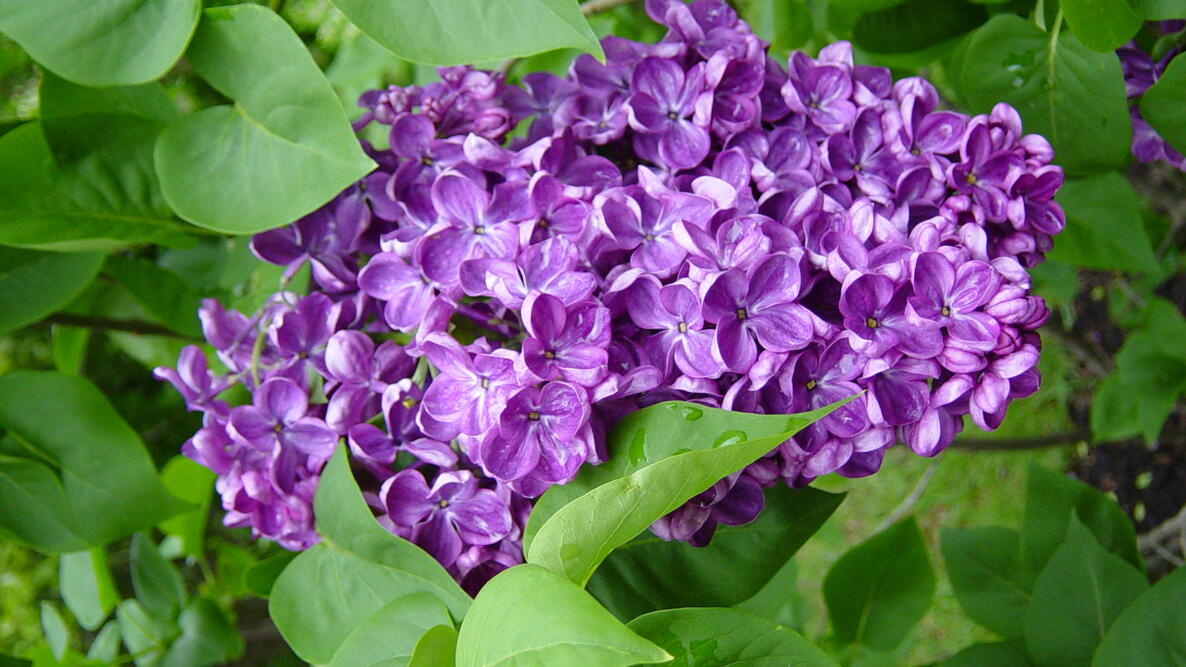
Caption
Huge blooms, wonderful scent.
Types
For early flowers, try Syringa x hyacinthiflora hybrids; they bloom 7 to 10 days before S. vulgaris. Its fragrant blooms attract butterflies and hummingbirds.
The most common and fragrant lilacs are of the S. vulgaris variety:
- Try ‘Charles Joly’, a double magenta flower, an early bloomer.
- Mid-season lilacs include ‘Monge’, a dark reddish purple, and ‘Firmament’, a fine blue.
- Late-season beauties include ‘Miss Canada’, a reddish-pink, and ‘Donald Wyman’, a pink-purple flower.
Uncommon types/varieties include …
- S. x ‘Penda’ Bloomerang Purple: flowers in spring, pauses, then flowers again from midsummer through fall.
- Although common lilacs love cold weather, a few thrive as far south as Zone 8, including cutleaf hybrid S. x laciniata, with fragrant, pale lavender flowers, and S. pubescens ssp. patula ‘Miss Kim,’ with pale, lilac-blue blooms that fade to white.
Small Lilacs
For gardeners, especially those in urban spaces, who just don’t have the room for the traditional larger lilac, there are compact varieties! They’ll even grow in a container on your patio or balcony.
- ‘Baby Kim’ grows only 2 to 3 feet high (and 3 feet wide) in a nicely rounded shape with purple flowers that attract butterflies. Extended hardiness from Zones 3 to 8.
- ‘Little Lady’ (S. x) is a compact lilac that matures to 4 to 5 feet tall and wide with dark pink buds that open to lilac-pink flowers. Hardy in Zones 2 to 7.
- ‘New Age Lavender’ and ‘New Age White’ (S. vulgaris) are super-compact, growing from 4 to 5 feet tall and wide, and bred for mildew resistance. Their fragrant flowers attract butterflies and hummingbirds. Hardy to Zone 4.





Hi, Charles, This is not really a lot to go on, but here are some ideas.
It maybe that you simply owe the plants some soil improvement. See above, with links for more details: "
- Lilacs thrive in fertile, humus-rich, well-drained, neutral to alkaline soil (at a pH near 7.0). If your soil is in poor condition, add compost to enrich. Learn more about soil amendments and preparing soil for planting."
It also may be, as per above, your plants could be in shade (just a guess), more shade than they prefer as a result of nearby tree growth or even building construction.
Then again, the lilacs may indeed be ill. There is more info than we can cover here on this coop extension web site (it's in Minnesota, but conditions may apply) https://extension.umn.edu/yard-and-garden-news/lilac-issues-season
We hope this helps!
Thanks for sharing, Sue!
Hi, Gina,
We can not say exactly what is wrong with your lilac. But we consulted with a few cooperative extension services and rather than try to explain, suggest you read their pages and see if the problems identified there match yours. You will find some remedies as well. Here you go (it does not really matter if these coops are not in your area; read for conditions):
• https://extension.oregonstate.edu/news/how-recognize-treat-avoid-lilac-bacterial-blight
• https://hortnews.extension.iastate.edu/lilac-bacterial-blight
• https://extension.psu.edu/lilac-diseases
We hope this helps!
We can not say exactly what is wrong with your lilac, Lakshimi. But we consulted with a few cooperative extension services and rather than try to explain, suggest you read their pages and see if the problems identified there match yours. You will find some remedies as well. Here you go (it does not really matter if these coops are not in your area; read for conditions):
• https://extension.oregonstate.edu/news/how-recognize-treat-avoid-lilac-bacterial-blight
• https://hortnews.extension.iastate.edu/lilac-bacterial-blight
• https://extension.psu.edu/lilac-diseases
We hope this helps!
- « Previous
- 1
- 2
- …
- 10
- Next »

Comments