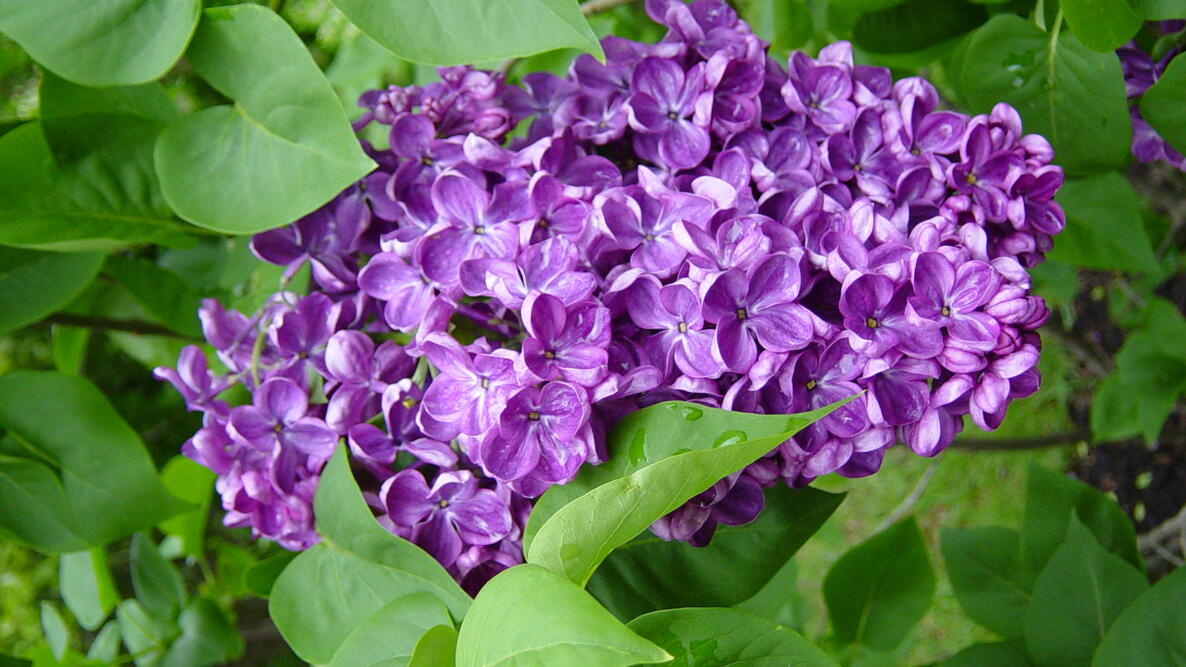
Caption
Huge blooms, wonderful scent.
Image Credit:
Wally Patrick
Botanical Name
Syringa spp.
Grown as
Toxicity
Sun Exposure
Water Needs
Height
Spread
Soil pH
Resilience
Plant Type
Types
For early flowers, try Syringa x hyacinthiflora hybrids; they bloom 7 to 10 days before S. vulgaris. Its fragrant blooms attract butterflies and hummingbirds.
The most common and fragrant lilacs are of the S. vulgaris variety:
- Try ‘Charles Joly’, a double magenta flower, an early bloomer.
- Mid-season lilacs include ‘Monge’, a dark reddish purple, and ‘Firmament’, a fine blue.
- Late-season beauties include ‘Miss Canada’, a reddish-pink, and ‘Donald Wyman’, a pink-purple flower.
Uncommon types/varieties include …
- S. x ‘Penda’ Bloomerang Purple: flowers in spring, pauses, then flowers again from midsummer through fall.
- Although common lilacs love cold weather, a few thrive as far south as Zone 8, including cutleaf hybrid S. x laciniata, with fragrant, pale lavender flowers, and S. pubescens ssp. patula ‘Miss Kim,’ with pale, lilac-blue blooms that fade to white.
Small Lilacs
For gardeners, especially those in urban spaces, who just don’t have the room for the traditional larger lilac, there are compact varieties! They’ll even grow in a container on your patio or balcony.
- ‘Baby Kim’ grows only 2 to 3 feet high (and 3 feet wide) in a nicely rounded shape with purple flowers that attract butterflies. Extended hardiness from Zones 3 to 8.
- ‘Little Lady’ (S. x) is a compact lilac that matures to 4 to 5 feet tall and wide with dark pink buds that open to lilac-pink flowers. Hardy in Zones 2 to 7.
- ‘New Age Lavender’ and ‘New Age White’ (S. vulgaris) are super-compact, growing from 4 to 5 feet tall and wide, and bred for mildew resistance. Their fragrant flowers attract butterflies and hummingbirds. Hardy to Zone 4.

I moved from Pennsylvania to southern California nine years ago. Our new home has 6 Lilacs near a fence which are blooming just fabulous at this writing. Mid April. I've been reading about the proper care of Lilacs. By the way, You Tube would be some good learning if you need, watch the videos, they are well worth it. Anyway, last season after reading and watching the videos, I went about pruning. I did some rather drastic pruning way at the top (some plants are about 15 feet high). I also removed some suckers way at the bottom and sawed off some obvious branches that needed to be trimmed. So. . . this season came about and I was rewarded with some very fragrant and beautiful blooms. Moral of the story? Listen and read and learn from other writings here on this page. You will learn much and maybe your situation will help others. It's the OFA way!
Mine is 4 years old and has never bloomed. Help
Bush is 2 years old and has started to but but all buds turned brown is it dying
I love these charmingly wonderful flowers! Especially their flavor.
I have the same issue and I believe it could be Peach curl fungus. It affects a wild peach tree on my place, and my lilacs have it as well. I have yet to spray for it, but I believe if you look it up, you may find it to be the case.
My mom had a huge lilac bush and it started reproducing she dug one of its “babies” and it just won’t bloom. It’s been like 4 years now with nothing. Could someone please tell me why or tips to help it bloom
I have the bust about 2 yes , it started to bloom this year, it's lovely, but its a bit unsteady, any tips on how to make it more stable as it grows? Thank You.
I know everything I've ever read says that lilacs bloom on old wood because they form "this year's blooms during last fall". However I beg to differ! I have a yellow lilac which is the Primrose and 7 out of 10 blooms on it, are on this year's new growth. I can't explain it. Can someone explain this to me??
Thank you!
Help! I have many different varieties of Lilacs living in Eastern Washington. I have a disease that results in stunted growth of the leaves, looking a bit curled, and doesn't initially affect the entire bush. It started with one lilac and after applying systemic treatment for a couple of years and removing the affected branches, I finally lost and removed the entire thing. Now I see a few of my other lilacs (and now, a few other species, like a rose and maple tree!) appear to have similar symptoms. None of my local nurseries can answer my questions, although I am now trying a new systemic and at one nursery suggestion, a new fertilizer as her thought was I was "starving" the plant. Does this sound familiar? Can you help with a potential solution? Thank you so much.
Hello I got a lilac bush that I transplanted 4 years ago and it bloomed good last year and I noticed it made new buds in July and in late September the buds broke open and the flower buds for this spring has opened and froze so what caused this and what can I do to prevent this from happening again?
- « Previous
- 1
- 2
- …
- 10
- Next »
📣The Gardening Club Just Got Better! 3 Deliveries, 10% Store Discount, and more!

Comments