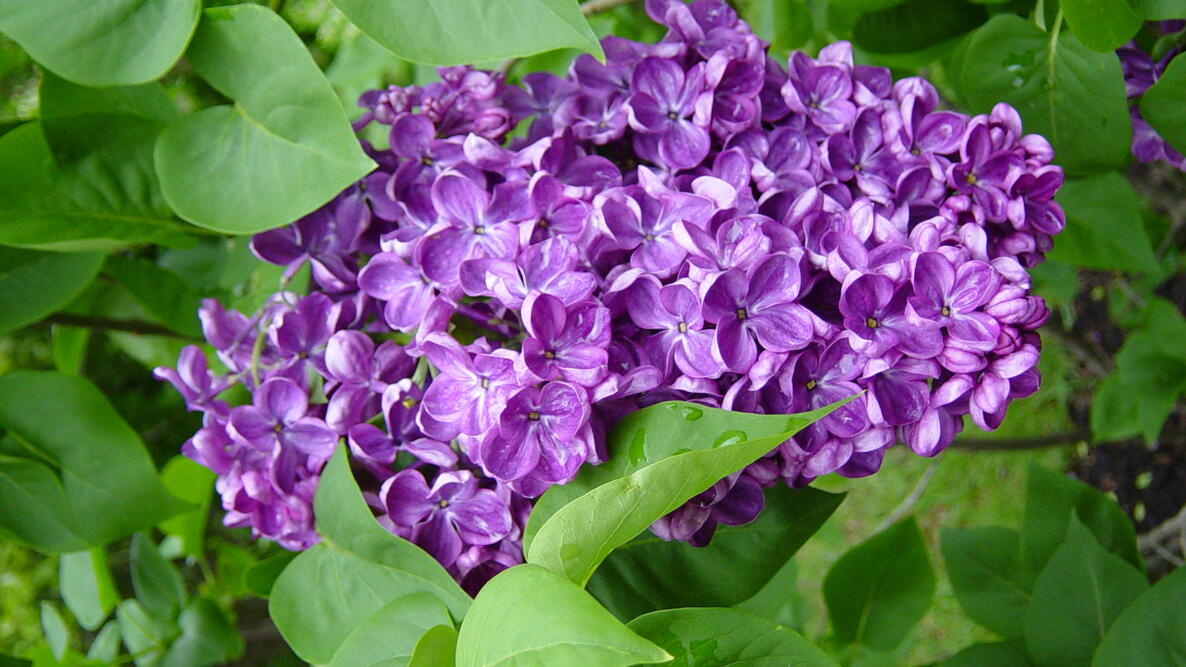
Caption
Huge blooms, wonderful scent.
Types
For early flowers, try Syringa x hyacinthiflora hybrids; they bloom 7 to 10 days before S. vulgaris. Its fragrant blooms attract butterflies and hummingbirds.
The most common and fragrant lilacs are of the S. vulgaris variety:
- Try ‘Charles Joly’, a double magenta flower, an early bloomer.
- Mid-season lilacs include ‘Monge’, a dark reddish purple, and ‘Firmament’, a fine blue.
- Late-season beauties include ‘Miss Canada’, a reddish-pink, and ‘Donald Wyman’, a pink-purple flower.
Uncommon types/varieties include …
- S. x ‘Penda’ Bloomerang Purple: flowers in spring, pauses, then flowers again from midsummer through fall.
- Although common lilacs love cold weather, a few thrive as far south as Zone 8, including cutleaf hybrid S. x laciniata, with fragrant, pale lavender flowers, and S. pubescens ssp. patula ‘Miss Kim,’ with pale, lilac-blue blooms that fade to white.
Small Lilacs
For gardeners, especially those in urban spaces, who just don’t have the room for the traditional larger lilac, there are compact varieties! They’ll even grow in a container on your patio or balcony.
- ‘Baby Kim’ grows only 2 to 3 feet high (and 3 feet wide) in a nicely rounded shape with purple flowers that attract butterflies. Extended hardiness from Zones 3 to 8.
- ‘Little Lady’ (S. x) is a compact lilac that matures to 4 to 5 feet tall and wide with dark pink buds that open to lilac-pink flowers. Hardy in Zones 2 to 7.
- ‘New Age Lavender’ and ‘New Age White’ (S. vulgaris) are super-compact, growing from 4 to 5 feet tall and wide, and bred for mildew resistance. Their fragrant flowers attract butterflies and hummingbirds. Hardy to Zone 4.




Comments

This is a generally low-maintenance variety; however, it likes full sun and medium water. If the garage takes direct sun and it was closed, it may have become oppressively hot in there and weakened the plant. A full soak or two, allowed to drain off, in moderate sun could help but it could take a couple or a few days. In the meantime, consult the folks that you bought it from or a local nursery.
We can't tell if you killed it, Amanda, but the chemicals could certainly be affecting it. Read the labels on the ferilizer and weed killer packaging. (If you discarded it after using, revisit your source and read it there.) Some provide warnings about use near other plants, and many provide phone numbers for specific questions such as this. Call and ask about the ingredients (especially the weed killer's components) and what effect they might have. They might advise watering to dilute; you won't know what to do until you know what it is.
Hi Lisa, This is a common question. Many old lilacs only flower at the top--and you really do want those gorgeous fragrant lilacs at eye-level.
The best practice is to cut back the entire plant within 6 to 8 inches of the ground before they leaf out (usually March or early April). You won't get flowers the first season but this severe pruning induces shoots to develop during the growing season. The following year, select the strongest, healthiest shoots and cut back to just above the bud to encourage branching. Remove all other shoots at ground level.
Or, for a more reserved approach, try a three-year program: Chop off one-third of all the older canes back as close to the ground as possible. The plant will send up a flush of leafy growth that should bud this summer and look better next year. Repeat the process every year until you have pruned all the older canes. Don't prune too late (after July) or you remove the flower buds for the next growing season.
Curling leaves are often a sign of dryness. Try digging into the soil to see if the moisture is getting to the roots. Your noting that your soil is sandy is a clue, even if you did the right things by adding compost and soil. The question is, is there enough of these ingredients for the plant to have a chance to absorb the water? Although lilacs don't like to sit in water, water passes quickly through sand—maybe too quickly for your plant to get any. Water more often, even laying the hose running lightly to moderately (not gushing and pushing soil around) and see if there is improvement. You might have to remove it, enlarge the hole, add more compost and soil, even peat moss (which holds water), and replant.
- « Previous
- 1
- 2
- …
- 10
- Next »

Hi, Helen, This is not something we have direct experience with (yet), so we'll tell you what we would do. Wait a while. Hopefully, the mower blade was set high and there is something left of the plant, some shred of a stem. It might have enough root to come back from this. If/when it makes an adequate recovery (as seen by new growth), then gently clear the grass from around it and mulch it. In the meantime, make sure that it is clearly marked on your property. You don't want someone stepping on it. Or mowing it again. Good luck!