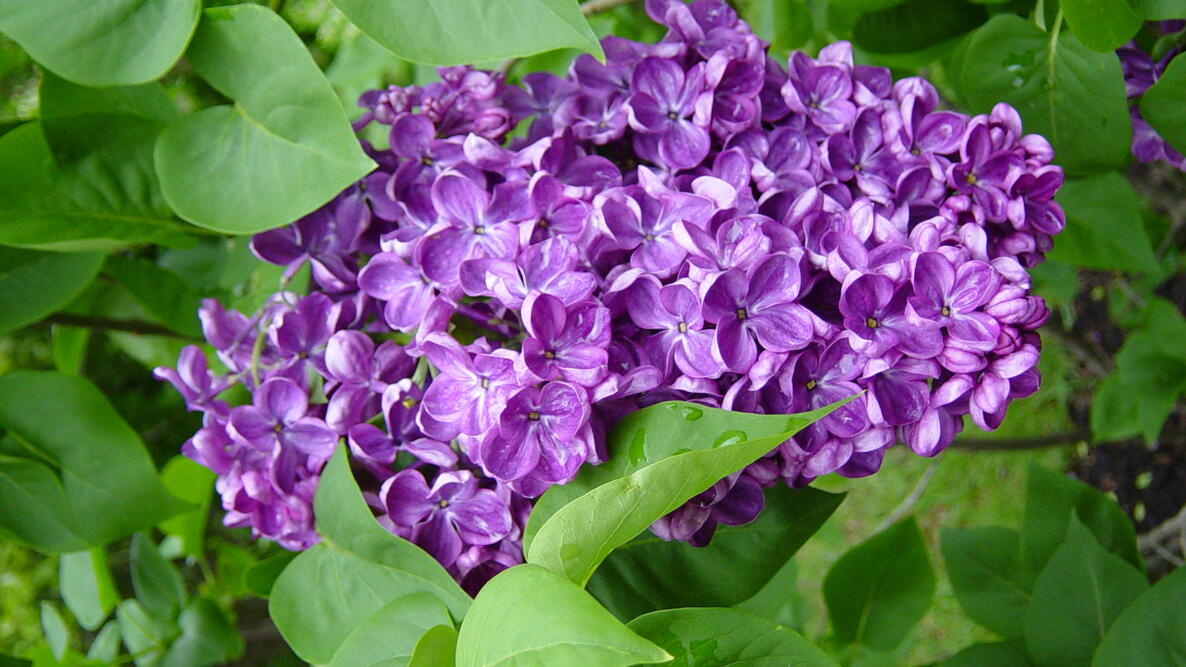
Caption
Huge blooms, wonderful scent.
Types
For early flowers, try Syringa x hyacinthiflora hybrids; they bloom 7 to 10 days before S. vulgaris. Its fragrant blooms attract butterflies and hummingbirds.
The most common and fragrant lilacs are of the S. vulgaris variety:
- Try ‘Charles Joly’, a double magenta flower, an early bloomer.
- Mid-season lilacs include ‘Monge’, a dark reddish purple, and ‘Firmament’, a fine blue.
- Late-season beauties include ‘Miss Canada’, a reddish-pink, and ‘Donald Wyman’, a pink-purple flower.
Uncommon types/varieties include …
- S. x ‘Penda’ Bloomerang Purple: flowers in spring, pauses, then flowers again from midsummer through fall.
- Although common lilacs love cold weather, a few thrive as far south as Zone 8, including cutleaf hybrid S. x laciniata, with fragrant, pale lavender flowers, and S. pubescens ssp. patula ‘Miss Kim,’ with pale, lilac-blue blooms that fade to white.
Small Lilacs
For gardeners, especially those in urban spaces, who just don’t have the room for the traditional larger lilac, there are compact varieties! They’ll even grow in a container on your patio or balcony.
- ‘Baby Kim’ grows only 2 to 3 feet high (and 3 feet wide) in a nicely rounded shape with purple flowers that attract butterflies. Extended hardiness from Zones 3 to 8.
- ‘Little Lady’ (S. x) is a compact lilac that matures to 4 to 5 feet tall and wide with dark pink buds that open to lilac-pink flowers. Hardy in Zones 2 to 7.
- ‘New Age Lavender’ and ‘New Age White’ (S. vulgaris) are super-compact, growing from 4 to 5 feet tall and wide, and bred for mildew resistance. Their fragrant flowers attract butterflies and hummingbirds. Hardy to Zone 4.




It may be difficult to transplant an old lilac. The root system is big and you want to get as much of it as possible. It can also be stressful to the plant. However, it can be done with care. Be aware that it may also take 1 to 3 years for it to recover and bloom. The timing must also be right: when they are dormant in early spring before the plant leafs out or in the fall. If you decide not to move the bush you can transplant suckers (offshoots from the bush). Use a sharp shovel to cut the underground stem that joins the offshoot to the lilac bush. and then carefully lift the sucker, trying to retain as many roots as possible.
For a lilac wall or hedge, just make sure you leave plenty of room between plants (6 feet for most varieties). Chinese lilacs make a nice hedge. If you mix the lilac with trees, just avoid any trees that will grow tall and produce shade because lilacs need sun to flower. Perhaps a conifer shrub would work. Visit your garden center for local varieties. As the lilac trunks can look bare after the flowing season, we would consider planting hostas and perennials at ground level.
Unfortunately, lilacs are sensitive to toxicity of black walnut trees. The toxic effects of a mature black walnut tree can extend 50 to 80 feet from the trunk of the tree, with the greatest toxicity occurring within the tree’s dripline.
If your lilac will get around 6 or more hours of direct sunlight, then it should be fine. Lilacs can grow in partial shade, but they will not bloom as profusely and may look more scraggly.
Choose a dwarf or shorter variety, such as 'Bloomerang', Korean dwarf lilac, 'Miss Kim', or 'Little Boy Blue', so that it won't overgrow the space; (still, some dwarfs can grow to 5 to 8 feet, so you'll need to keep up with pruning). Prune and water as needed. Provide good air circulation and good drainage. You may need to repot as the plant grows; allow a good amount of space for the roots to grow. Avoid black plastic pots, as these may get too hot.
Chicago is USDA Plant Hardiness Zone 6, so make sure that your cultivar is hardy in that Zone. Still, it might be good to provide winter protection (wrap the base and bush with burlap filled with leaves or straw; remove in early spring before new growth starts, but after last expected spring frost).
Good luck!
- « Previous
- 1
- 2
- …
- 10
- Next »

Comments