
Caption
Huge blooms, wonderful scent.
Image Credit:
Wally Patrick
Botanical Name
Syringa spp.
Grown as
Toxicity
Sun Exposure
Water Needs
Height
Spread
Soil pH
Resilience
Plant Type
Types
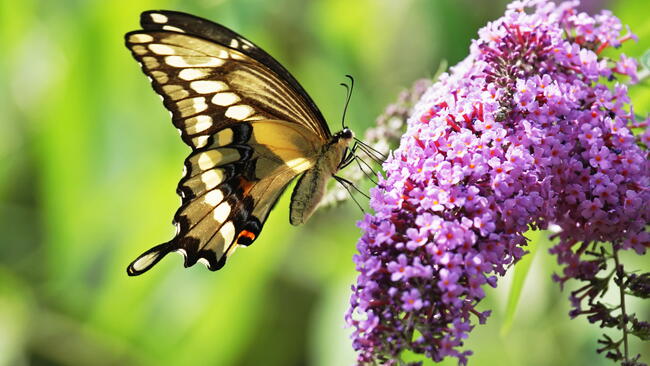
For early flowers, try Syringa x hyacinthiflora hybrids; they bloom 7 to 10 days before S. vulgaris. Its fragrant blooms attract butterflies and hummingbirds.
The most common and fragrant lilacs are of the S. vulgaris variety:
- Try ‘Charles Joly’, a double magenta flower, an early bloomer.
- Mid-season lilacs include ‘Monge’, a dark reddish purple, and ‘Firmament’, a fine blue.
- Late-season beauties include ‘Miss Canada’, a reddish-pink, and ‘Donald Wyman’, a pink-purple flower.
Uncommon types/varieties include …
- S. x ‘Penda’ Bloomerang Purple: flowers in spring, pauses, then flowers again from midsummer through fall.
- Although common lilacs love cold weather, a few thrive as far south as Zone 8, including cutleaf hybrid S. x laciniata, with fragrant, pale lavender flowers, and S. pubescens ssp. patula ‘Miss Kim,’ with pale, lilac-blue blooms that fade to white.
Small Lilacs
For gardeners, especially those in urban spaces, who just don’t have the room for the traditional larger lilac, there are compact varieties! They’ll even grow in a container on your patio or balcony.
- ‘Baby Kim’ grows only 2 to 3 feet high (and 3 feet wide) in a nicely rounded shape with purple flowers that attract butterflies. Extended hardiness from Zones 3 to 8.
- ‘Little Lady’ (S. x) is a compact lilac that matures to 4 to 5 feet tall and wide with dark pink buds that open to lilac-pink flowers. Hardy in Zones 2 to 7.
- ‘New Age Lavender’ and ‘New Age White’ (S. vulgaris) are super-compact, growing from 4 to 5 feet tall and wide, and bred for mildew resistance. Their fragrant flowers attract butterflies and hummingbirds. Hardy to Zone 4.



My Lilac was a gift 4 years earlier, I transplanted it this spring due to damage @ the base w/much of it dead. The main branch was moved to a sloped area which gets sun/shade. I went on vacation, there was considerable rain, when I returned, leaves were curled, it is still alive tho', I was told it might be infested w/aphids, I sprayed w/Neam's Oil. I'd be sorry to lose this as it was a gift from my daughter. Should I cut it back, transplant it, need help here!

Don't prune or transplant now. Let the lilac adjust to its new spot. Check for bugs and spray again if needed. The lilac is a hardy plant and will survive if it wasn't damaged too badly.
Hello! I just planted a Miss Canada lilac from a 2 gallon bucket to the ground yesterday, and today it is drooping and the blossoms on it are dying. I am worried I shocked it too much and it may die. Any suggestions as to how to keep it going strong? It rained heavily last night during a thunderstorm but I haven't watered it since for fear of too much water. I have it 4 feet from my deck in a sunny location next to a mulched walkway. I am located in Northwestern PA.
I have a Lilac bush that has been planted for about 6 years, all that grows on it is leaves. It's always had 2 suckers and they are only about 2 ft.tall. Is there something I need to do with the soil to help it grow more suckers and flowers?
If your lilacs are in full sun and aren't overfertilized, they should flower. To shock your lilac into flowering next season, try driving a spade into the soil around the base of the plants to cut off some of the roots, but not all. Avoid any lawn fertilizer near the root zone. Do not prune. If they don't grow next year, then they need to be in a sunnier spot. Also: If you are pruning too late in the season, they will not bloom.
I have a 3 year old lilac that has bloomed well in the past but only has two blooms this year. May I assume the same advice will apply? I also realize that I need to keep the peeing dog away. Thanks.
Have you had any luck finding an answer? I too have a beautiful Miss Kim lilac about 3 years old, lots of healthy leaves but no buds or blooms....maybe the soil is too acid?
Yes, it is also possible that you don't have the right soil pH. Lilacs do not like acid soil. Get it tested. Call your county cooperative extension.
Lack of blooms is usually related to lack of sunlight or using nitrogen fertilizer (don't). Another common reason is pruning at the wrong time. If you prune in July or later, you are cutting off next season's flower buds. Just stop pruning. We're not sure where you live, but winterkill of flower buds could be another reason; if so, you need milder winters or a heartier lilac. Finally, it is important that lilacs aren't planted too deeply. The top of the roots should be slightly exposed; pull back the soil if needed.
Hello! I recently moved into a house on Cape Cod. The yard has not been maintained and I just noticed that we have two lilacs on the property. I almost missed them because they are really tall and very skinny! One of them only has one branch and is about 9 feet tall with 3 flowers at the very top!! Should I trim the one branch to eye level like you suggested? Is there any way I can get it to spread its wings, so to speak? thanks for any help!
- « Previous
- 1
- 2
- …
- 10
- Next »
📣The Gardening Club Just Got Better! 3 Deliveries, 10% Store Discount, and more!

Comments