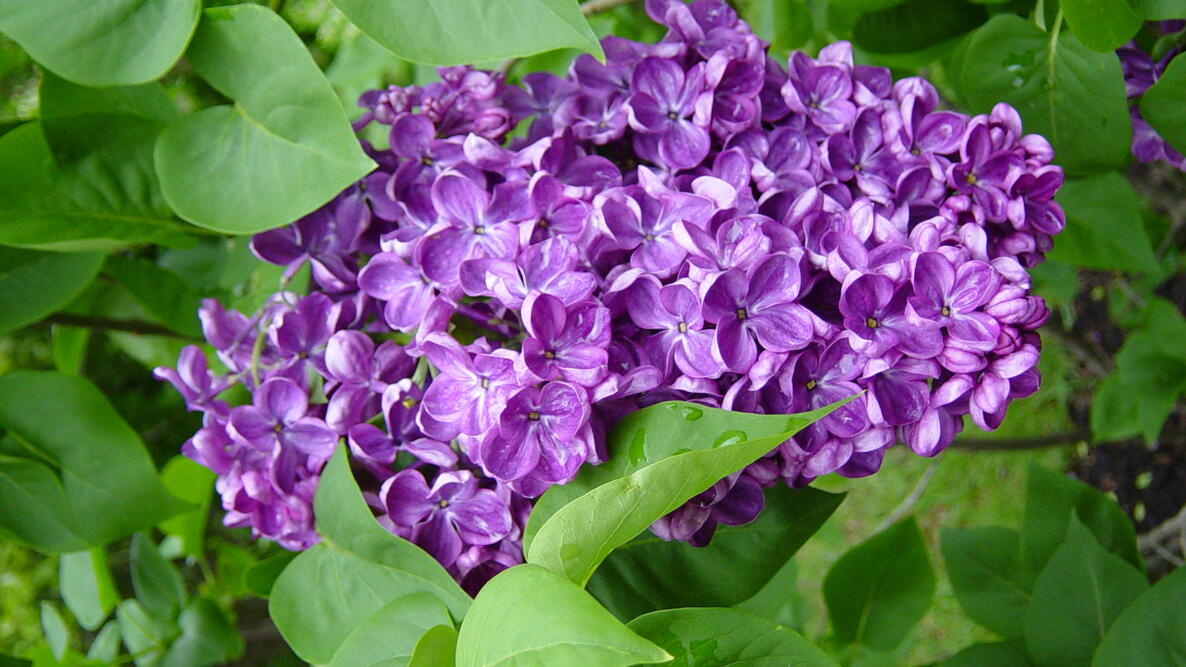
Caption
Huge blooms, wonderful scent.
Image Credit:
Wally Patrick
Botanical Name
Syringa spp.
Grown as
Toxicity
Sun Exposure
Water Needs
Height
Spread
Soil pH
Resilience
Plant Type
Types
For early flowers, try Syringa x hyacinthiflora hybrids; they bloom 7 to 10 days before S. vulgaris. Its fragrant blooms attract butterflies and hummingbirds.
The most common and fragrant lilacs are of the S. vulgaris variety:
- Try ‘Charles Joly’, a double magenta flower, an early bloomer.
- Mid-season lilacs include ‘Monge’, a dark reddish purple, and ‘Firmament’, a fine blue.
- Late-season beauties include ‘Miss Canada’, a reddish-pink, and ‘Donald Wyman’, a pink-purple flower.
Uncommon types/varieties include …
- S. x ‘Penda’ Bloomerang Purple: flowers in spring, pauses, then flowers again from midsummer through fall.
- Although common lilacs love cold weather, a few thrive as far south as Zone 8, including cutleaf hybrid S. x laciniata, with fragrant, pale lavender flowers, and S. pubescens ssp. patula ‘Miss Kim,’ with pale, lilac-blue blooms that fade to white.
Small Lilacs
For gardeners, especially those in urban spaces, who just don’t have the room for the traditional larger lilac, there are compact varieties! They’ll even grow in a container on your patio or balcony.
- ‘Baby Kim’ grows only 2 to 3 feet high (and 3 feet wide) in a nicely rounded shape with purple flowers that attract butterflies. Extended hardiness from Zones 3 to 8.
- ‘Little Lady’ (S. x) is a compact lilac that matures to 4 to 5 feet tall and wide with dark pink buds that open to lilac-pink flowers. Hardy in Zones 2 to 7.
- ‘New Age Lavender’ and ‘New Age White’ (S. vulgaris) are super-compact, growing from 4 to 5 feet tall and wide, and bred for mildew resistance. Their fragrant flowers attract butterflies and hummingbirds. Hardy to Zone 4.



I received a dwarf lilac as a house warming gift and because it was in full bloom at the time (currently) , I'm greeted with that wonderful fraquence every time I reenter my apartment. Can I expect this smell after the blossoms fall?

We also love the fragrance of lilacs! The fragrance is from the blooms, so you'll have to wait until next spring. To ensure you have blooms next year, be sure to prune at the right time--AFTER flowering. Lilacs bloom on old wood. The flower buds are set during the summer for flowers the following spring. Therefore, prune within six weeks after bloom so you give your lovely lilac time to grow new wood and buds for the next spring season.
We have to burn a house to the ground. There are very mature lilacs and other flowering trees around the house that will die from the fire. We were told by a local gardener that there is no way we can salvage these plantings and we should just let them burn. Our local nursery manager told us that we could move them, but there is a chance there may be some damage and that they probably will not bloom this summer. I think its worth it to try to save them? What do you advise? Is the gardener that told us she wont move them wrong?
I had two "Miss Kim Lilac Bushes" that I had for three years and they always bloomed profusely. When we moved...I dug them up and took them to my new house. The first year after replanting..I got a few flowers on each bush. But in the last two years, I haven't had one bloom. The bushes are healthy, get the right amount of sunlight and the bushes are only 6 years old. I wonder if moving them, did something to cause them not to bloom. I wish you the best of luck with your lilacs.
Based on what you have told us, you could try digging up the lilacs and transplanting. If they are large and old, it may be difficult; transplanting could remove part of the root system which is stressful to the plant. However, it can be done with care. Be aware that it may also take 1 to 3 years for it to recover and bloom. If you do it, the timing must be right: when they are dormant in early spring BEFORE the plant leafs out. In general, small lilacs do transplant well as long as they are not coming into leaf. We hope this helps.
I want to start my new lilac suckers in pots to keep on my deck until they are mature enough to plant in the ground (probably 6-12 mos). What size pots, what medium, and what ammendments if any do you recommend? I live in zone 6. Thanks.
Plant the suckers in 1 gallon pots. Use a good potting mix and keep the soil moist. You can add a root stimulator but often the suckers will start growing without any help. Good luck!
Just bought this plant today online and can't wait to get it. It is end of March and we live in Missouri. The plant will come in 2x3" pot, very small. I bought 2 of them. Can I plant them together in one big pot? Can I keep them in the pot until they grow taller- a few years? Should I use fertilizer? Thank you
A gem of a lilac! Ideally, lilacs prefer to be planted outside to truly thrive. They can grow in pots though. In terms of fertilizer: do not overdo it. A little phosphorus is fine but nitrogen feeds foliage instead of flowers. I am unclear as to the size of your lilac but can tell you that a 4-inch container is good for starting a cutting (one per pot) and they you'd want to move to a 1-gallon container by late summer. Hope this helps.
I have had my (2) Lilac bushes for 4 yrs now and they have not bloomed at all. I planted them when they were very small and now they are about 3' high with beautiful green leaves, but no Lilacs. I need to know what to do with them to get them to bloom.
- « Previous
- 1
- 2
- …
- 10
- Next »
📣The Gardening Club Just Got Better! 3 Deliveries, 10% Store Discount, and more!

Comments