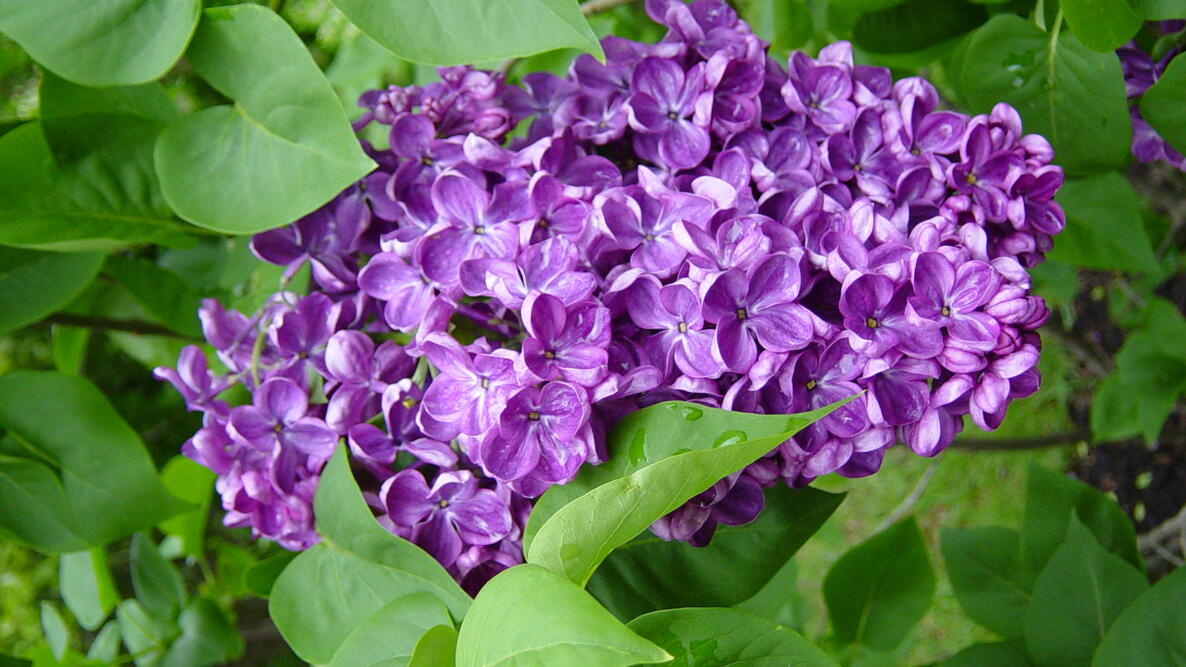
Caption
Huge blooms, wonderful scent.
Image Credit:
Wally Patrick
Botanical Name
Syringa spp.
Grown as
Toxicity
Sun Exposure
Water Needs
Height
Spread
Soil pH
Resilience
Plant Type
Types
For early flowers, try Syringa x hyacinthiflora hybrids; they bloom 7 to 10 days before S. vulgaris. Its fragrant blooms attract butterflies and hummingbirds.
The most common and fragrant lilacs are of the S. vulgaris variety:
- Try ‘Charles Joly’, a double magenta flower, an early bloomer.
- Mid-season lilacs include ‘Monge’, a dark reddish purple, and ‘Firmament’, a fine blue.
- Late-season beauties include ‘Miss Canada’, a reddish-pink, and ‘Donald Wyman’, a pink-purple flower.
Uncommon types/varieties include …
- S. x ‘Penda’ Bloomerang Purple: flowers in spring, pauses, then flowers again from midsummer through fall.
- Although common lilacs love cold weather, a few thrive as far south as Zone 8, including cutleaf hybrid S. x laciniata, with fragrant, pale lavender flowers, and S. pubescens ssp. patula ‘Miss Kim,’ with pale, lilac-blue blooms that fade to white.
Small Lilacs
For gardeners, especially those in urban spaces, who just don’t have the room for the traditional larger lilac, there are compact varieties! They’ll even grow in a container on your patio or balcony.
- ‘Baby Kim’ grows only 2 to 3 feet high (and 3 feet wide) in a nicely rounded shape with purple flowers that attract butterflies. Extended hardiness from Zones 3 to 8.
- ‘Little Lady’ (S. x) is a compact lilac that matures to 4 to 5 feet tall and wide with dark pink buds that open to lilac-pink flowers. Hardy in Zones 2 to 7.
- ‘New Age Lavender’ and ‘New Age White’ (S. vulgaris) are super-compact, growing from 4 to 5 feet tall and wide, and bred for mildew resistance. Their fragrant flowers attract butterflies and hummingbirds. Hardy to Zone 4.


There a few things that could be going wrong:
Check your soil’s acidity. Lilacs prefer soil pH from 6 to 7. You can find soil testing kits at most garden centers.
Perhaps your lilac is not getting enough sun. Lilacs need at least 6 hours of sunlight per day.
Lilac bushes tend to not bloom for the first few years, though it sounds like you were lucky to have blooms in year 1. They spend the first 3 years getting established and start to bloom regularly by age 6.
Hang on! It is worth it!
I live in Tucson and have two lilac in large pots. Each year about May they get many holes in their leaves about the size of a quarter. We have seen bees cutting away the leaves. Is this damaging to the plants and is there anything to prevent it?
Are the holes round and perfectly shaped? If so, they are not honeybees or your traditional bees. As you live out West, you may have "leafcutter" bees. The damage is only aesthetic and minor as they're just cutting bits of the leaves for their nesting. They are not aggressive with humans. Importantly, they are valuable pollinators for your garden so we'd leave them be. Pesticides don't work and their nests are hard to find so you don't have much choice.
Every spring, as soon as my lilacs bloom, they are invaded with bees, butterflies, sphinx moths and hummingbirds which destroy the flowers. What can I do to repel these pests?
Oh my dear, these are the pollinators that make the blooms and beauty of the garden possible. They are not destroying the lilac. The lilac is actually using its floral scent to attract these beneficial insects.
Did you just call hummingbirds, bees and butterflies pests? Seriously? Last I checked, plants are marketed specifically to attract these desirable and necessary fauna. It's called "ecosystem"...Check out concrete paving. That attracts nothing. Not even people. (Just cars)
At my grandparents homestead where I live and grew up, there is a patch of lilac, no more than 4' tall that has never bloomed in my entire life time. We are talking 40+ years. What's wrong? Are they too old? Should they be cut back? It's an issue I've pondered for some time. Its a lovely shrub, but would love to see it bloom.
My lilacs are currently in bloom. Yesterday I pruned out a ton of dead wood, but nothing green. Was this a bad thing?
Do I cut back the blooms on these after they bloom the first time in the spring so they will bloom again?
Yes, you prune right after bloom in the spring but do it before new flower buds set. So prune after May and before July. The lilacs bloom once each season and they'll bloom again next spring.
- « Previous
- 1
- 2
- …
- 10
- Next »
📣The Gardening Club Just Got Better! 3 Deliveries, 10% Store Discount, and more!

Comments