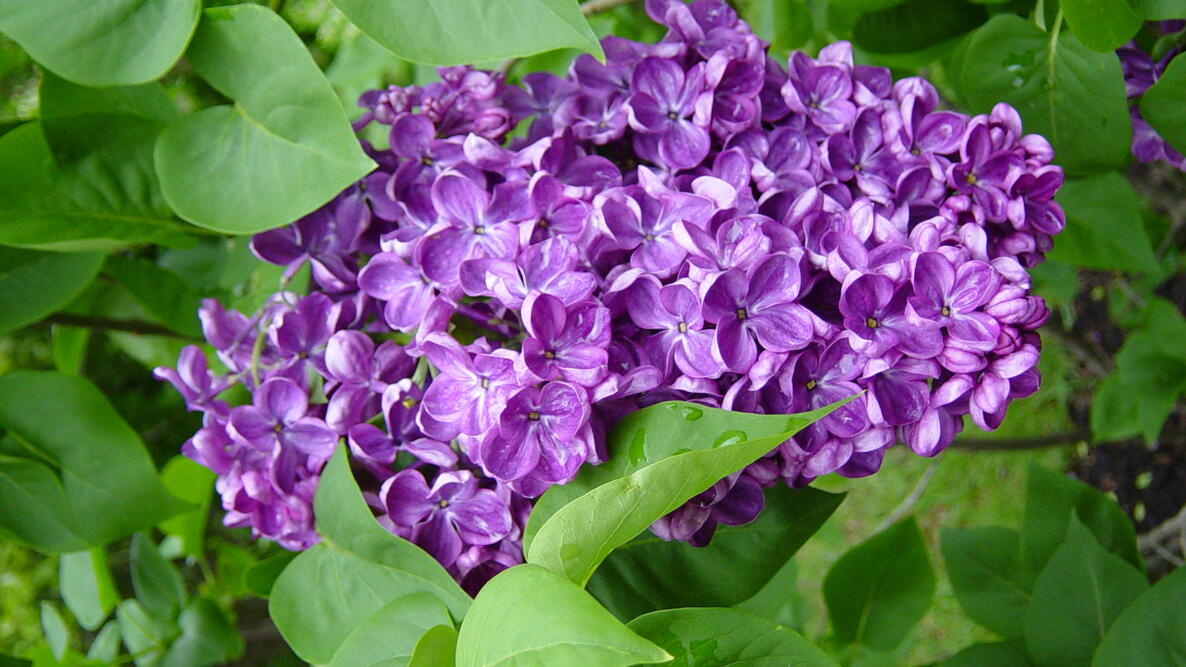
Caption
Huge blooms, wonderful scent.
Image Credit:
Wally Patrick
Botanical Name
Syringa spp.
Grown as
Toxicity
Sun Exposure
Water Needs
Height
Spread
Soil pH
Resilience
Plant Type
Types
For early flowers, try Syringa x hyacinthiflora hybrids; they bloom 7 to 10 days before S. vulgaris. Its fragrant blooms attract butterflies and hummingbirds.
The most common and fragrant lilacs are of the S. vulgaris variety:
- Try ‘Charles Joly’, a double magenta flower, an early bloomer.
- Mid-season lilacs include ‘Monge’, a dark reddish purple, and ‘Firmament’, a fine blue.
- Late-season beauties include ‘Miss Canada’, a reddish-pink, and ‘Donald Wyman’, a pink-purple flower.
Uncommon types/varieties include …
- S. x ‘Penda’ Bloomerang Purple: flowers in spring, pauses, then flowers again from midsummer through fall.
- Although common lilacs love cold weather, a few thrive as far south as Zone 8, including cutleaf hybrid S. x laciniata, with fragrant, pale lavender flowers, and S. pubescens ssp. patula ‘Miss Kim,’ with pale, lilac-blue blooms that fade to white.
Small Lilacs
For gardeners, especially those in urban spaces, who just don’t have the room for the traditional larger lilac, there are compact varieties! They’ll even grow in a container on your patio or balcony.
- ‘Baby Kim’ grows only 2 to 3 feet high (and 3 feet wide) in a nicely rounded shape with purple flowers that attract butterflies. Extended hardiness from Zones 3 to 8.
- ‘Little Lady’ (S. x) is a compact lilac that matures to 4 to 5 feet tall and wide with dark pink buds that open to lilac-pink flowers. Hardy in Zones 2 to 7.
- ‘New Age Lavender’ and ‘New Age White’ (S. vulgaris) are super-compact, growing from 4 to 5 feet tall and wide, and bred for mildew resistance. Their fragrant flowers attract butterflies and hummingbirds. Hardy to Zone 4.

I have a lilac bush that my aunt gave me a long time ago. The bush is probably 10X10ft. It's at my childhood home where my brother lives. You have inspired me to go dig up some of the suckers to plant in my yard . I will wait until Fall to do so as I think it may be too late now. I'll be going for the 4 ft or taller suckers on the outskirts of the main plant. Again, thanks for sharing your knowledge and letting us all know how easy it is to grow these beautiful plants. They have been my favorite since I found them as a small child in my aunt's yard.
Being from Illinois, the one thing I miss in spring is the Lilacs. South Alabama is no place to grow them, all Northerners enjoy!
I live in South Carolina and have a lilac bush in my yard. It blooms in April every year. I don't understand why you say South Alabama is no place to grow lilacs. I have even separated my bush and replanted it with great success. Have you tried growing lilacs in Alabama? If not, you might want to give it a try.
the next door's workmen have hacked at my lilac plant and its in a right mess, if i up root it to re plant it, will it grow ok?

If the roots are still in the ground, leave it. Lilacs are very tough plants and should survive. You may see some growth but not blooms this year. Cut out any hacked stems. Unfortunately, this would be a bad time to replant. The best time is early spring and the next best time is the fall after the leaves have dropped. Wait til then if you can.
I want to plant a lilac bush in a spot where it will have full sun in winter and early spring, but only partial after mid-May. This means it will have good sun through it's blooming season (I am in the north east), but then less through summer and fall. What do you all think? Enough sun? Thanks!
As long as they get 6 hours of sun through the end of their blooming season, they should be OK. They really need the sun to bloom profusely.
We've taken shoots from the same original purple lilac bush over the years and planted them in different places through out the property, all in full sun. But the blooms of each new bush seem to be a shade or 2 different than the parent, some darker, some lighter, some redder. What causes this?
Would lilacs do well in an area like Houston Texas. Not too much chill here, even in the winter.
Some of our readers have had success with the 'Miss Kim' lilac and the Persian Lilac (Syringa persica) as they are low-chill hybrids. However, it's not a sure bet because lilacs just love that long winter chill and simply aren't native to this area. Here are some possible substitutions: Crepe Myrtle, Texas Mountain Laurel, and the Lilac Chaste Tree (Vitex agnus-castus).
- « Previous
- 1
- 2
- …
- 10
- Next »
📣The Gardening Club Just Got Better! 3 Deliveries, 10% Store Discount, and more!

Comments