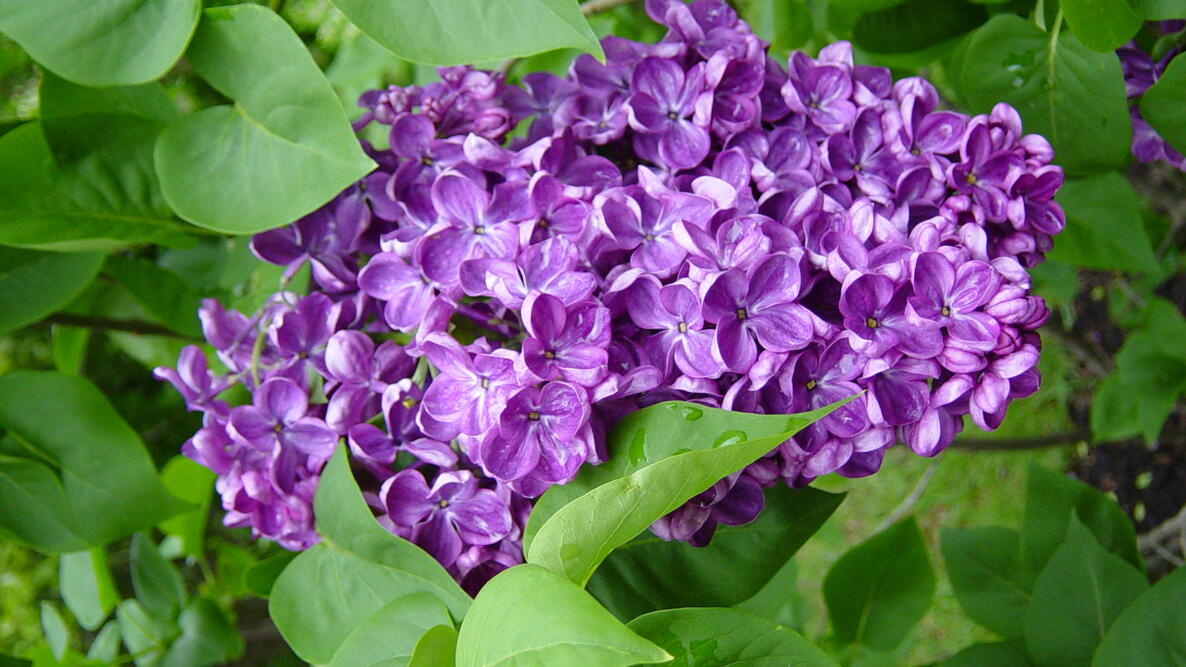
Caption
Huge blooms, wonderful scent.
Image Credit:
Wally Patrick
Botanical Name
Syringa spp.
Grown as
Toxicity
Sun Exposure
Water Needs
Height
Spread
Soil pH
Resilience
Plant Type
Types
For early flowers, try Syringa x hyacinthiflora hybrids; they bloom 7 to 10 days before S. vulgaris. Its fragrant blooms attract butterflies and hummingbirds.
The most common and fragrant lilacs are of the S. vulgaris variety:
- Try ‘Charles Joly’, a double magenta flower, an early bloomer.
- Mid-season lilacs include ‘Monge’, a dark reddish purple, and ‘Firmament’, a fine blue.
- Late-season beauties include ‘Miss Canada’, a reddish-pink, and ‘Donald Wyman’, a pink-purple flower.
Uncommon types/varieties include …
- S. x ‘Penda’ Bloomerang Purple: flowers in spring, pauses, then flowers again from midsummer through fall.
- Although common lilacs love cold weather, a few thrive as far south as Zone 8, including cutleaf hybrid S. x laciniata, with fragrant, pale lavender flowers, and S. pubescens ssp. patula ‘Miss Kim,’ with pale, lilac-blue blooms that fade to white.
Small Lilacs
For gardeners, especially those in urban spaces, who just don’t have the room for the traditional larger lilac, there are compact varieties! They’ll even grow in a container on your patio or balcony.
- ‘Baby Kim’ grows only 2 to 3 feet high (and 3 feet wide) in a nicely rounded shape with purple flowers that attract butterflies. Extended hardiness from Zones 3 to 8.
- ‘Little Lady’ (S. x) is a compact lilac that matures to 4 to 5 feet tall and wide with dark pink buds that open to lilac-pink flowers. Hardy in Zones 2 to 7.
- ‘New Age Lavender’ and ‘New Age White’ (S. vulgaris) are super-compact, growing from 4 to 5 feet tall and wide, and bred for mildew resistance. Their fragrant flowers attract butterflies and hummingbirds. Hardy to Zone 4.




The size of the flowers may be caused by the weather this past winter and early spring.
Too much nitrogen in the soil can also cause poor blooming. Use a fertilizer high in phosphorus. A tip from the Almanac archives is to spread your fireplace ashes around the lilac bush for bigger, better blooms.
We have had a lilac tree for about 3-4 years now. It has yet to bloom. It's aprrox. 7' in height. After we bought it and planted it, we found a better spot for it so decided to transplant it. I thought perhaps it was in shock. The leaves look great as does the tree itself. Any help would be greatly appreciated. I have no idea what kind of lilac it is though. Thank you in advance. Lesley
I had the same problem. Lilac plant beautiful but would not bloom. I removed trees that kept the lilac in the shade and
fed it lots of lime. The next year it bloomed.
If your lilac plant is only 3 to 4 years old and you have never seen blooms on it, it may not be mature enough to produce flowers. You may need to be patient and wait another year. Or, it may be due to other factors. Does your new location have full sunlight and dry soil? No sun, no blooms. Did you plant too deep? Is it the right type of lilac for your region? Are you using a fertilizer with too much nitrogen? And you pruning incorrectly--see this page on how to prune lilacs so that you do not remove its very buds for next next year's growth.
I live in the tri-corner of CA, NV, and AZ. I want to plant a lilac in my barren backyard. I have many wind chimes and bird baths but no trees or other bushes, back yard is very sunny and windy except close to the house. What lilac is best for my area and conditions?
Given the heat, try Persian lilac or Chinese lilac. They are low-chill lilacs (which normally need a chill) and best for desert areas.
Will I stunt the growth (blooms) of Charles Joly shrub if I plant it in a huge pot instead of in the ground?
This shrub appears to be fine for containers: http://www.buyplantsonline.com/charles-joly-lilac-plant-one-gallon.html
I bought a Charles Joly lilac bush from a nursery and was ready to plant it, but when I started to dig the whole, I found that about a foot into the dirt, I hit clay and rock. Now I'm afraid to plant it there. Although there are trees and bushes growing all around. Should I find another place?
Lilacs are actually one of the plants that will tolerate clay soil with a pH of 6 to 7. Working compost in with the soil will help provide nutrients.
In terms of proximity to other trees and shrubs: Be sure they are spaced properly. A Charles Joly Lilac is a medium-size lilac shrub and should be spaced 4 to 7 feet apart to allow it to spread. Also, lilacs prefer 5 to 6 hours of sun so you don’t want them shaded by other trees and shrubs.
- « Previous
- 1
- 2
- …
- 10
- Next »
📣The Gardening Club Just Got Better! 3 Deliveries, 10% Store Discount, and more!

Comments