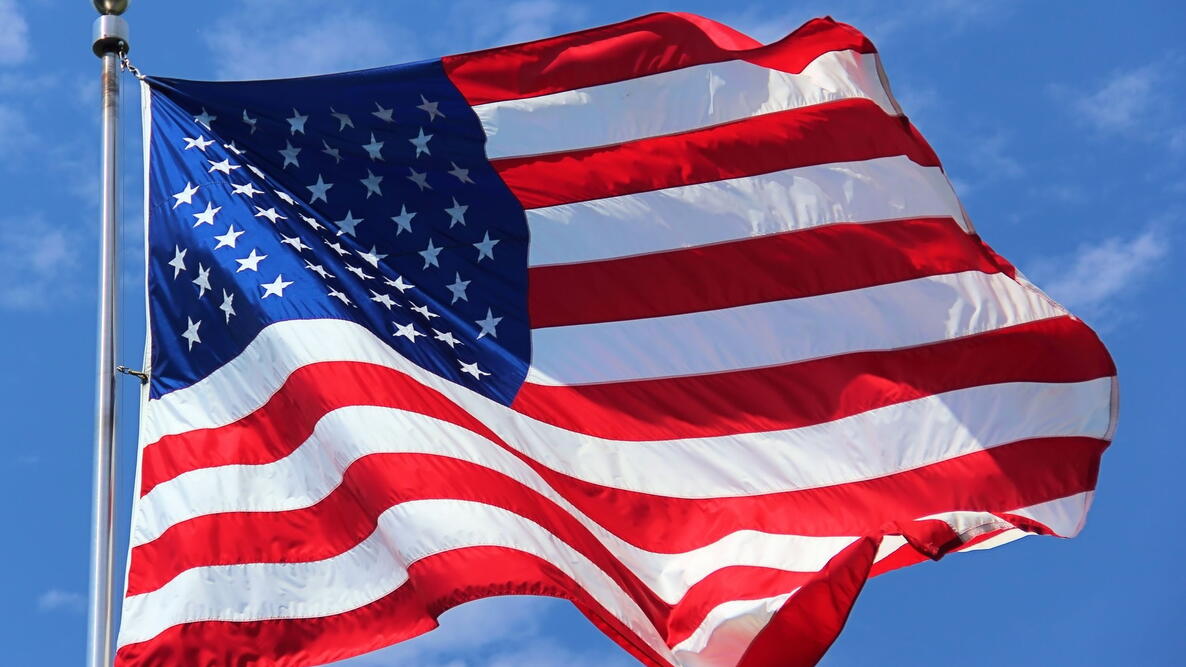
How to Properly Display the American Flag
Wondering how to display the American flag? When is it flown at half-staff? What happens if it touches the ground? Here is a list of rules and guidelines on American flag etiquette and the U.S. Flag Code.
Honoring the U.S. Flag Code
On June 22, 1942, Congress passed a joint resolution, later amended on December 22, 1942, that encompassed what has come to be known as the U.S. Flag Code.
Note: Although this is a U.S. federal law, following the Flag Code is voluntary and meant as a guideline. The flag of the United States is the emblem of our identity as a sovereign nation, which the United States of America has been for well over 200 years.
Perhaps the most important guideline involves how citizens should behave around the Stars and Stripes. For example, members of the armed services and veterans are asked to stand at attention and salute when their flag is passing in a parade or being hoisted or lowered; civilians should place their right hand over their hearts.
It may appear as if there are an overwhelming number of guidelines below; however, this article has become longer over time to answer the many questions that have come up. You will see more questions from readers in the comments!
Did you know: A flag expert is called a vexillologist!
When to Display the Flag
The flag is a symbol of respect, honor, and patriotism. It may be displayed on any day of the year according to the following guidelines:
The flag should not be displayed on days when the weather is inclement. The custom is to display the flag only from sunrise to sunset on flagstaffs in the open, but it may be displayed at night—if illuminated—to produce a patriotic effect. The flag should be displayed on all days, especially on:
| New Year’s Day, January 1 |
|---|
| Inauguration Day, January 20 |
| Martin Luther King Jr.’s birthday, the third Monday in January |
| Lincoln’s Birthday, February 12 |
| Washington’s Birthday, the third Monday in February |
| National Vietnam War Veterans Day, March 29 |
| Easter Sunday (variable) |
| Mother’s Day, the second Sunday in May |
| Peace Officers Memorial Day, May 15 |
| Armed Forces Day, the third Saturday in May |
| Memorial Day (half-staff until noon), the last Monday in May |
| Flag Day, June 14 |
| Father’s Day, the third Sunday in June |
| Independence Day, July 4 |
| National Korean War Veterans Armistice Day, July 27 |
| Labor Day, the first Monday in September |
| Constitution Day, September 17 |
| Indigenous Peoples’ Day/Columbus Day, the second Monday in October |
| Navy Day, October 27 |
| Veterans Day, November 11 |
| Thanksgiving Day, the fourth Thursday in November |
| Christmas Day, December 25 |
| Other days as may be proclaimed by the President of the United States |
| Birthdays of states (date of admission) |
| State holidays |
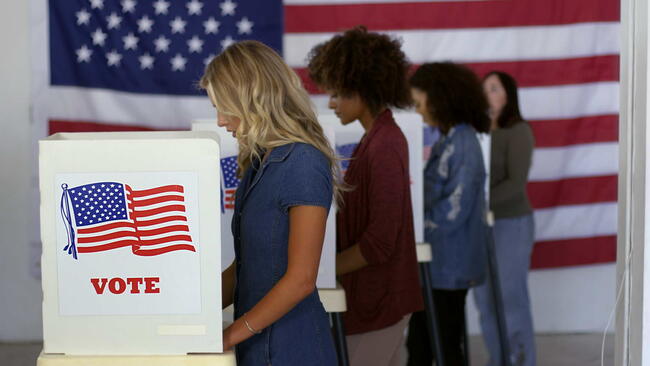
- The flag should be displayed at every public institution, in or near every polling place on election days, and at schoolhouses during school days.

How to Properly Display the American Flag
As a symbol of the country and its people, the flag should be treated with respect and be honored when on display. In order to treat the flag with the dignity it deserves, the following display guidelines are recommended.
General Guidelines for Displaying the Flag:
- When the flag is hung vertically on a wall, window, or door, the union (blue section) should be to the observer’s left. When the flag is hung either horizontally or vertically against a wall, the union should be to the observer’s left.
- In a procession, the American flag should be to the right (the flag’s own right) of any other flag or, if in a line of other flags, in front of the center of that line.
- When displayed from a staff projecting from a building, the union should be at the peak of the staff.
- When the flag is displayed otherwise than by being flown from a staff, it should be displayed flat, whether indoors or out, or so suspended that its folds fall as freely as though the flag were staffed.
- When displayed over a street, the flag should be suspended vertically with the union to the north in an east and west street or to the east in a north and south street.
- On a platform, the flag should be above and behind the speaker, with the union uppermost and to the observer’s left.
- When displayed from a staff in a church or auditorium, the flag should occupy the position of honor and be placed at the speaker’s right as he faces the audience.
- When the flag is used to cover a casket, the union should be at the head and over the left shoulder.
Hoisting and Lowering the Flag:
- The flag should be hoisted briskly and lowered ceremoniously.
- When flown at half-staff, the flag should be first hoisted to the peak for an instant and then lowered to the half-staff position. It should again be raised to the peak before it is lowered for the day. Half-staff is one-half the distance between the top and bottom of the staff. The flag must be flown at half-staff on all buildings on the death of any officer (of the U.S.) listed below for the period indicated:
- For the president or a former president: 30 days from the date of death.
- For the vice president, the chief justice or a retired chief justice of the United States, or the Speaker of the House of Representatives: 10 days from the day of death.
- For an associate justice of the Supreme Court, a member of the Cabinet, a former vice president, the president pro tempore of the Senate, the majority leader of the House of Representatives, or the minority leader of the House of Representatives: from the day of death until interment.
- For a United States senator, representative, delegate, or the resident commissioner from the Commonwealth of Puerto Rico: The flag should be flown in the metropolitan area of the District of Columbia on the day of death and on the following day; in the state, congressional district, territory, or commonwealth of such senator, representative, delegate, or commissioner, from the day of death until interment.
- For a governor: within the state, territory, or possession, from the day of death until interment.
Displaying the American Flag on a Vehicle:
- The flag should not be displayed on a float except from a staff, nor draped over the hood, top, sides, or back of a vehicle.
- When the flag is displayed on a vehicle, the staff should be fixed firmly to the chassis.
Displaying the American Flag Alongside Other Flags:
- In the United States, no other flag should be placed above the American flag or, if they are to be placed on the same level, to the right of the American flag.
- The United Nations flag may not be displayed above or in a position of superior prominence to the United States flag except at the United Nations Headquarters.
- The flag, when displayed with another against a wall—both from crossed staffs—should be on the right (the flag’s own right), and its staff should be in front of the other staff.
- The American flag should be at the center and the highest point when displayed with a group of state flags.
- When flags of states, cities, etc., are flown on the same halyard, the American flag should be at its peak.
- When flags of two or more nations are displayed, they are to be flown from separate staffs of the same height, and the American flag should be hoisted first and lowered last.

How Not to Display the American Flag
The flag and its likeness should be treated with respect. Its image should not be cheapened or tarnished by improper use.
- The flag should not be dipped to any person or thing, including government officials—even the president.
- The flag should never be displayed with the union (stars) down, unless as a signal of dire distress.
- The flag should never touch anything beneath it, such as the ground, the floor, water, or merchandise.
- The flag should never be carried flat or horizontally but always aloft and free.
- The flag should never be fastened, displayed, used, or stored so that it might be easily torn, soiled, or damaged in any way.
- The flag should never be used to cover a ceiling.
- The flag should never have anything placed on it.
- The flag should never be used for any advertising purpose, embroidered on cushions or handkerchiefs, printed on paper napkins or boxes, nor used as any portion of a costume.
How to Properly Dispose of an American Flag
- If the U.S. flag does touch the ground, it does not need to be disposed of. This is a myth. Just ensure the flag is washed or dry-cleaned.
- However, when the flag is torn or in a condition such that it is no longer a fitting emblem, it should be destroyed in a dignified and ceremonious fashion, preferably by burning.
- Most American Legion posts will conduct an annual ceremony, often on Flag Day (June 14), to retire old or worn flags; contact your local chapter if you are unable to dispose of the flag yourself. You could also ask your local Boy Scouts or Girl Scouts troops about retiring your flag.

More Like This



Hi, Ailisha: Yes, they may, because at that point they are just pieces of fabric in the shape of a star—not an actual flag. Thanks for caring so much to ask!
Hi, Hal: The pole can really be placed anywhere that would enable Old Glory to fly freely and not be encumbered by the building. If you are asking with regard to positioning at the front of the building, usually the pole would be placed somewhere to the left of the main entrance, as you faced it—although this is not necessary. Thanks for caring so much to ask!
Hi, Richard: Black (or deep purple) mourning ribbons really have no set rules. Technically, they can be of any length (because—really—it's the thought that counts, and many, many people are just not equipped to show their respect in exactly the right way), and they can be flown from Old Glory in any position. Yes, it is most customary to fly a ribbon when the half-staff position is not possible, but it is also OK to do so when the Stars and Stripes are indeed at half-staff, sort of as an extra measure of solemnity, so to speak. And yes, it is customary—but not necessary—for the ribbon to be the length (or "fly") of the flag (which would equate to your example of a ribbon twice as long that is draped—and thus halved—across the staff). And while a double ribbon is often preferred, a single one also works just fine. The most important thing is just for folks to do the best they can with what they have. Thanks for being so patriotic to ask!
Hi, Shane: Thank you for treating Old Glory so respectfully by retiring her when she became worn. Still, though, she is now retired and should no longer be displayed, except if for some special reason or meaning you wished to frame her and keep her under glass, as is often done with historical flags. But, basically, the moral of the story is that if Old Glory is too bedraggled to be flown on a pole, she is also by definition too bedraggled to be hung on a wall. Thanks for being so patriotic to ask!
Hi, Linda: Your congressman is correct... and incorrect. In fact, there is an Army regulation stating that from a military standpoint, the eagle finial (aka "Presidential Eagle") is reserved for the president, as commander-in-chief of the Army. However, there is no law or rule anywhere that restricts its use to the president, and in fact the eagle is employed by many other officials, agencies, and organizations. Interestingly, there are actually two types of eagle finials, the Presidential Eagle (which is somewhat flat, with the eagle looking to its right) and the Spread (or Naval) Eagle (which is somewhat more 3-D, with the eagle looking straight ahead, wings swept back). Thanks for caring so much to ask!
- « Previous
- 1
- 2
- …
- 10
- Next »

Comments