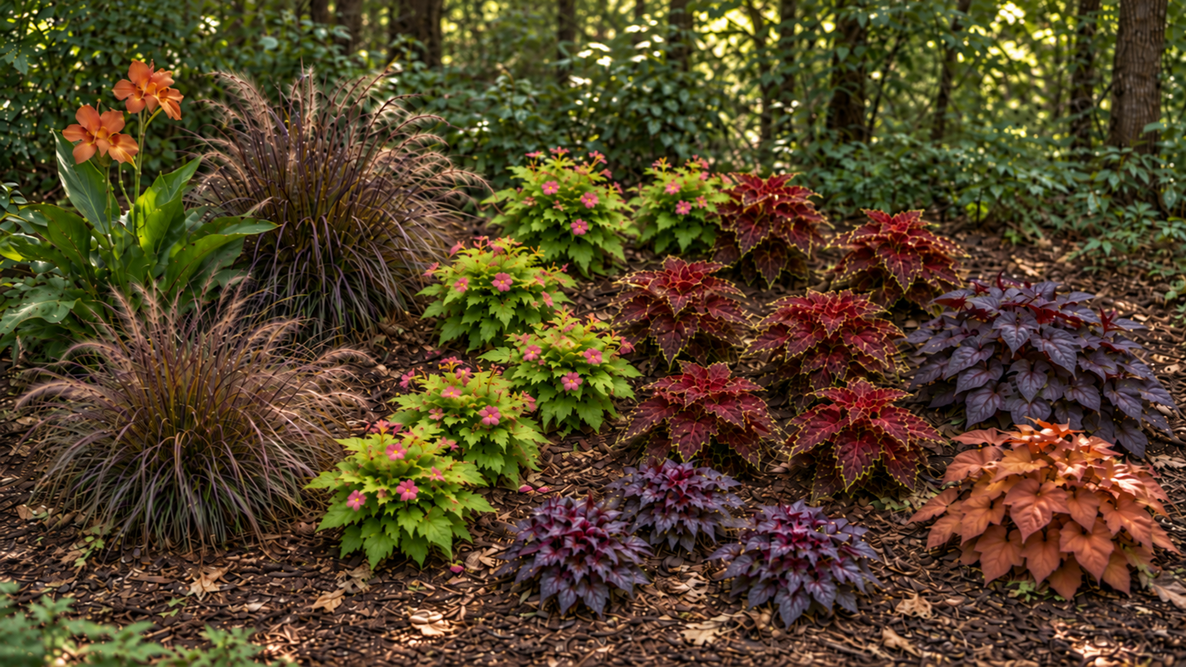
Caption
An illustration showing how this shade garden uses foliage and flowers to create season-long interest.
Have a partly shaded spot that needs color? This shade garden layout uses bold foliage in chartreuse, burgundy, bronze, and purple to create season-long interest without relying on flowers.
This plan is designed for part shade—about 4 to 6 hours of sun a day or bright, dappled light—not deep shade. It combines canna, purple fountain grass, four-o’clocks, coleus, alternanthera, and sweet potato vine in a lush, low-maintenance planting for a partly shaded corner or accent bed.
Quick Plan Overview
| Feature | Details |
|---|---|
| Garden Type | Foliage shade garden |
| Difficulty | Beginner |
| Sun Exposure | Part shade; about 4 to 6 hours of sun or bright, dappled light |
| Season | Late spring through frost |
| Soil | Moist, well-drained soil enriched with organic matter |
| Watering | Regular, consistent moisture |
| Best For | Shady corners, accent beds, colorful foliage, and a low-maintenance seasonal display |
Shade Garden Layout
This compact foliage garden works well in a shady corner, along a patio, or as an accent bed. The layout layers plants by height, color, and form rather than relying on flowers for most of its impact.
Canna and purple fountain grass provide height on the left; chartreuse four-o’clocks brighten the center; burgundy coleus adds rich color; and lower alternanthera and sweet potato vines fill the front and right side of the bed.
The mix of upright grasses, broad leaves, compact mounds, and spreading foliage gives the garden a lush look from late spring until frost, even when relatively few plants are in bloom.

The Plant List
The plant list below matches the shade garden layout above. Quantities refer to the number of plants shown in the plan.
| Plant | Quantity | Garden Role |
|---|---|---|
| Canna lily | 1 | Tall accent with bold foliage and orange flowers |
| Purple fountain grass | 2 | Arching burgundy foliage and soft plumes |
| ‘Limelight’ four-o’clock | 6 | Chartreuse foliage that brightens the center of the bed |
| Coleus | 6 | Burgundy foliage with lime-green edges |
| ‘Purple Knight’ alternanthera | 3 | Compact deep-purple foliage near the front |
| ‘Sweet Caroline Purple’ sweet potato vine | 1 | Low, spreading dark-purple foliage |
| ‘Sweet Caroline Bronze’ sweet potato vine | 1 | Low, spreading bronze foliage |
Starting the Plants
Most of the plants in this design are easiest to start with nursery-grown plants, including purple fountain grass, coleus, alternanthera, and sweet potato vines. Cannas can be purchased as potted plants or planted from rhizomes.
‘Limelight’ four-o’clocks may also be available as nursery-grown plants or grown from seed. If starting from seed, sow directly outdoors after danger of frost has passed, or start seeds indoors 4 to 8 weeks before your last spring frost
Plant Notes
- Tropicanna canna: A tall accent plant with broad, striped foliage in shades of burgundy, red, yellow, and green, topped by orange flowers. It can reach about 5 feet tall. In colder climates, grow it as a seasonal plant or lift and store the rhizome over winter.
- Purple fountain grass: Arching burgundy-purple foliage and soft, brush-like plumes add height and movement. It is perennial in warm climates but commonly grown as an annual where winters are cold.
- ‘Limelight’ four-o’clock: Bright chartreuse foliage creates a glowing contrast in shade, with vivid pink flowers that typically open in late afternoon and evening. Plants typically grow about 2 to 3 feet tall.
- Coleus: Burgundy-red leaves edged in lime green provide strong color without relying on flowers. Coleus performs well in partial shade and is generally grown as an annual in colder regions.
- ‘Purple Knight’ alternanthera: Low, spreading plants provide deep burgundy-purple foliage near the front of the bed. Leaf color is often deepest with more light, but the plant also performs in partial shade.
- ‘Sweet Caroline Bronze’ sweet potato vine: A low, spreading foliage plant with warm bronze to copper-brown leaves that soften the front edge of the garden.
- ‘Sweet Caroline Purple’ sweet potato vine: Deep purple foliage provides a dark contrast to the chartreuse and burgundy plants nearby. Its spreading habit helps fill the edge of the bed.
This plan is best suited to partial shade or bright shade. Place the canna, fountain grass, and alternanthera where they receive the brightest light available, since their flowering and foliage color are generally stronger with more sun.
How to Grow This Shade Garden
Light matters: When we say shade, we’re referring to partial shade, not a deep-shade garden without light. Give the bed the brightest part-shade location available. Canna, purple fountain grass, four-o’clocks, alternanthera, and sweet potato vine generally grow more strongly and develop better foliage color with more light.
- Prepare the soil. Before planting, work compost or other organic matter into the soil to improve moisture retention and drainage.
- Keep moisture consistent. Water regularly, especially during hot, dry weather, so the foliage stays lush and healthy.
- Add mulch. A layer of mulch helps conserve soil moisture, moderate soil temperature, and suppress weeds.
- Trim as needed. Pinch or lightly prune fast-growing plants if they begin to crowd their neighbors or overwhelm the design.
- Plan for frost. Most of the plants in this design are grown as annuals in colder climates. Remove them after frost, or overwinter tender plants when practical.
Why This Shade Garden Design Works
This garden gets most of its color and texture from foliage rather than flowers. Taller plants create structure at the back and side of the bed, medium-height plants provide bold blocks of color through the center, and lower spreading plants soften the front edge.
Because the leaves provide the main display, the garden stays colorful for much of the growing season without depending on continuous bloom. It also requires little deadheading, making it a good choice for gardeners who want a strong visual effect with relatively simple care.
More Garden Plans to Explore
Frequently Asked Questions
-
Is this shade garden for full shade or part shade?
This plan is best for part shade, with about 4 to 6 hours of sun a day or bright, dappled light. It is not designed for deep shade.
-
Will these plants grow in deep shade?
Most will not perform their best in deep shade. Canna, purple fountain grass, four-o’clocks, alternanthera, and sweet potato vine generally develop stronger growth and better color with more light. For a darker site, choose plants specifically adapted to full shade.
-
Are the plants in this shade garden annuals or perennials?
Most of the plants in this design are grown as annuals in colder climates. Some, including canna, purple fountain grass, and sweet potato vine, are perennial in warmer regions or can be overwintered indoors.
-
Can I substitute other plants in this garden layout?
Yes. Choose replacements with similar height, spread, foliage color, and light needs so the overall balance of the design stays intact.
-
Can I adapt this shade garden plan to a smaller bed?
Yes. Reduce the number of plants while keeping the same basic layers and color contrasts, and leave enough room for each plant to reach its mature size.


Vegetable Garden Plans
Flower Garden Plans
More Like This

Comments