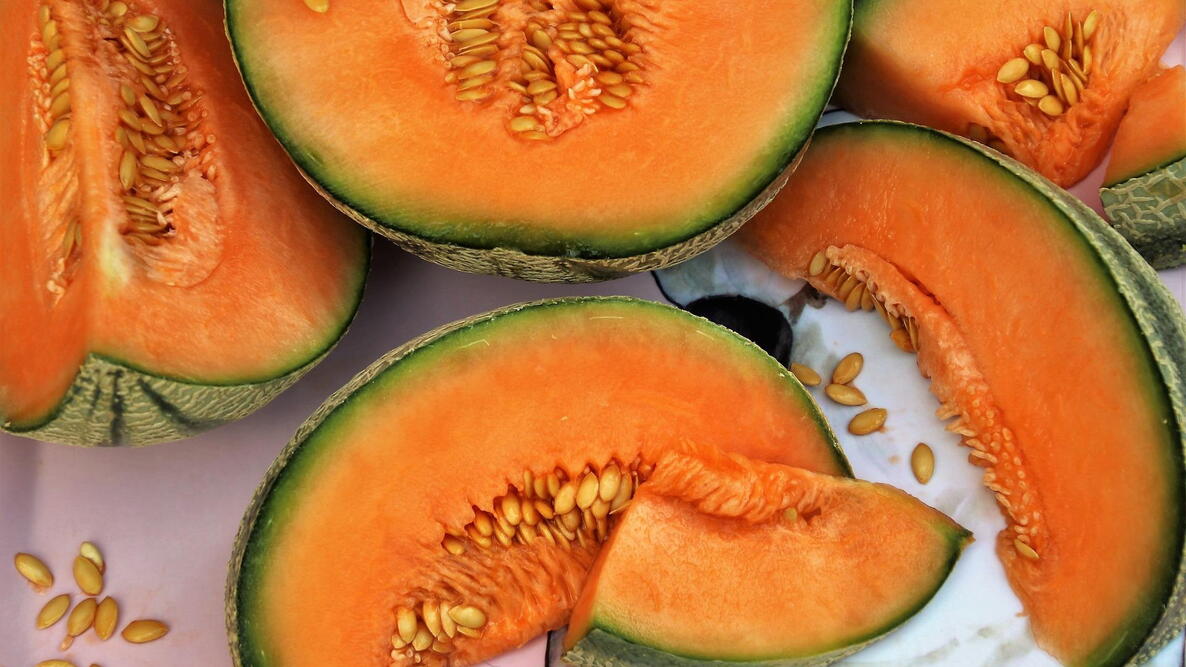
Nothing whispers summer like a chilled slice of sweet, orange cantaloupe juice dribbling down your chin.
Good news: These sun-loving melons are easy to grow—and even easier to devour. Let’s get planting!
Cantaloupes are a type of melon with a tan-green rind. Typically, the rind is covered in a spiderweb-like pattern, though some varieties may also be striped. Inside, the flesh is bright orange and sweet. Their growing requirements are similar to those of other popular melons, such as watermelons and honeydew melons.

Planting
Plant in a spot that gets full sun (6 to 8 hours of direct sunlight per day) with well-draining soil that’s a mix between loamy and sandy. (Growing the plants in raised rows—a.k.a. “hills”—ensures good drainage.) Amend the soil with aged manure or compost before planting. Learn more about soil amendments and preparing soil for planting.
Mulching the planting site with black plastic will serve multiple purposes: It will warm the soil ahead of planting, hinder weed growth, and keep developing fruits clean.
When to Plant Cantaloupes
This warm-season, very tender crop thrives in heat and hates the cold! It thrives in warmer climates with longer growing seasons.
- It’s best started directly from seed. If you live in a warmer climate, you may direct sow seeds outdoors after all danger of frost is well past and when the soil temperature warms to at least 70°F (21°C).
- However, if you’re set on growing cantaloupes in a colder region, you can start seeds indoors 4 to 6 weeks before your last spring frost date. Transplant outdoors 2 to 3 weeks after the last spring frost when the soil is at least 70°F (21°C).
How to Plant Cantaloupes
- Plant seeds 1 inch deep, 18 inches apart, in hills (or hilled rows) about 3 feet apart.
- If you have limited space, vines can be trained up a support, such as a trellis.
- If you plant indoors, use peat pots or soil blocks to avoid root disturbance. Harden off seedlings before transplanting.

Types
- ‘Ambrosia’ – 85 days to maturity. Among the sweetest varieties.
- ‘Athena’ – 70–80 days to maturity. Early variety that produces large, 5- to 6-pound fruits.
- ‘Hale’s Best Jumbo’ – 80–90 days to maturity. Produces 3-pound aromatic melons.
- ‘Minnesota Midget’ – 70–80 days to maturity. Early variety well-suited for gardens in colder regions. Produces 1-pound, sweetly flavored melons.
- ‘Bush Star’ – 90 days to maturity. Bush variety suits gardeners with limited space.

More Like This


Comments

If you got lots of flowers, you may have had pollination issues. Are there enough bees around? Cantaloupe flowers have a pollination window of one day. Pollen must be transferred from the male flower to the female flower on this day for seed set and fruit development. Fruit size and shape are related to the number of seeds set. Poorly pollinated flowers either abort or produce misshapen fruit. Poor pollination can happen because of weather conditions or lack of pollinators; you can always use a Q-tip and pollinate yourself to help your plants along!
If the melons haven't grown for over a month, they probably won't grow any more. They will continue to ripen for several days at room temperature once they are picked. For faster ripening, put them in a brown paper bag.
Cantaloupe can be challenging to grow in northern climates because they really need 2 to 3 months of constant heat. The cooler temperatures and the shortening direct daylight mean that the season is coming to a close. Next year, if you want to continue the learning curve, you could use black ground cover to warm soil and floating row covers to trap warm air near plants. Contact your local cooperative extension in NY county for more on-the-ground advice. We hope these tips get you started in the right direction. All the best, the OFA editors.
Harvest your cantaloupe when the stem easily separates from the fruit. To avoid over-ripening, harvest cantaloupes before they naturally separate from the vine. The best way to check maturity of cantaloupes is to place your thumb beside the stem and gently apply pressure to the side. If the stem separates easily, the cantaloupe is ripe.
- « Previous
- 1
- 2
- …
- 10
- Next »

Transplants should have 2 to 3 mature leaves. They need to be in the ground either way, so you have no choice but to carefully move them.