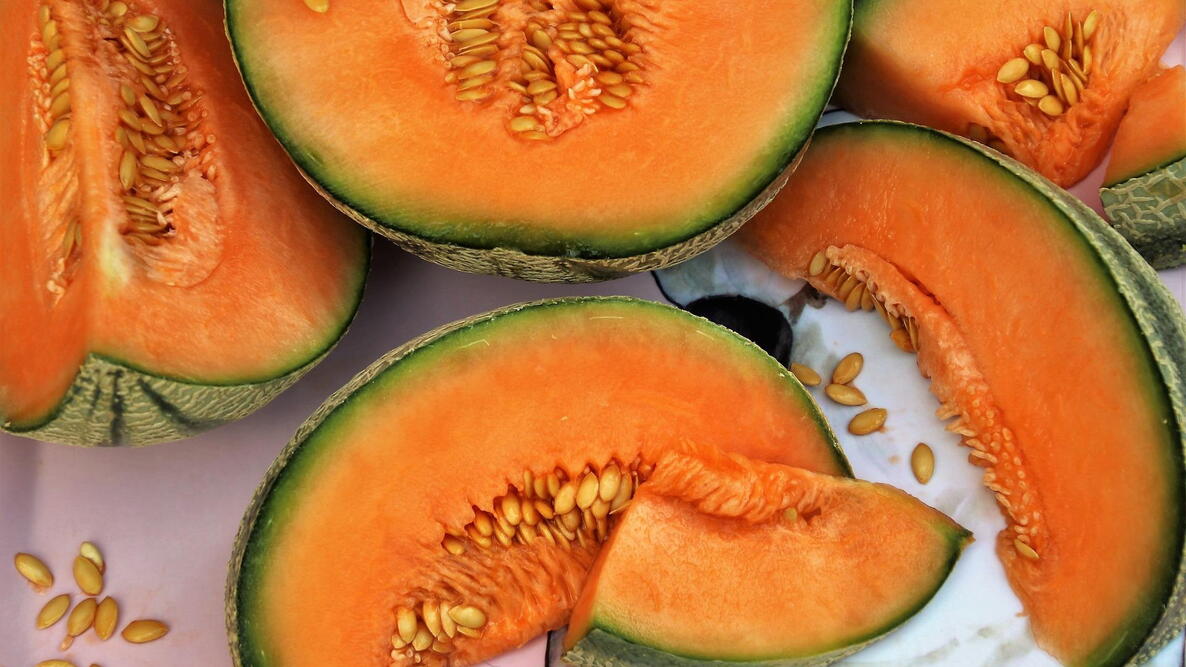
Nothing whispers summer like a chilled slice of sweet, orange cantaloupe juice dribbling down your chin.
Good news: These sun-loving melons are easy to grow—and even easier to devour. Let’s get planting!
Cantaloupes are a type of melon with a tan-green rind. Typically, the rind is covered in a spiderweb-like pattern, though some varieties may also be striped. Inside, the flesh is bright orange and sweet. Their growing requirements are similar to those of other popular melons, such as watermelons and honeydew melons.

Planting
Plant in a spot that gets full sun (6 to 8 hours of direct sunlight per day) with well-draining soil that’s a mix between loamy and sandy. (Growing the plants in raised rows—a.k.a. “hills”—ensures good drainage.) Amend the soil with aged manure or compost before planting. Learn more about soil amendments and preparing soil for planting.
Mulching the planting site with black plastic will serve multiple purposes: It will warm the soil ahead of planting, hinder weed growth, and keep developing fruits clean.
When to Plant Cantaloupes
This warm-season, very tender crop thrives in heat and hates the cold! It thrives in warmer climates with longer growing seasons.
- It’s best started directly from seed. If you live in a warmer climate, you may direct sow seeds outdoors after all danger of frost is well past and when the soil temperature warms to at least 70°F (21°C).
- However, if you’re set on growing cantaloupes in a colder region, you can start seeds indoors 4 to 6 weeks before your last spring frost date. Transplant outdoors 2 to 3 weeks after the last spring frost when the soil is at least 70°F (21°C).
How to Plant Cantaloupes
- Plant seeds 1 inch deep, 18 inches apart, in hills (or hilled rows) about 3 feet apart.
- If you have limited space, vines can be trained up a support, such as a trellis.
- If you plant indoors, use peat pots or soil blocks to avoid root disturbance. Harden off seedlings before transplanting.

Types
- ‘Ambrosia’ – 85 days to maturity. Among the sweetest varieties.
- ‘Athena’ – 70–80 days to maturity. Early variety that produces large, 5- to 6-pound fruits.
- ‘Hale’s Best Jumbo’ – 80–90 days to maturity. Produces 3-pound aromatic melons.
- ‘Minnesota Midget’ – 70–80 days to maturity. Early variety well-suited for gardens in colder regions. Produces 1-pound, sweetly flavored melons.
- ‘Bush Star’ – 90 days to maturity. Bush variety suits gardeners with limited space.

More Like This



Comments

Hi, Holly: Like all melons and "water-heavy" fruit, cantaloupes are indeed susceptible to frost. You will want to cover them with blankets or towels at night to help retain the earth's warmth and then remove same during the day so that they continue to ripen in the sun. Labor-intensive, but it can be done! Good luck and thanks for asking!
The modern melon we know today was not imported but was created by the Burpee company who introduced this cultivar in the early 1880s. This was a different kind of melon with a net-like skin covering. It became known as the Rocky Ford melon (named for the region of Colorado). It was landowner, politician, and entrepreneur George Washington Swink who helped built the melon industry; he transformed the region by developing a canal-based irrigation system; he also introduced honeybees to the region and invented the cantaloupe crate. Later, California and other states built up their melon business and surpassed Colorado.
Read more: http://www.aces.edu/pubs/docs/A/ANR-0974/ANR-0974.pdf
Once a cantaloupe is harvested off the vine, it will no longer sweeten. There are a few ways to ripen a whole cantaloupe if it was picked to soon, but not when it has been cut into. For melons already cut, you can try to get it to soften a bit by placing it in a container with a little lemon juice or orange juice. Place in the refrigerator until ready to serve (storing at room temperature can encourage bacteria). Use within a day or two.
- « Previous
- 1
- 2
- …
- 10
- Next »

Hi Debbie,
Melons crack due to stress, usually from soil that holds too much water or from inconsistent watering. In the fall, add compost to where you will grow melons next year to make for a well-draining mix. Also, melons enjoy pH of 6.0 to 6.5, so testing the soil never hurts. Plant next year's melons in mounds 6 to 8 inches high to help with drainage as well. For watering, try to water 1 to 2 inches a week when there is no rain.