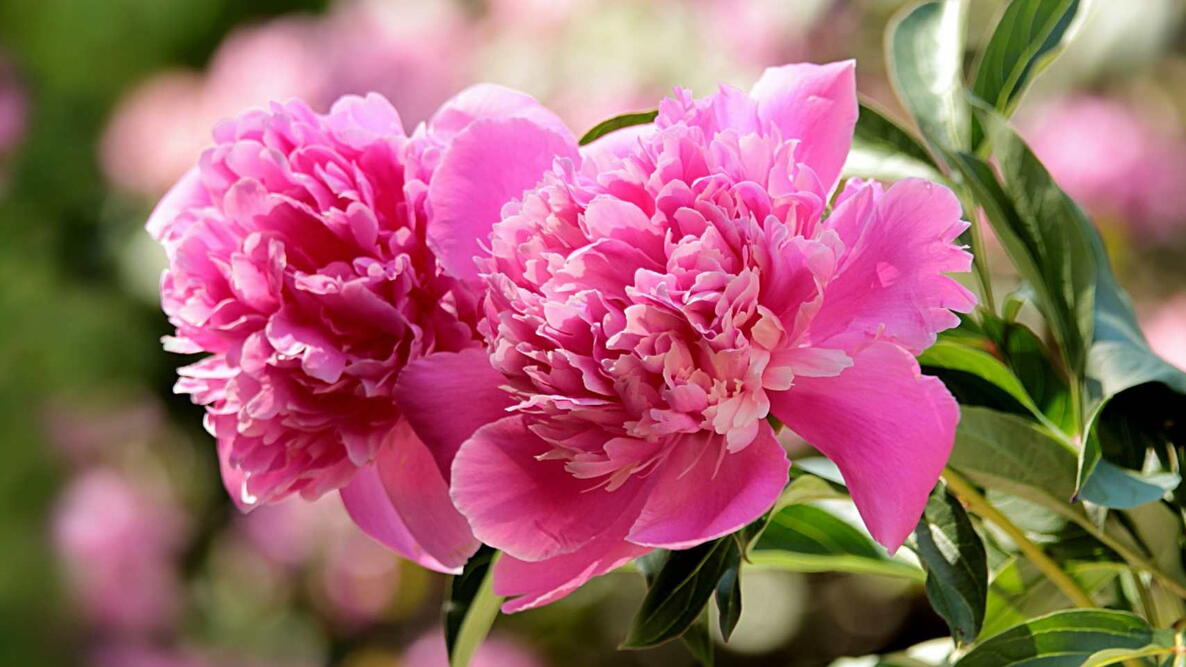
From Bud to Bloom: How to Plant, Grow, and Care for Stunning Peonies in Your Garden
Read Next
Planting
Where to Plant Peonies
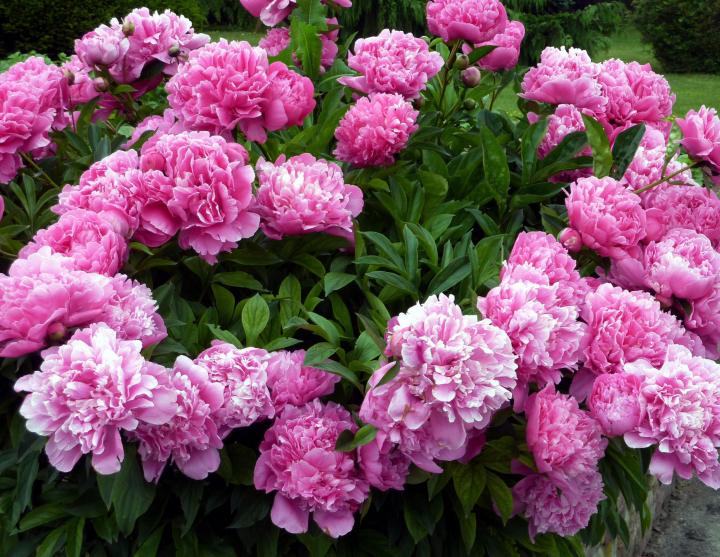
Peonies make fine sentinels lining walkways or a lovely low hedge. After their stunning bloom, the peony’s bushy clump of handsome, glossy green leaves lasts all summer and then turns purplish-red or gold in the fall. It is as stately and dignified as any flowering shrub.
In mixed borders, peonies bloom with columbines, baptisias, and veronicas and combine well with irises and roses. Plant white peonies with yellow irises and a froth of forget-me-nots; set off pink peonies with blue nepeta or violets.
- Peonies are not too fussy, but choose your location wisely as they resent disturbance and do not transplant well.
- Peonies like full sun, and though they can manage with half a day, they bloom best in a sunny spot that gets 6 to 8 hours of sunlight each day. In southern states, provide some shade.
- Provide shelter from strong winds, as peonies’ large blooms can make them top-heavy. (Use stakes to hold them up, if necessary.) Don’t plant too close to trees or shrubs, as peonies don’t like to compete for food, light, and moisture.
- When growing peonies, plant in deep, fertile, humus-rich, moist soil that drains well. The soil pH should be neutral.
- They are cold hardy, so any place you need an overcoat makes them happiest—they require a cold period for bud formation, a frustration to some southern gardeners.
When to Plant Peonies
Peony plants require little maintenance as long as they are planted properly and establish themselves. Note, however, that they do not respond well to transplanting, so you should plan your planting site accordingly.
- Plant peonies in the fall: in late September and October in most of the U.S., and even later in the fall in Zones 7 and 8 (Find your planting zone here).
- If you must move a mature plant, fall is the time to do it—specifically, when the plant has gone dormant.
- Peonies should be settled into place about 6 weeks before the ground freezes.
- Although it’s certainly possible to plant peonies in the spring, spring-planted peonies don’t do as well. Experts agree: they generally lag about a year behind those planted in the fall.
How to Plant Peonies
- Peonies are usually sold as bare-root tubers with 3 to 5 eyes (buds), divisions of a 3- or 4-year-old plant.
- Space peonies 3 to 4 feet apart to allow for good air circulation between the plants. Stagnant, humid air can be a recipe for disease to develop.
- Dig a generous-sized hole, about 2 feet deep and 2 feet across, in well-draining soil in a sunny spot. The soil will benefit from the addition of organic material in the planting hole. If the soil is heavy or very sandy, enrich it with extra compost. Incorporate about one cup of bone meal into the soil. Learn more about soil amendments and preparing soil for planting.
- Set the root so the eyes face upward on top of a mound of soil in the hole, placing the roots just 2 inches below the soil surface. Don’t plant too deep! (In southern states, choose early-blooming varieties, plant them about 1 inch deep, and provide some shade.)
- Then, backfill the hole, taking care that the soil doesn’t settle, and bury the root deeper than 2 inches. Tamp the soil gently.
- When planting a container-grown peony, cover it no deeper than it grew in the pot.
- Water thoroughly at the time of planting.
Types
In the 1930s and 1940s, plant catalogs listed only three peony choices: white, crimson, and rose pink. Today, thousands of varieties are available.
There are six main peony flower types: anemone, single, Japanese, semidouble, double, and bomb. Fragrances vary as well—some plants, such as ‘Festiva Maxima’ and ‘Duchesse de Nemours’, have intoxicating rose-like scents, while others are lemony or have no scent at all.
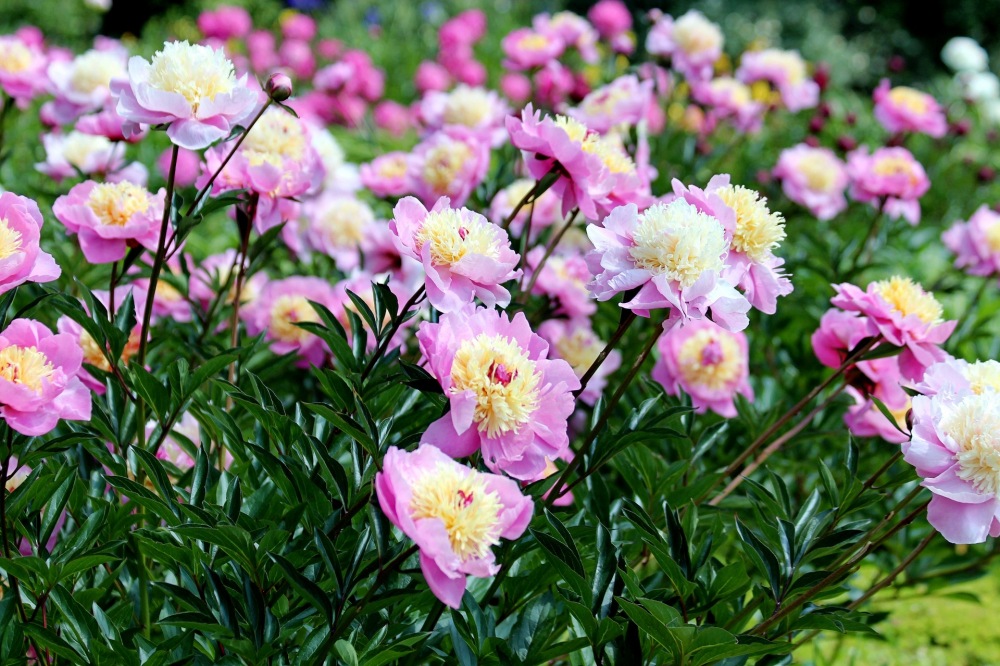
Peonies bloom between late spring and early summer, but you can plan your garden for a successive display of flowers from mid-May to late June by planting various varieties. Here are some choices:
- Anemone (an advanced Japanese form)—‘Laura Dessert’: cream/pale lemon to white; strong fragrance; early-season
- Single (one row of petals)—‘Sparkling Star’: deep pink; early- to midseason
- Japanese (decorative centers)—‘Carrara’: white, with soft yellow centers; fragrant; midseason
- Semidouble (five or more guard petals and prominent centers)—‘Pink Hawaiian Coral’: pink to coral rose form; slight fragrance; early-season
- Double (large petals, needs support)—‘Candy Stripe’: white, with red streaks; slight fragrance; mid- to late-season
- Bomb (large, like a scoop of petals)—‘Angel Cheeks’: soft pink; slight fragrance; midseason
- Consider, too, the Itoh peony: Named after its developer, Japanese botanist Dr. Toichi Itoh (d. 1956), this flower is a cross between a herbaceous (bush) peony and a tree peony. Its large single, semidouble, and double blooms appear later in the season and last longer than traditional peonies.
Harvesting
Keeping Peony Flowers in a Vase
Peonies make wonderful cut flowers and last more than a week in a vase. For best results, cut long stems in the morning when the buds are still fairly tight; look for the “marshmallow” stage, when buds are soft but not fully open. Use clean, sharp pruners and snip just above a set of healthy leaves to encourage continued growth on the plant.
To store cut peonies for later use, wrap the stems in a damp paper towel and place them in a plastic bag in the refrigerator. They can be stored this way for several days to even weeks. When you’re ready to use them, recut the stem ends at an angle under running water or submerged in water. Then, place them in a clean vase filled with lukewarm water to help the blooms rehydrate and open fully.
Keep your vase in a cool spot out of direct sunlight and change the water every couple of days to prolong the blooms’ beauty. See more tips on keeping cut flowers alive longer.
Gardening Products
Pests and Problems
Peonies are generally very hardy. Plus, peonies are also one of many deer-resistant plants you can grow in your garden.
However, they are susceptible to:
- Verticillium wilt
- Ringspot virus
- Tip blight
- Stem rot
- Botrytis blight
- Leaf blotch
- Japanese beetles
- Nematodes
- Aphids
FAQ
Why are there ants on my peonies?
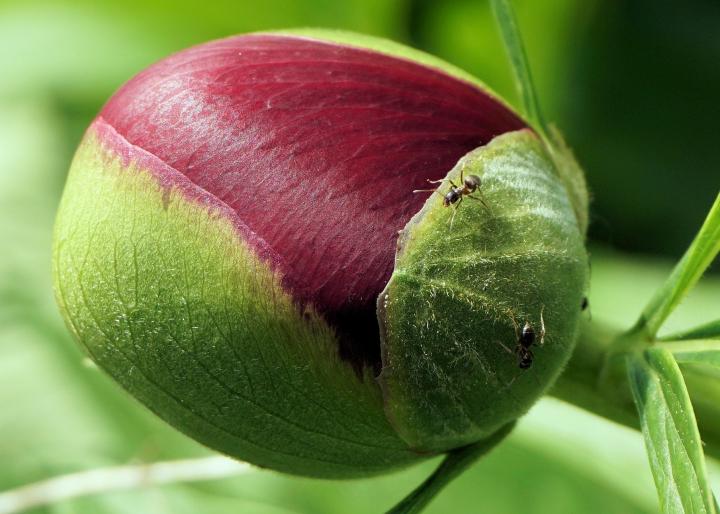
Many gardeners wonder why so many ants crawl on the peony buds. Don’t worry! They are just eating the peony’s nectar in exchange for attacking bud-eating pests. They are attracted to the sugary droplets on the outside of flower buds or to the honeydew produced by scale insects and aphids. Never spray the ants; they’re helping you by keeping your peonies safe!
Why are my peonies not blooming?
There are a few reasons why your peonies fail to bloom. If it is planted too deep (the eyes should only be about 2 inches below the soil), it will lead to beautiful foliage but very few flower buds. Depending on your fertilizing schedule, it may be receiving too much or too little fertilizer. Also, remember not to remove the foliage too early in the season. Wait for the foliage to die back naturally before removing it after the first frost.
Peonies need a certain amount of cold weather in the winter to set buds and to flower. If you live in a warmer location, your peonies may be getting just enough cold weather to produce the buds, but not enough to make them flower.
Bud blast can also be the cause since it results in buds turning brown and shriveling up. The best thing to do is to make sure it has the ideal growing environment in terms of sun, fertilizer, cold winter temps, and proper planting depth.
Can I plant the seed pods on my peonies?
The pods that remain on your peonies will contain seeds. You can collect the seeds when the pods turn dark brown and slightly crack open. To make sure that you don’t lose seeds to birds or weather, tie nylon or small mesh bags around maturing seed pods before they split open to catch any seeds that may fall. Ripe seeds can be planted immediately after collection.
Peony seeds require a warm/cold cycle to produce their first true leaves in the spring. In nature, seeds are dispersed on warm late summer to autumn days and quickly germinate. By winter, they form small roots. They are then dormant during the winter before emerging in the spring. Press peony seeds into the ground at no more than a 1/2 inch depth. Then cover with an inch of wood chips to provide protection.
You can certainly dry and save seeds for future planting, but dry seed takes longer to hydrate than fresh seed, and dormancy is more difficult to break.
Can I grow peonies indoors?
Yes, you can, although they are best grown outdoors. Inside, you’ll need to provide enough light (about 6 to 8 hours); if you don’t have enough natural daylight, a grow light can help. It is also necessary to give them a period of cold (about 3 to 6 weeks, depending on variety, of temperatures between 32 and 40 degrees F) over winter, which is needed for flowering. If you live in a cold climate, this can sometimes be done by leaving the pot in a cool garage or shed, with the top of the soil covered with straw to protect the roots once plants are dormant; remove the straw at the first sign of growth in spring.
Select a variety of peony that is shorter (not those that can grow to 4 to 6 feet, for example); if you live in a warm climate, choose a variety that does not need as long a period of cold (aka “chilling hours”) over winter. Plant in fall or spring. Choose a heavy pot (ideally, not terracotta) that is about 18 to 24 inches wide and deep, with drainage holes, and fill with rich, well-draining potting soil. Keep soil evenly moist but not soggy; when plants are established, you can let the soil dry out a tiny bit before watering deeply.
How long will it take my peonies to bloom?
Peonies typically take 2 to 3 years to bloom after planting, especially if planted from bare roots. The first year is focused on establishing strong roots, and blooms are usually sparse or absent. By the second or third year, you’ll see more consistent and fuller flowering.

More Like This






Hi, Gina, We have a page on dealing with voles: https://www.almanac.com/pest/voles
Hope this helps!
Hi Sylvia, Congratulations on your success with your new peonies! Determining what to add depends on a few factors. Since peonies like a rich, moist, and well-draining soil with a neutral pH (6.0–7.5), before adding anything you might want to have your soil tested just to make sure that it is in the preferred range. Once you get the results of your soil test, your local cooperative extension can make suggestions as to what is needed for a balanced pH and if your soil is either clay heavy or sandy. It will also tell you any nutrients that might be needed. Adding 2 to 3 inches of compost in the spring is also a good way to add soil depth to your garden while providing needed nutrients. It is best to mix it in to the existing soil by hand being careful not to disturb established roots.
That must have been a lot of mulch! Usually it grows back, but just has fewer flowers. You'll only know if your peony is coming back if you start to see signs of growth. They have pointed maroon sprouts.
If we were you, we would leave them to see what happens. You don't describe the situation in detail but consider this: The roots should be about 2 inches below the surface. If they are, you can help these remainders to get a new lease on life by mixing the top soil with compost and some bonemeal (this is described above re planting)—generally improving their environment. You should know soon enough if they are coming back. (Hope so!)
- « Previous
- 1
- 2
- …
- 10
- Next »

Comments