Growing
Watering
- Be sure to water the young trees heavily every week during the first growing season to help promote growth. Then, water regularly. It’s best to water the plant deeply at the soil line, then let the soil dry out (though not completely) and water again.
- If rain is lacking, water your tree well into mid-October to give it plenty of moisture through the winter months.
Fertilizing
- Do not fertilize young fruit trees until they have set a crop.
- Once established, fruit production requires regular fertilizing all year long. If there’s good fruit set, fertilize with one pound of calcium nitrate per tree or 1½ pounds of 10-10-10. Cut back the nitrogen in fall and winter to avoid encouraging new growth in those seasons.

How to Prune Plum Trees
When to Prune
- Prune in early spring or mid-summer to avoid infection. The best time for pruning is usually spring for young trees and mid-summer for established ones.
- Do NOT prune in the fall. Winter injury and infection may occur.
Thinning Fruit
“Thinning” is the process of removing developing fruit from a tree in order to increase the overall quality of the produced fruit and to prevent damage to the tree.
- Thinning is usually done about a month after blooming ends in the spring.
- Leave 2–4 inches between each fruit, removing those in between.
- Thinning helps to prevent branches from breaking under the weight of the fruit. If branches do break, prune them back to undamaged wood, ideally cutting back to a natural fork to avoid leaving stubs.
Pruning Japanese Plum Trees
- If you have a Japanese variety, the best pruning method is to create an “open center” shape, where the central trunk is cut short and several large branches radiate outwards from its tip. In the summer of the first year, cut the vigorous shoots that form on the top of the tree by two or three buds. After about a month, check the tree. As soon as you have three wide-angled branches, spaced equally apart, cut back any other branches so that these three are the main branches. In the early summer of the second year, cut back the branches in the middle of the tree to short stubs and prune any shoots developing below the three main branches. After the third year, remove any shoots in the center of the tree to keep its shape.
- Japanese types require heavy pruning to help keep them in shape and to produce better fruit. It is also good to thin out the fruit on these types of trees. You should space the plums about 3 to 4 inches apart on each branch.
Pruning European Plum Trees
- If you have a European variety, the best pruning method is to create a central leader. This shape features a central trunk with branches that spiral out every 5 to 8 inches, making sure that no branch is directly above another. The training for such a system begins in the early summer of the first year, during which time you should remove any shoots that form within 18 inches of the ground. The end result should resemble a Christmas tree.
- European types do not typically require fruit thinning because they do not produce as much fruit as Japanese types. However, the fruit on these types should be spaced about 2 inches apart on each branch.
For more pruning tips, check our spring pruning guide.
Types
There are three major categories of plum trees: European, Japanese, and American hybrids.
European
The hardy European types do well in most regions across the U.S., and are generally self-fertile. If you have space for only one tree, go with a European plum. (However, even self-fertile trees will produce better if cross-pollinated with a second tree.)
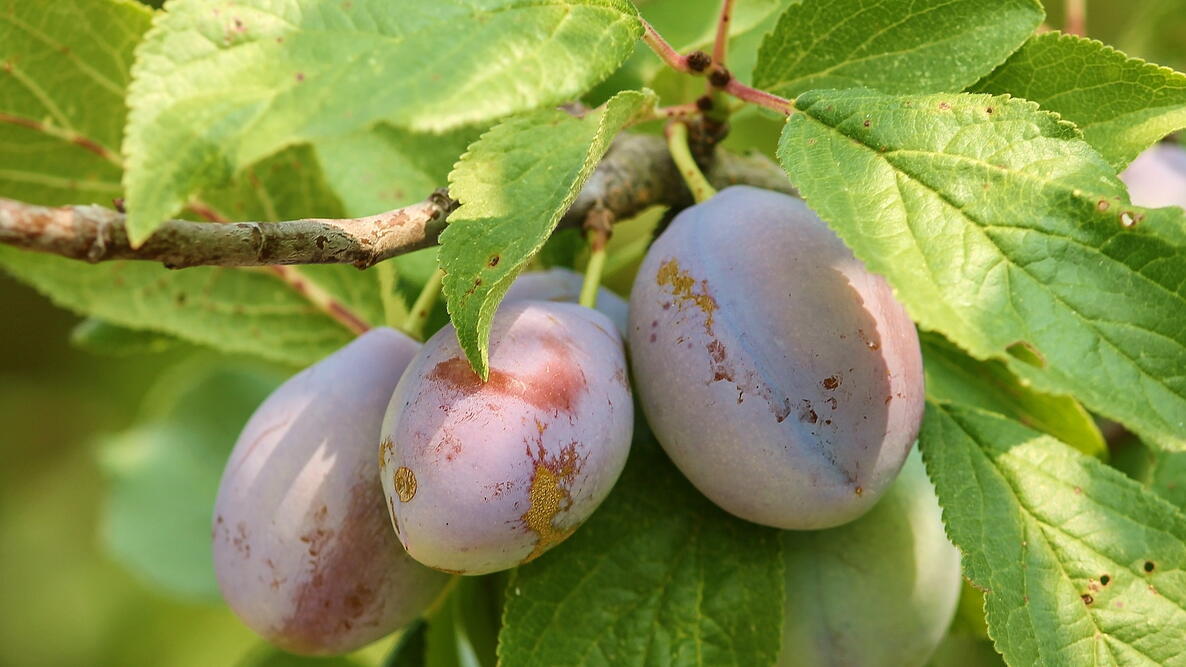
For a European type, try the ‘Stanley’. This semi-freestone type works great for the eastern, midwestern, and some of the northwest regions of the U.S. It is self-fertile, meaning no cross-pollination is necessary. It’s harvested in late August, producing medium to large plums with dark blue skin and greenish-yellow flesh and is great for cooking, canning, or eating fresh.
Japanese
The Japanese types flourish where peach trees thrive (warmer regions, generally). The Japanese plums’ early blooms make them more susceptible to spring frosts in colder areas. They need to cross-pollinate with a second variety.
For a Japanese type, try the ‘Satsuma’, which produces large, dark-red plums. This kind is good for eating fresh and canning because of its sweet taste.
American Hybrids
American hybrids are typically the hardiest of the plums, with some varieties surviving as far north as Zone 3. They need to cross-pollinate with a second variety.
American hybrid trees, such as ‘Alderman’, ‘Superior’, and ‘Underwood’, are all popular choices. These trees combine the taste of the Japanese variety with the hardiness of the European variety. These types work well for regional extremes.
Order bare-root, rather than container-grown trees, if possible. Bare-root plants usually establish better. A well-established tree will yield up to 2 bushels of plums from late summer into fall.

More Like This

Here are a few reasons why the tree may drop the plums. If the tree is stressed, too little or too much water, not enough sun, it will drop the fruit before they are ripe. If a plum tree has too many plums it will thin itself by dropping extra plums before ripening the ones left on the tree. You can help the tree by removing enough plums by hand. Thin the fruit until the branches can support the remaining fruit without props.
Plum curlicos can also cause plum drop. Google curlicos to read about the disease.
Pruning is best done in early spring. It's important to remove any broken branches to a good section of wood.
You can pick plums just before they are ripe and then store them in a cool place to ripen.
Hi, Emily: Assuming that your fruit are mature, sweet, and juicy, but just small, one thing to consider is simply that you have a variety or type that produces small fruit. In general, though, plums are energized by the leaves above them on a branch, so you would cull below--although it's a little late for that now. Bear in mind, too, that smaller fruit come with age for a plum tree as well. The older the tree, often the smaller the fruit. Good luck!
- « Previous
- 1
- 2
- …
- 10
- Next »

Comments